Rifle Ranges Realistic in Steep Terrain
Navigating the rugged, beautiful mountains and hollows of West Virginia with a rifle in hand is an experience unlike any other, but it comes with its own unique set of challenges, especially when it comes to shot placement. Many hunters, even seasoned ones, find themselves scratching their heads when confronted with an animal standing at a steep angle, wondering if their carefully practiced flat-range zero is still going to hold true. It’s a common frustration, and one that can lead to missed opportunities or, worse, an unethical shot, if not properly understood. This guide is all about demystifying those tricky angled shots, helping you understand the real-world effective ranges of your rifle in our challenging West Virginia topography, and making sure you're prepared for whatever angle the mountain throws at you.
The Unique Challenges of West Virginia's Steep Terrain
West Virginia isn't known as the Mountain State for nothing, and those rolling hills and deep hollows, while picturesque, fundamentally change the dynamics of rifle shooting. You're rarely on flat ground, and that means your bullet isn't always flying perfectly horizontal. This isn't just a minor tweak; it's a critical factor that can make a significant difference in where your bullet impacts downrange.
Understanding Angle Compensation in Mountain Hunting
The biggest head-scratcher for most hunters in steep country is the concept of angle compensation. Here’s the deal: gravity pulls your bullet downward from the moment it leaves the barrel. On flat ground, this means your bullet constantly drops relative to your line of sight. When you're shooting uphill or downhill, gravity is still pulling straight down, but its effect relative to the bore line changes.
Think of it like this: if you're shooting straight up or straight down, gravity isn't pulling the bullet "down" its flight path, but rather perpendicular to it (or nearly so). The bullet essentially travels a shorter "horizontal distance" that gravity has time to act upon. This means your bullet will impact higher than it would at the same actual distance on flat ground. For example, if you're shooting at a deer 300 yards away straight downhill, your bullet will hit higher than it would if that deer was 300 yards away on a flat field. Many hunters have made the mistake of holding dead-on in these situations, only to shoot over the animal's back. It’s a classic scenario that underscores why understanding true horizontal distance is so vital. This phenomenon applies whether you're climbing up to a High Elevation Mountain Bench or peeking into a deep ravine.
Line of Sight Versus Actual Distance
Another deceptive element of steep terrain is how it plays tricks on your eyes and even basic rangefinders. When you glass across a deep hollow or up a towering ridge, the line-of-sight distance might seem manageable, but the true horizontal distance – the distance gravity actually "sees" – is often much shorter. This is where an angle-compensating rangefinder becomes your best friend, and we'll talk more about those in a bit.
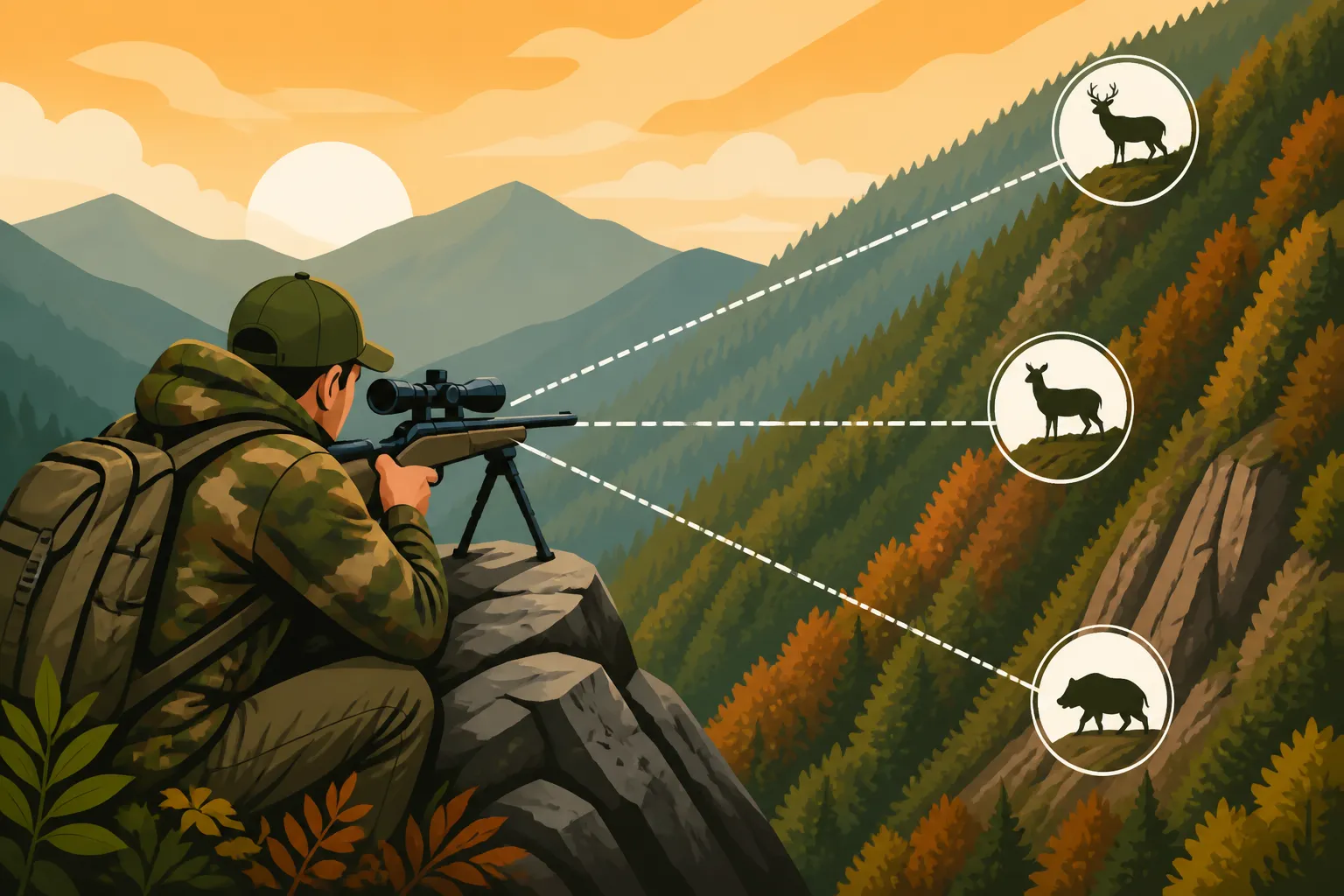
Imagine you're standing on an Allegheny ridge, looking down into a hollow, and you spot a deer browsing on the far side. Your traditional rangefinder might tell you it's 250 yards. That's the straight-line distance. But because of the steep angle, the effective ballistic distance, the one your bullet thinks it's traveling on flat ground, might only be 200 yards. If you hold for 250 yards, you'll shoot high. The steeper the angle and the longer the line-of-sight distance, the more pronounced this effect becomes. This is especially true when you're Hunting Steep Allegheny Ridges, where every shot can be a puzzle of angles and elevation changes. Knowing the difference between what your eyes see and what your bullet needs to know is key to consistent, ethical shot placement in our rugged West Virginia landscape. Tools like the "GoHunt" app can sometimes help you visualize these elevation changes on a map, but nothing beats a good rangefinder in the field.
Equipment Considerations for Angled Shots
Having the right gear isn't just about comfort; it's about accuracy and confidence when the moment of truth arrives. For hunting in West Virginia's steep terrain, some pieces of equipment become absolutely essential, not just helpful accessories. They’re the tools that bridge the gap between flat-range practice and real-world mountain conditions.
The Role of an Angle-Compensating Rangefinder
If there's one piece of gear that every serious mountain hunter in West Virginia should consider, it's an angle-compensating rangefinder. This isn't just a luxury; it's a necessity. Traditional rangefinders simply give you the line-of-sight distance. An angle-compensating model, however, takes that line-of-sight distance, measures the angle of incline or decline, and then calculates the true horizontal distance – often called "shoot-to distance" or "ballistic range." This is the number you need to use for your holdover or turret adjustments, as it's the distance gravity effectively acts upon for bullet drop.
Imagine you're set up on a steep hillside, perhaps after a long climb, and a beautiful buck steps out at what your old rangefinder says is 300 yards down a 30-degree slope. Your angle-compensating rangefinder might tell you the "shoot-to" distance is actually closer to 260 yards. That 40-yard difference is significant at longer ranges and could easily mean the difference between a clean kill and a frustrating miss or, worse, a wounded animal. Look for models that are easy to use with gloves, have clear optics for low light conditions – something critical in our dense hollows – and offer quick, reliable readings. Many top brands offer these features, making them invaluable for everything from Hunting Potomac Highlands Ridgelines to stalking timber in the Monongahela National Forest.
Scope Features for Mountain Hunting
Your rifle scope plays an equally critical role in making accurate angled shots. While any good scope will let you see your target, certain features make life much easier in steep terrain. First, consider the reticle. A simple duplex might be fine for close-range timber hunting, but for longer, angled shots, a reticle with hash marks or holdover points (often called a BDC or Christmas tree reticle) can be incredibly useful. This allows for quick adjustments without having to dial your turret. If you prefer to dial, ensuring your scope has clear, repeatable turrets that track accurately is paramount.
Another aspect often overlooked is glass quality and light transmission. West Virginia's mountains mean deep shadows and often low light, especially at dawn and dusk when deer are most active. High-quality glass in your scope will give you those precious extra minutes of legal shooting light and a clearer picture of your target, which is essential for precise shot placement. Features like side parallax adjustment also become more important when you're shooting at varying ranges and angles. When you’re spending hours Sitting a Saddle Between Two Peaks or patiently waiting in a Treestand Setups in Monongahela National Forest, having clear, reliable Optics for Steep Allegheny Terrain means everything. Some hunters find that a lower minimum magnification can be beneficial for those quick, close shots in thick cover, while still having enough top-end power for longer pokes across hollows.
Practical Shooting Drills and Field Practice
You can have all the fancy gear in the world, but if you don't practice realistically, it won't do you much good. The typical flat shooting range, while great for zeroing and fundamental accuracy, rarely simulates the real-world conditions you'll encounter in West Virginia's rugged landscape. To become proficient at angled shots, you need to get off the bench and put yourself in scenarios that mirror hunting conditions.
Practicing from Unconventional Positions
In the mountains, you're rarely afforded the luxury of a perfectly flat, level shooting bench. You might be shooting prone uphill, kneeling on a steep decline, or bracing against a tree trunk. Your practice needs to reflect this reality. Instead of always shooting from a bench, try these drills:
- Prone Uphill/Downhill: Find a safe, steep bank at your range (or an appropriate outdoor location). Practice shooting prone both up and down the slope. Pay attention to how your body position changes, how you manage recoil, and how you breathe. You'll quickly discover that a comfortable prone position on flat ground is very different from one on a 25-degree incline.
- Kneeling and Sitting: These are common positions in the woods when a quick shot is needed but going prone isn't feasible. Practice shooting from kneeling, sitting, and even standing with a rest (like a tripod or trekking poles).
- Off Your Pack: Your hunting pack can be an excellent impromptu shooting rest. Practice setting up quickly and shooting off your pack, adjusting its height and stability. This simulates a real-world scenario where you need to get steady in a hurry.
- Against Natural Rests: Use tree trunks, rocks, or even a sturdy branch. The goal is to get stable, but in a way that mimics what's available in the field.
These drills will not only improve your stability from less-than-ideal positions but also build muscle memory, so you react instinctively when a deer appears on a steep slope. Don't forget to practice Slings for a Long Monongahela Forest Walk to get into position efficiently.
Simulating Real-World Scenarios
Beyond just unconventional positions, you need to simulate the environment itself. This means moving beyond the manicured range. If possible, find a location with natural terrain variation – a hillside, a small ravine, or even just some uneven ground.
- Walk-and-Shoot Drills: Mimic the energy expenditure of hunting by walking a challenging route, then quickly setting up for a shot. This tests your ability to control your breath and heart rate before making a precise shot.
- Angled Targets: Set targets at varying angles and distances. Use your angle-compensating rangefinder to get the "shoot-to" distance and practice holding or dialing accordingly. Pay attention to how different angles feel, both uphill and downhill.
- Low Light Practice: Safely practice shooting closer targets in legal low-light conditions (dawn/dusk, with proper backstops). This helps you get comfortable with your optics when visibility isn't perfect, a common occurrence in West Virginia's dense woods.
- Shot Process under Pressure: Practice your entire shot process – ranging, adjusting, acquiring the target, breathing, and squeezing – as if a trophy buck were in your sights. The more you simulate the stress of the hunt, the better prepared you'll be.
Getting comfortable with these scenarios will give you a significant edge when you're Scouting West Virginia Public Land Before Season and finding those ideal hunting spots. You'll be ready for whatever West Virginia's rugged landscape throws at you.
Ethical Shot Placement and Limiting Your Range
Every hunter has an ethical responsibility to make a clean, quick kill. In the challenging terrain of West Virginia, this means understanding and respecting your personal limitations, especially when it comes to the ranges at which you can consistently place a lethal shot. Pushing your limits on an animal in steep country can lead to a wounded deer that's incredibly difficult to track and recover from a deep hollow.
Knowing Your Maximum Effective Range (MER)
Your Maximum Effective Range (MER) isn't just about how far your bullet can travel or how tight a group you can shoot on a perfect day at the range. It's about the maximum distance at which you can consistently and ethically place a shot into a vital area on an animal under real-world hunting conditions. This includes factors like:
- Your Personal Accuracy: Can you consistently hit a 6-inch vital zone at that distance from a field position (not a bench rest)?
- The Animal's Behavior: Is the animal calm, or is it alert and likely to move? A moving animal drastically reduces your MER.
- Environmental Conditions: Wind, rain, snow, and low light all reduce your MER.
- Recovery Potential: Even with a good hit, how difficult will it be to track and recover that animal from its location if it runs? If you're Recovering a Deer From a Steep Hollow, you want that deer to go down fast.
For many hunters, their MER in the field is significantly less than their range accuracy might suggest. It's often wiser to set a conservative MER, say 200-250 yards, for steep terrain hunting, and stick to it. This ensures you're confident in your ability to make a clean kill shot. For specific information on how different calibers perform, you might want to read up on Best Rifle Caliber for West Virginia Deer.
Factors Influencing Ethical Range in Steep Country
Beyond your personal MER, several factors are amplified in West Virginia's steep country that can further reduce your ethical shooting range:
- Wind: Wind behaves unpredictably in mountains, swirling and funneling through hollows and over ridges. A strong crosswind can push your bullet off target, and estimating its effect on an angled shot is even harder. What might be a slight breeze on your perch could be a gale down in the valley where your target stands. Consider how Wind and Thermals on a Steep Ridge can impact your shot.
- Shooter Fatigue: Long climbs, hours of still-hunting, and the general physical exertion of mountain hunting can lead to fatigue. A tired shooter is a less accurate shooter.
- Animal Movement: Deer are constantly moving, even subtly. In dense cover, a small step can obscure vitals. Patience is often the best weapon; waiting for a broadside, stationary shot is always preferable.
- Recovery Difficulty: This is huge in West Virginia. Even a perfectly placed shot might see a deer run a short distance. If that deer tumbles into a precipitous hollow or a rhododendron thicket, recovery can become a monumental, if not impossible, task. The steeper the terrain and the thicker the cover, the more you should consider shortening your ethical range. It’s better to pass on a marginal shot than to risk losing an animal or having a brutal recovery experience. This is especially true when you're after a buck in the Monongahela National Forest Hunting areas.
Always prioritize ethical shot placement over pushing limits. There will always be another opportunity, but an ethical kill is paramount.
Calculating and Adjusting for Angle
While modern rangefinders and ballistic apps do a lot of the heavy lifting for us these days, understanding the underlying principles of angle compensation can only make you a more confident and proficient shooter. It gives you a deeper appreciation for why your bullet behaves the way it does on inclines and declines.
The "Rifleman's Rule" Simplified
The "Rifleman's Rule" is a classic, simplified method for understanding and calculating the true horizontal distance for angled shots. It basically states that you should always shoot for the true horizontal distance, not the line-of-sight distance.
Here's the basic concept:
Imagine a right triangle.
- The hypotenuse is your line-of-sight distance (what a non-compensating rangefinder gives you).
- The vertical side is the elevation change between you and the target.
- The horizontal side is the true horizontal distance, which is what your bullet "sees" in terms of gravity's pull.
The formula is True Horizontal Distance = Line-of-Sight Distance * Cosine (Angle of Inclination/Declination).
Don't worry, you don't need a scientific calculator in the field! The key takeaway is that the steeper the angle, the greater the difference between line-of-sight and true horizontal distance, meaning you'll need to hold lower or dial less than you would for the same line-of-sight distance on flat ground. Most modern ballistic solutions are built on this principle. For example, if you're Hanging a Stand on a Steep Allegheny Ridge, you'll instantly notice how much a deer below you differs in line-of-sight versus horizontal distance.
Let's look at a simplified example:
| Line-of-Sight Distance | Angle (Degrees) | Approx. True Horizontal Distance (yards) |
|---|---|---|
| 200 yards | 15 | 193 |
| 200 yards | 30 | 173 |
| 300 yards | 15 | 290 |
| 300 yards | 30 | 260 |
| 400 yards | 15 | 386 |
| 400 yards | 30 | 346 |
As you can see, the difference becomes more significant the longer the line-of-sight distance and the steeper the angle.
Using Ballistic Calculators and Apps
While the Rifleman's Rule is great for understanding, for precise hunting, modern ballistic calculators and apps are incredibly powerful tools. Many companies, including those that make rangefinders or rifle scopes, offer their own free or paid apps. Brands like "GoHunt" also provide robust mapping and planning tools that can sometimes incorporate terrain features, offering another layer of information.
These apps allow you to input a vast array of data:
- Your Rifle/Ammunition Profile: Bullet weight, ballistic coefficient, muzzle velocity, zero distance.
- Environmental Factors: Temperature, barometric pressure, humidity (these can subtly affect bullet flight, especially at longer ranges).
- Angle: Most critically, the angle of your shot.
Once all the data is entered, the app will instantly calculate the precise holdover or turret adjustment needed for your specific shot, taking the angle into account. Some rangefinders even integrate with these apps or have internal ballistic solvers, giving you an immediate, precise firing solution. This means you don't have to remember complex charts or do mental math under pressure. Simply range, get your compensated distance, input it (or let the device do it), and get your solution. This level of precision is invaluable when you're hunting in challenging environments like our beloved West Virginia mountains, where every variable seems to be working against you. Make sure you use your West Virginia Hunter Education Requirements wisely and know how to use these tools before heading out.
Understanding Your Rifle and Ammunition
Your rifle and the ammunition you choose are the heart of your hunting system. To confidently make those angled shots in West Virginia's rugged terrain, you need to have a deep understanding of how your specific setup performs, not just on paper, but in the real world.
Ballistic Performance on Angled Shots
We've discussed the concept of true horizontal distance, and how on an angled shot, your bullet effectively travels a shorter horizontal path. What this means for your ballistic performance is that your bullet will impact higher than if you were shooting at the same line-of-sight distance on flat ground. If you've zeroed your rifle at 100 or 200 yards on a flat range, and then take a 300-yard shot downhill, your bullet won't drop as much as you'd expect for 300 flat yards.
This isn't because the bullet suddenly gains magical properties; it's simply because gravity has less time to pull it down along its horizontal trajectory. The angle effectively "shortens" the horizontal component of the shot. Therefore, when your rangefinder gives you a compensated "shoot-to" distance, you use that number as if you were shooting on flat ground. Your 200-yard flat zero still applies, but you apply it to the compensated distance. So, if your rangefinder says 300 yards line-of-sight, but 260 yards compensated, you would hold or dial for 260 yards. This nuanced understanding is paramount to success when you're Hunting the West Virginia Rut in November and that trophy buck appears in a deep hollow.
Caliber and Bullet Choice for Mountain Deer
The choice of rifle caliber and bullet construction is always a hot topic among hunters, and it becomes even more critical in West Virginia's varied terrain and for the West Virginia Deer Herd Size. While many calibers will ethically take deer, some offer advantages for the specific challenges of mountain hunting.
- Adequate Energy Transfer: You want a caliber that delivers sufficient energy to ensure a quick, humane kill at your maximum ethical range. This means considering both bullet drop and retained energy. A flatter-shooting caliber can simplify holdovers, but ultimately, bullet construction that performs well on impact is key. Calibers like the .30-06, .308, .270, and 6.5 Creedmoor are all excellent choices for West Virginia deer, with each offering a different balance of recoil, trajectory, and energy. For a deeper dive, check out Choosing a Rifle Caliber for West Virginia Deer or 6.5 Creedmoor for Allegheny Ridges.
- Bullet Construction: In steep, timbered terrain, you often get shots at various ranges, from close timber pokes to longer shots across hollows. A good all-around bullet will perform reliably across this range. Controlled expansion bullets are generally preferred, as they hold together well on impact at higher velocities (close shots) but still expand effectively at lower velocities (longer shots). This minimizes meat damage and maximizes penetration for vital organ destruction.
- Recoil Management: Heavy recoil can make it harder to spot your impacts, especially on angled shots, and can lead to flinching. Choose a caliber you can shoot accurately and comfortably, not just one that looks good on paper. A smaller, well-placed bullet from a comfortable rifle is always better than a larger bullet from a rifle you flinch with.
Ultimately, familiarity with your chosen rifle and ammunition through rigorous practice is far more important than any specific caliber. Knowing your specific rifle's ballistics inside and out, especially how it performs on angled shots, is the biggest asset you can take into the West Virginia woods. You can't just set a Zeroing at 100 Yards for Woods Hunting and forget about it; you need to understand its behavior at all relevant ranges and angles.
Disclaimer
This article is for general informational purposes only and does not constitute professional advice. Laws, prices and regulations vary by location and change over time. Consult a qualified professional for guidance on your specific situation.