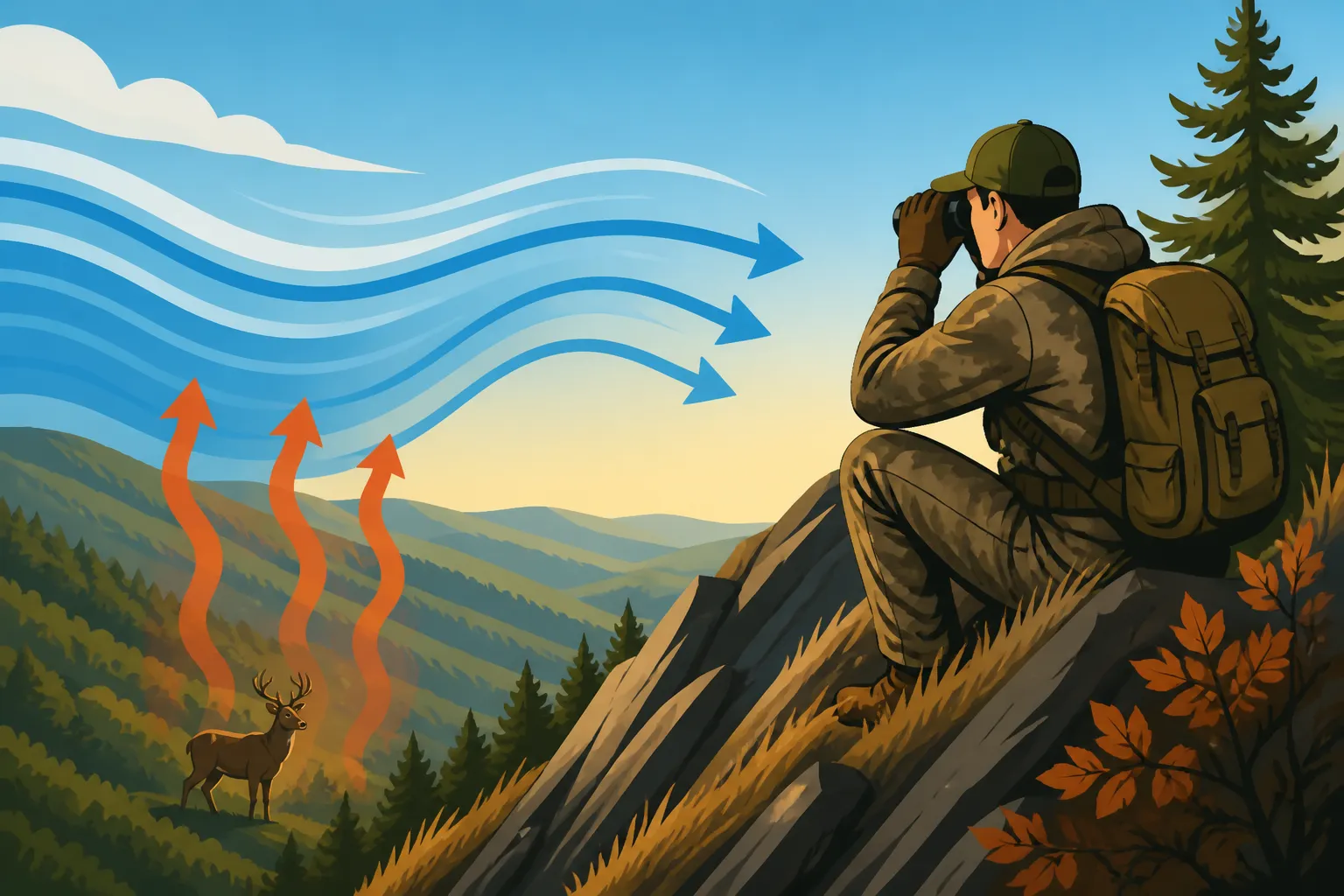
Wind and Thermals on a Steep Ridge
There’s nothing quite as frustrating as meticulously scouting a killer stand location, putting in the work to get there in the predawn dark, and then having the entire hunt blown by a swirling, unpredictable wind that carries your scent right to the deer you’re trying to ambush. On West Virginia’s notoriously steep ridges, navigating wind and thermals isn't just a preference; it’s an absolute necessity for success. This guide is all about demystifying mountain airflow, helping you understand its patterns, and giving you the strategies to use it to your advantage, rather than constantly fighting against it.
The Unseen Dance of Air: Understanding Wind and Thermals
Before you can hope to outsmart a mature whitetail buck on a steep West Virginia ridge, you’ve got to become a student of the air currents swirling around you. It's not as simple as checking a weather app for wind direction. What you feel on your face might be entirely different just a hundred yards away, or even at a different elevation on the same ridge. The mountains here play by their own rules, and those rules are heavily influenced by something called thermals.
True Wind Versus Thermal Dynamics
First, let’s distinguish between true wind and thermals. True wind is the broader, regional air movement, often what you see predicted on your weather forecast. It's driven by larger atmospheric pressure systems and can blow from any direction at varying speeds. While important, it's only part of the puzzle in West Virginia’s steep terrain. You might have a steady 10 mph northwest wind at the valley floor, but climb a thousand feet, and that wind could be calm, or even blowing from the southwest due to micro-climates and terrain features.
Thermals, on the other hand, are localized air currents driven by temperature differences. Think of it like a giant invisible convection oven. As the sun rises, it heats up the earth, and that heat transfers to the air. Warm air is less dense than cold air, so it rises. Conversely, as the sun sets, the earth cools, and the air above it cools, becoming denser and sinking. This constant cycling of warm air rising and cool air sinking is the foundation of thermal activity, and it’s especially pronounced on the dramatic elevation changes found in the Allegheny Mountains or the rugged terrain of the Potomac Highlands.
The Daily Cycle of Mountain Thermals
The thermal dance generally follows a predictable daily rhythm, though local conditions like cloud cover, elevation, and terrain features can certainly throw a wrench in the works. Understanding this cycle is your first step to becoming a more effective hunter on steep ground.
In the early morning, before the sun has had a chance to significantly warm the landscape, the air is typically cold and heavy. This cool, dense air "drains" downhill, settling into the hollows and creek bottoms. This creates what are known as descending thermals or down-thermals. If you're hunting high on a ridge at first light, your scent will likely be carried down into the hollow below. This is crucial for your approach to your stand – you want to move above where the deer are likely to be bedded or feeding at first light, keeping your scent from dropping directly on them.
As the sun climbs higher and begins to warm the slopes, especially those facing east or south, the air starts to heat up. This lighter, warmer air then begins to rise, creating ascending thermals or up-thermals. These thermals will pull your scent upwards, often along the face of a ridge. This transition usually starts an hour or two after sunrise and can last well into the afternoon. If you’re hunting a bench or saddle in the midday, your scent will be drifting upwards. In many cases, these up-thermals can become quite strong, overriding lighter true winds. This is a classic dilemma for hunters who find themselves caught between thermals and a prevailing wind.
As the afternoon wears on and the sun begins to set, the earth cools once again. The air on the ridges and upper slopes loses its heat, becomes denser, and starts to sink back into the hollows and valleys. These descending thermals resume, often becoming very strong in the late afternoon and evening. This is a critical time for evening hunts, as deer are often moving up from bedding areas in the hollows towards feeding grounds on the ridges. If you're on a ridge point, your scent will be funneling down. Knowing this helps you strategically place yourself, perhaps just off the top of a ridge, or on a side spur, to keep your scent from blowing directly into those uphill travel corridors.
Predicting and Using Air Currents on West Virginia's Steep Ridges
Now that we've touched on the basics of wind and thermals, let's talk about how these apply specifically to the rugged, vertical world of West Virginia's deer woods. The difference between a successful hunt and a busted one often comes down to how well you can read the invisible currents of the air.
Scouting for Thermal Funnels and Eddies
Just like water, air flows around and over obstacles, creating predictable patterns. On a steep West Virginia ridge, certain features act as natural funnels or create eddies where the air swirls. When you're scouting, pay close attention to saddles, benches, draws, and points. A saddle between two ridge tops, for example, can act as a natural conduit, often channeling true wind in a specific direction, or creating a vacuum that pulls thermals up or down. A bench along a steep hillside might hold a pocket of cooler air longer in the morning, or offer a slight thermal advantage by keeping your scent above a lower-lying travel route.
Deep draws and hollows are primary thermal highways. If deer are moving through a steep hollow, you can bet your bottom dollar they'll use it to their advantage, especially when it comes to bedding down. They’ll often bed just off the main thermal flow, allowing them to smell anything coming from below. This understanding is key for effectively Hunting Steep Allegheny Ridges and identifying those subtle advantages. Using mapping apps like GoHunt or the WVDNR's own Go Wild West Virginia mapping tool can help you visualize elevation changes, draws, and hollows even before you step foot on the ground.
Leveraging Thermals for Your Entry and Exit
Your approach and departure from your stand are just as critical as your time on stand. Many hunters blow their chances before they even get settled because they disregard the thermals during their walk-in. In the pre-dawn hours, when cold air is sinking, you want to approach your stand from above your intended hunting area if possible. This means walking along a ridgeline or a high bench, allowing your scent to be carried down and away from where deer might be feeding or bedding in the hollows.
Conversely, for an evening hunt, you might want to approach from below or across a slope, ensuring your scent is rising with the morning thermals, then as the thermals start to shift and fall in the evening, you position yourself so your scent isn't blowing into their travel corridors. The challenge in West Virginia is that true "above" and "below" can be relative on a thousand-foot elevation change. It’s all about minimizing the chance of your scent hitting a deer that’s either already in its bedding area or on its way there. Consider the advice in Scouting West Virginia Public Land Before Season to plan your routes meticulously.
The Impact of Weather on Mountain Airflow
West Virginia weather can be famously fickle, and changes in atmospheric pressure, temperature, and precipitation can drastically alter thermal and wind patterns. A strong cold front moving in, for instance, can bring high, steady winds that override thermals entirely. During heavy rain or dense fog, thermals often cease to function predictably, and the true wind becomes the dominant factor.
On clear, calm days, thermals will be at their strongest and most predictable. Overcast days, especially those with consistent cloud cover, can dampen thermal activity, leading to more stable, but sometimes lighter and more swirling winds. A warm, humid day might mean weaker, less defined thermals, while a crisp, cold day with bright sunshine will produce very distinct thermal shifts. Paying attention to the day's forecast, not just for temperature and precipitation, but also for general wind speeds, is crucial. If you're planning a Cold-Weather Sitting Strategy in the Mountains, remember that extreme cold can affect how quickly thermals develop or dissipate.
Advanced Strategies for Hunting Steep Terrain
Successfully hunting West Virginia's steep ridges requires more than just understanding the basics; it demands a strategic mindset and the willingness to adapt. This is where experience truly pays off, but with a few pointers, you can accelerate your learning curve.
Stand Placement: Just Off the Top or a Strategic Bench
One of the most common mistakes hunters make on ridges is placing their stand directly on the ridge crest. While this offers great visibility, it often puts you in a swirling wind trap. The true wind will hit the ridge top, create eddies, and often swirl down both sides. Instead, consider positioning your stand "just off the top" – 20 to 50 yards down from the very peak, typically on the leeward side if you have a prevailing wind, or on a strategic bench.
Another effective strategy is to find a bench that runs along the side of a ridge. Deer love benches for travel and sometimes for bedding, as they offer easier walking than the steep slopes. Placing your stand on a small knob or higher point above a bench, and ensuring your evening thermals carry your scent down and away from the bench, can be incredibly effective. Conversely, in the morning, if you are above a bench, ascending thermals will carry your scent up, so you want to be high enough that your scent passes over the deer on the bench. Understanding Where Monongahela Forest Bucks Bed often involves recognizing these subtle terrain features and how they interact with air currents.
Using Scent Control and Wind Checkers Reliably
Even with the best thermal knowledge, scent control remains paramount. Layers of scent-absorbing clothing, showering with scent-free soap, and storing hunting clothes in airtight containers are all basic steps. But the real game-changer is carrying a wind checker – a small bottle of powder or milkweed fluff – and using it constantly. Flick it out every few minutes, especially when you feel a slight shift or lull in the breeze. The visual confirmation of airflow is invaluable. You'll be amazed at how quickly the wind can change direction on a steep slope.
Some hunters even carry multiple wind checkers and place them at different elevations around their stand to get a better read on micro-thermals. While modern apps can predict general wind and thermal patterns, nothing beats real-time, on-the-ground observation. Combine your digital scouting tools like GoHunt (many hunters prefer it for its detailed terrain maps) with practical observation to maximize your advantage.
When to Hunt and When to Stay Home
Sometimes, the best strategy is no strategy at all if the conditions aren’t right. If you arrive at your stand and the wind is wildly unpredictable, swirling constantly, it might be best to cut your losses and either move to a different, less thermally complex area or, perhaps, switch tactics. On days with strong, consistent prevailing winds that dominate thermals, a different kind of stand setup might be in order – one that strictly plays the prevailing wind.
Alternatively, if the thermal activity is strong and predictable, those calm, sunny days can be fantastic. Pay close attention to the forecast, but always trust your real-time observations more. There’s a lot of truth to the saying, "hunt the wind." But in West Virginia, it's more accurate to say, "hunt the wind and the thermals." When the air is calm and stagnant, deer are often much more wary, as there's no air movement to mask their sound or scent. These are often the toughest days to hunt, and you might consider Finding Ground Others Walk Past that offers more cover or natural advantages.
| Time of Day | Thermal Movement | Wind Interaction (General) | Best Hunter Position (Ideal Scenario) |
|---|---|---|---|
| Predawn (Before Sunrise) | Cool air draining down hollows | Low influence, can be stable/calm | High on ridge, just below crest (scent drops away) |
| Morning (Sunrise-Midmorning) | Warm air rising up slopes/hollows | Can be overridden by stronger true wind | Just below ridge crest, watching hollows (scent rises over deer) |
| Midday (Late Morning-Early Afternoon) | Variable, can "stall" or swirl | Dominant if strong, can combine/override | Higher elevation, stable prevailing wind, or strategic bench |
| Evening (Late Afternoon-Sunset) | Cool air sinking down slopes/hollows | Can be overridden by stronger true wind | Ridge points or high benches, scent funneling down away from travel |
| Night (Post-Sunset) | Cool air draining down hollows | Low influence, stable | N/A (not hunting, but helpful for next morning's plan) |
Practical Application and Avoiding Common Mistakes
It's one thing to understand the theory; it's another entirely to put it into practice when you're shivering on a treestand at 6 AM. The key is to be adaptable, observant, and patient. Don't be afraid to adjust your plans on the fly if the conditions aren't what you expected.
The Art of the Mobile Hunt
On those days when the wind is just not cooperating, or the thermals are swirling unpredictably, consider a more mobile approach. Still-hunting along a ridgeline, especially into a gentle breeze or crosswind, can be highly effective. This allows you to constantly monitor the wind with your checker and adjust your pace and direction. You might even discover new hotspots that your fixed stand strategy missed. Remember that in some of West Virginia's dense cover, moving quietly is critical, and a good pair of Boots for West Virginia Hollows and Ridges will serve you well.
When still-hunting, always try to keep the wind or thermal in your favor. This might mean making wide loops to circle around areas where you expect deer, positioning yourself to have the wind blowing from the deer towards you. It’s a game of chess, always thinking a few moves ahead about how your scent is dispersing.
Avoiding the "Thermal Bubble" Myth
Many hunters talk about a "thermal bubble" where their scent just sits around them. While stagnant air can certainly occur, especially in deep hollows with no true wind, it’s rarely a reliable pattern. Air is always moving, even if it’s subtle. The goal isn’t to negate all scent, but to ensure that whatever scent you do have is carried away from the deer’s nose. Thinking of it as a constant, dynamic flow rather than a static bubble will lead to better decision-making.
Always assume a deer can smell you. With that assumption, your objective becomes simply positioning yourself so that they can't smell you from their current location. That might mean being 50 yards higher than them with an up-thermal, or 100 yards downwind on a crosswind. Tools like GPS Units Versus Phone Apps can provide invaluable assistance in navigating the terrain and understanding your exact position relative to elevation changes.
Long-Term Scouting and Adjustments
Finally, don't treat any stand location as a permanent fixture. Deer patterns change, mast crops vary year to year, and hunting pressure can alter how deer use the landscape. Always be scouting, even when you’re hunting. Observe how deer enter and exit areas relative to the wind and thermals. Did that buck get busted because he caught your wind on the thermal, or because he skirted wide and hit the prevailing wind?
Over time, you'll build an intuitive understanding of how specific ridges and hollows in your favorite Hunting Potomac Highlands Ridgelines spots behave under different conditions. This deep, personal knowledge of your hunting grounds, combined with a solid understanding of thermal and wind dynamics, is what truly separates consistent success from hopeful luck. It's a journey, not a destination, and every hunt is a chance to learn more about the invisible forces that shape the wild.
Disclaimer
Please note that hunting regulations and conditions can change. Always consult the latest West Virginia Division of Natural Resources (WVDNR) official regulations before heading afield. This guide provides general information and recommendations for educational purposes only. Always prioritize safety, respect wildlife, and adhere to all local, state, and federal laws.