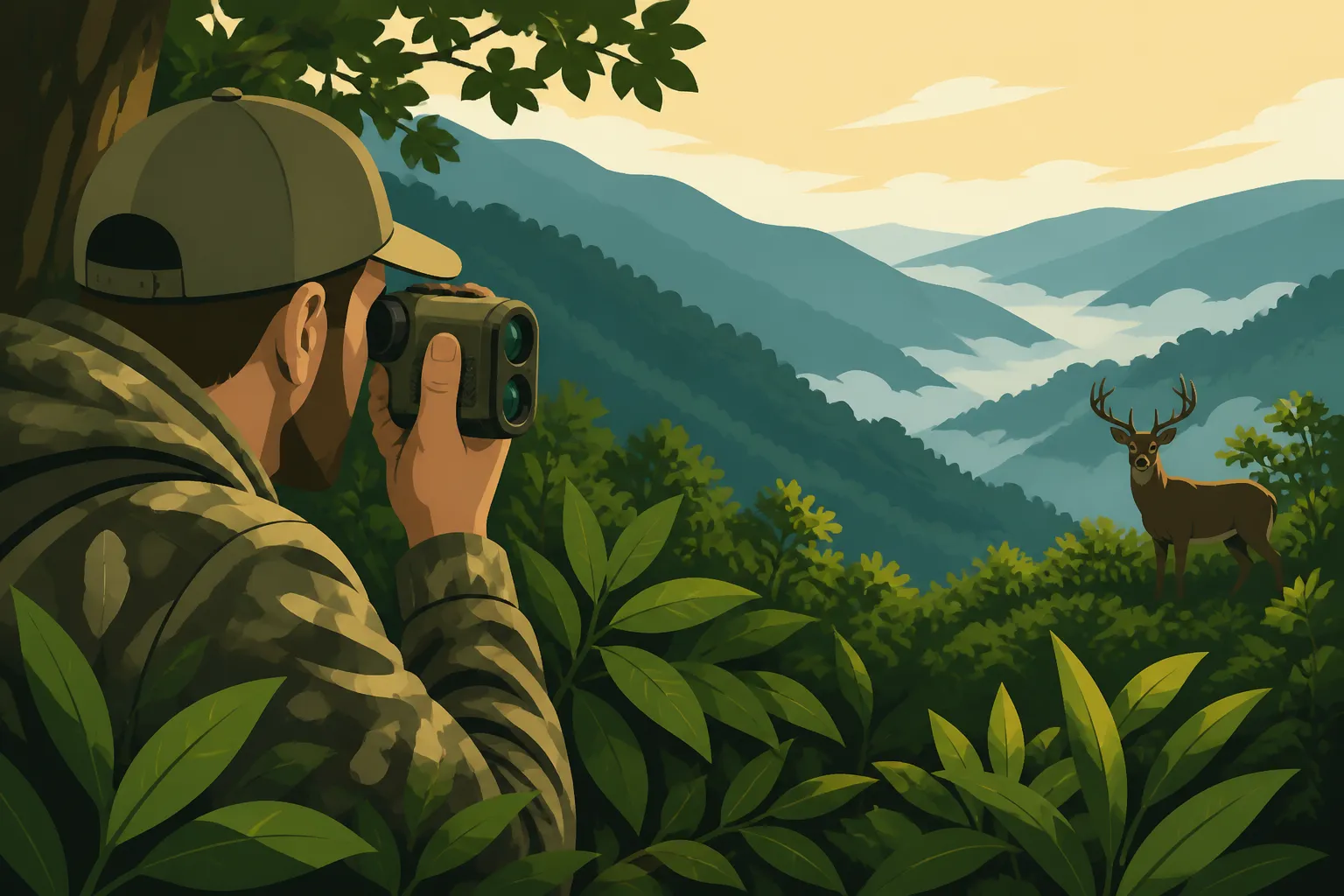
Rangefinders in Thick Highlands Cover
Hunting in West Virginia's rugged highlands presents unique challenges, especially when it comes to accurately judging distance. The steep terrain, dense cover, and ever-shifting light can play tricks on your eyes, leaving you second-guessing your shot and potentially missing out on an opportunity. This guide will delve into the nuances of using rangefinders in these challenging environments, helping you gain the confidence and precision you need to be successful in the Mountain State.
Why Traditional Ranging Fails in West Virginia's Highlands
For generations, hunters relied on their instincts and practiced eye to judge distance. While admirable, this approach becomes incredibly unreliable when you’re standing on a steep hillside overlooking a deep hollow, with a thick curtain of laurel and rhododendron obscuring your view. The unique topography and vegetation of West Virginia create a perfect storm of optical illusions that can throw off even the most seasoned hunter.
The Deceit of Mountain Angles
Imagine you're perched on an Allegheny ridge, glassing a deer feeding fifty yards below you in a hollow. Your brain, used to flat-ground estimations, might tell you it's a straightforward shot. However, the true horizontal distance – the one that gravity acts on your bullet or arrow – is significantly less than the line-of-sight distance. Shooting a fifty-yard shot downhill at what is actually a forty-yard horizontal distance will result in you shooting over your target every single time. This is a common and frustrating mistake that can easily ruin a hunt, especially during the peak of Hunting the Rut in Mid-November when every opportunity counts. Your eyes simply aren't designed to instinctively calculate ballistic compensation for severe inclines or declines.
The steeper the angle, the greater the discrepancy between what your rangefinder measures as "line of sight" and what the projectile actually experiences. Without a rangefinder that can account for this, you’re essentially guessing at a critical variable. It's not just about hitting low or high; it's about understanding the entire ballistic arc of your shot in relation to gravity. In West Virginia's dramatic landscape, you're rarely on flat ground, so every shot you take, whether with a bow or a rifle, is likely to involve an angle.
Dense Laurel and Rhododendron Thickets
West Virginia's highlands are renowned for their incredibly thick undergrowth, especially vast expanses of mountain laurel and rhododendron. These evergreen thickets create an impenetrable maze that a deer can vanish into in an instant, and they pose a significant challenge for ranging. When you try to range a deer standing just behind a screen of these leaves and branches, your rangefinder might pick up the closest foliage instead of your intended target. This "first target priority" issue means you could be ranging a branch five yards away, believing it's the deer's actual distance, leading to a major miscalculation.
The visual clutter created by these dense thickets also makes it hard to pinpoint an exact aiming point on the animal. If your rangefinder is struggling to punch through the cover, you're left with an unreliable reading. You need a rangefinder that is sensitive enough to differentiate between foreground obstacles and the actual game animal, or one that offers different ranging modes to help you cut through the interference. It's a truly exasperating feeling to finally spot a buck, only for the dense cover to mock your efforts at a clean range. It almost makes you want to crawl into the rhododendron with a small game rifle and target squirrels. Squirrel Hunting West Virginia Bottomland Hardwoods is a much less stressful endeavor.
Low Light in Deep Hollows
The deep, steep-sided hollows characteristic of West Virginia's mountains often remain shrouded in low light, even during midday. Sun penetration can be limited, and shadows stretch long and dark, making visibility difficult. In these conditions, traditional optics and ranging methods suffer. A rangefinder needs excellent light transmission and a bright, clear display to function effectively when you're hunting in a shaded hollow or when a cloudy day turns the woods into a dimly lit cathedral. Trying to get a reading on a deer moving through such an environment can be frustratingly difficult if your equipment isn't up to the task.
Many budget-friendly rangefinders simply can't gather enough light or project a strong enough laser beam to give consistent readings in these challenging low-light scenarios. The result is often "no read" messages or wildly inconsistent numbers, right when you need a precise range the most. This is especially true at dawn and dusk, those magical hours when deer are most active, but when the light is at its poorest for optical devices. You’ve put in the time Scouting West Virginia Public Land Before Season, found that perfect Hunting a Funnel Between Two Hollows setup, and the last thing you want is your gear to fail you.
Key Features to Look For in a Highlands Rangefinder
When you're equipping yourself for West Virginia's challenging terrain, your rangefinder isn't just a gadget; it's a critical tool. Selecting the right one means focusing on features that directly address the problems posed by steep angles, thick cover, and low light. Don't just grab the cheapest option; invest in something that will perform when it truly matters.
Angle Compensation Technology
This feature is non-negotiable for hunting in West Virginia. Rangefinders equipped with angle compensation (often labeled as "ARC" for Angle Range Compensation, "TRUE ballistic range," or similar terms) don't just give you the line-of-sight distance; they calculate the equivalent horizontal distance adjusted for the angle of your shot. As we discussed, shooting downhill at what appears to be fifty yards might actually be a forty-yard shot horizontally. An angle-compensating rangefinder gives you that accurate forty-yard number, removing the guesswork and dramatically increasing your chances of a clean kill.
It works by using an inclinometer to measure the angle of your shot, then applying a mathematical formula to determine the true ballistic distance. This is absolutely crucial whether you're bowhunting from a Hanging a Stand on a Steep Allegheny Ridge or taking a rifle shot across a deep canyon. Without it, every angled shot is a gamble. Many modern rangefinders now include this as a standard feature, but it's important to verify it's present and accurate. Think of it as your secret weapon against gravity's deceptive influence in the mountains.
Crystal-Clear Optics and Display
Poor optics are a deal-breaker in low-light conditions or when trying to pick out a deer from a tangled backdrop of brush. A good rangefinder will have high-quality glass that provides a bright, clear image, even in dim light. This allows you to better identify your target and ensure you're ranging the animal itself, not a leaf in front of it. Look for fully multi-coated lenses, which maximize light transmission and reduce glare.
Equally important is the display. An illuminated reticle, ideally with adjustable brightness settings, is incredibly helpful in low light or against dark backgrounds. Some displays use red LEDs, others use black LCDs. For West Virginia's varied conditions, a red LED display is often preferred because it's easier to see against dark timber or a deer's hide in fading light. You want to be able to see your ranged distance clearly and quickly without straining your eyes. After all the effort it takes to get into prime hunting ground, say, deep in the Monongahela National Forest Hunting, you shouldn't have to fight your optics.
Brush Mode and Target Priority
This feature is designed specifically for those exasperating moments when a deer is partially obscured by brush. Many rangefinders offer different "priority" modes. A "first target priority" mode will give you the range to the closest object, which is great for open country but terrible in thick cover. What you need is a "last target priority" or "brush mode." This mode ignores foreground objects like branches, tall grass, or light brush, and gives you the range to the furthest object the laser detects within its beam.
This is a lifesaver when you're trying to range a deer through a screen of rhododendron or a few scattered saplings. It allows you to sweep the rangefinder across the area, knowing it's trying to find the game animal behind the immediate obstacles. Some advanced models even have algorithms that help filter out "noise" from the cover. Learning to use these modes effectively will greatly reduce the number of "no read" errors or inaccurate ranges caused by West Virginia's famously dense cover.
Rugged, Weatherproof Construction
West Virginia weather can be unpredictable. You might start the day with clear skies and end it in a soaking rain or even an unexpected snow squall. Your gear needs to be able to withstand these conditions without failing. Look for a rangefinder that is advertised as waterproof or at least water-resistant and fog-proof. This usually means it's O-ring sealed and nitrogen-purged to prevent internal fogging and moisture ingress.
Beyond weather, the ruggedness extends to the exterior construction. A rubber-armored housing provides a better grip, especially when wet, and offers a degree of shock absorption against accidental drops or bumps against rocks and trees. It should feel solid in your hand, not flimsy. You're going to be climbing Hunting Steep Allegheny Ridges and navigating dense terrain; your rangefinder needs to be as tough as you are. Spending a little more for a robust build will save you money and headaches in the long run by preventing costly damage.
Best Practices for Using a Rangefinder in Thick Cover
Having a great rangefinder is only half the battle; knowing how to use it effectively in challenging environments like West Virginia's highlands is the other. It's not always as simple as pointing and pressing a button. A few key techniques and considerations can make all the difference in getting an accurate range when you need it most.
Aiming Small, Missing Small
In dense cover, the laser beam of your rangefinder can easily hit a branch or a leaf that's not your intended target. To counteract this, practice "aiming small." Instead of just pointing generally at the deer, try to find a small, clear spot on its body – like the crease behind the shoulder or the base of the neck – and aim your reticle precisely there. This reduces the chance of the laser picking up a closer obstruction. If you have a rangefinder with a very small, tight beam divergence, this technique becomes even more effective.
If the deer is partially obscured, try to range an object directly in line with it, either just to the side or above/below, that you know is at the same distance plane. For example, if a buck is standing behind a thick bush, you might range a tree trunk just beyond the bush that's clearly at the deer's distance. Practice makes perfect here. The more you consciously try to pick a precise point, the better you'll become at getting consistent, accurate readings, even when the woods are a tangled mess.
Understanding the "First Target" vs. "Last Target"
As mentioned earlier, some rangefinders default to "first target priority," meaning they'll give you the distance to the closest object in the laser's path. Others have a "last target priority" or "brush mode" that attempts to range past foreground clutter to the furthest object. It's absolutely critical to understand which mode your rangefinder is in and how to switch between them, if applicable.
When hunting in thick cover, you'll almost always want to be in "last target priority" or "brush mode." Practice using this mode before you hit the woods. Point your rangefinder at a distant object through some close-up branches or tall grass. Does it give you the distance to the branches, or to the object behind them? Knowing your equipment intimately in a controlled setting will prevent panic and missed opportunities when a West Virginia whitetail suddenly steps out from behind a thicket of grapevines.
Battling the Elements
West Virginia's weather can be a real adversary, and it impacts your rangefinder's performance. Rain, snow, and fog can all interfere with the laser beam, leading to inaccurate readings or "no read" messages. When hunting in these conditions, take extra care. Try to keep your rangefinder lenses clean and dry. A small lens cloth in your pocket is invaluable. If it's raining, try to range from under the cover of a tree or quickly shield the lenses with your hand.
Extreme cold can also affect battery life, so always carry spare batteries, especially for those late-season hunts when you're Hunting Into the Late December Archery Close. Condensation can also be an issue when moving from a warm vehicle or camp into cold, damp air. Let your rangefinder acclimate to the ambient temperature to prevent fogging. Being prepared for the elements means your gear will be ready when you are, even on the dampest, dreariest West Virginia day.
Types of Rangefinders and Their Ideal Applications
When it comes to rangefinders, you've got options. Each type has its own set of advantages and disadvantages, and understanding these can help you choose the best tool for your specific West Virginia hunting style. It's not a one-size-fits-all world out there.
Standalone Laser Rangefinders
These are the most common and often the most affordable type of rangefinder. They are compact, lightweight, and typically designed for quick, single-handed operation. You bring it up, press a button, and get your reading. For most West Virginia hunters, a good quality standalone laser rangefinder with angle compensation is an excellent choice. They are easy to slip into a pack or hang around your neck for quick access.
| Feature | Standalone Laser Rangefinder |
|---|---|
| Portability | Excellent, typically small and lightweight |
| Cost | Generally more affordable, good entry-level options |
| Speed of Use | Very fast for quick ranges |
| Optics Quality | Good to excellent, depending on price point |
| Versatility | Primary function is ranging; dedicated tool |
| Weight | Very light, easy to carry all day |
| Battery Life | Typically good, uses common CR2 batteries |
Their primary advantage lies in their dedicated function: they are built for one job, and they do it well. For instance, when you're still-hunting the edges of Hunting Potomac Highlands Public Land and need to quickly range a deer before it slips into a thicket, the speed and simplicity of a standalone unit are hard to beat. The downside can be that it's another piece of gear to carry and manage, especially if you also carry binoculars. However, for sheer accuracy and ease of use in ranging, they are top-notch.
Rangefinding Binoculars
Combining the functionality of binoculars with a laser rangefinder, these units offer a streamlined approach, reducing the amount of gear you need to carry. Instead of juggling two separate optical devices, you have one tool that does both jobs. This is particularly appealing for hunters who spend a lot of time glassing, like those targeting elk in the Tomblin Wildlife Management Area or patiently scouting for deer on expansive public lands.
The integrated design means you can glass an area, spot an animal, and immediately range it without having to lower one optic and raise another. This saves precious seconds, which can be critical when game is on the move. Many top-tier rangefinding binoculars also boast exceptional optical quality, often surpassing that of many standalone rangefinders, making them fantastic for low-light performance. Brands like GoHunt often integrate detailed mapping with their platforms, and having a rangefinder that can quickly gather distance data while simultaneously glassing helps inform strategic decisions.
The main drawbacks are usually cost and weight. Rangefinding binoculars are significantly more expensive than standalone units, and they tend to be heavier and bulkier than a dedicated rangefinder. For someone who only ranges occasionally or prefers lighter gear, the added expense and weight might not be justified. However, for those who value efficiency and high-end optics, they represent a premium, highly effective solution for West Virginia hunting.
Integrated Scopes
While less common for thick cover hunting, it's worth a brief mention of scopes with integrated rangefinders. These allow you to range your target directly through your rifle scope. The appeal is obvious: range and shoot with one eye, one optic. However, for the dense, short-to-medium range shots common in West Virginia's thick highlands, they often don't provide the same flexibility or quickness as a handheld unit.
Many of these systems are geared more towards long-range, open-country hunting, where rapid ranging and ballistic solutions are paramount. In the tangled woods of West Virginia, where your longest shot might be 150 yards and often much less, the added complexity and cost might not deliver a significant advantage over a good standalone rangefinder. Plus, you might not always be able to get a clean range through your scope in thick brush.
Common Mistakes and How to Avoid Them
Even with the best gear, mistakes can happen. In West Virginia's challenging hunting environment, these errors can cost you a deer. Being aware of common pitfalls with rangefinders can help you avoid them and ensure you get accurate, reliable data every time.
Ranging the Wrong Bush
This is perhaps the most common and frustrating mistake. You spot a deer, quickly bring up your rangefinder, press the button, and get a number. You feel confident, make the shot, and later realize you hit five feet short because your rangefinder picked up a cluster of leaves or a small sapling between you and the deer. This happens all too frequently in the dense laurel and rhododendron thickets of West Virginia.
To avoid this, first, ensure you're using "last target priority" or "brush mode" if your rangefinder has it. Second, practice being deliberate with your aiming point. Don't just point generally at the deer; try to pick a small, clear spot on the animal itself. If the deer is partially obscured, try ranging just to the side of it, aiming at a tree trunk or rock that you know is on the same distance plane as the deer. Taking a second to confirm your reading or even ranging the same spot two or three times can save a lot of heartache. When Hunting the Cranberry Backcountry Wilderness Edge, it's easy for your eyes to play tricks on you, so rely on your technology, but verify it.
Forgetting Battery Checks
Nothing is worse than finally getting a shot opportunity on a beautiful West Virginia buck, reaching for your rangefinder, and getting a "low battery" warning or, worse, nothing at all. Rangefinders rely on power, and cold weather, in particular, can drain batteries faster. Those deep, dark hollows don't care about your battery life.
Make it a habit to check your rangefinder's battery status before every hunt, or at least before opening day. Carry a spare set of batteries in your pack, especially if you're planning a multi-day trip or hunting in cold conditions. Keep the spares in a warm, dry place, like an interior pocket, to preserve their charge. A dead battery is a preventable mistake that can derail an entire hunt. Treat your rangefinder like any other essential piece of gear – always check it.
Lack of Field Practice
A rangefinder isn't just for checking distances; it's a tool that requires practice to master, especially in varied terrain. Too many hunters buy a rangefinder, test it in their backyard a few times, and think they're good to go. West Virginia's hunting grounds are far more complex than a flat lawn.
Spend time practicing with your rangefinder in actual hunting conditions. Take it with you when you're Scouting West Virginia Public Land Before Season. Range trees, rocks, and imaginary deer at different angles and through different types of cover. Practice ranging quickly, as if a deer just stepped out. Test out the different modes, especially brush mode. Understand how your specific model performs in low light or light rain. The more familiar you are with your rangefinder's quirks and capabilities, the more instinctively and effectively you'll use it when a real opportunity arises. This kind of practice builds muscle memory and confidence, which are invaluable when the pressure is on.
Integrating Your Rangefinder with Your Hunting Strategy
Your rangefinder isn't just for the moment of truth; it's a versatile tool that can be integrated into almost every aspect of your hunting strategy. From pre-season scouting to boosting your shot confidence, leveraging its capabilities can make you a more effective and prepared West Virginia hunter.
Pre-Season Scouting with a Rangefinder
Scouting is paramount for success, and your rangefinder should be a constant companion. As you explore new areas or re-familiarize yourself with old haunts, use your rangefinder to get precise measurements of key features. How far is that rub line from this old logging road? What's the distance from your potential stand tree to that acorn flat? How far is it from that saddle to the steep drop-off where deer often funnel? Answers to these questions, precisely measured, allow you to plan your hunt with incredible detail.
When you're walking along a ridge and find fresh sign, use your rangefinder to mark distances to prominent landmarks. This helps you visualize shooting lanes and effective ranges from potential stand locations. If you're using mapping apps like those that integrate with GoHunt, you can even overlay these ranged distances onto your digital maps, creating a highly accurate and personalized hunting plan. Knowing exact distances during scouting helps you decide on the most effective setup for Treestand Setups in Monongahela National Forest or Using a Ground Blind on West Virginia Public Land. It takes the guesswork out of "that looks about 60 yards."
Setting Up Your Stand with Precision
Once you've identified a promising location for your treestand or ground blind, your rangefinder becomes indispensable for optimizing your setup. Before you even hang your stand, range various landmarks from your chosen tree. Measure the distances to trails, rub lines, scrapes, pinch points, and natural funnels. Identify your maximum ethical shooting range in every direction. This allows you to clear shooting lanes strategically, knowing exactly how far each opening extends.
When you're settled in your stand, take the time to range multiple points of reference. Find a distinctive tree or rock at 20, 30, 40, and 50 yards. Make mental notes of these "range markers." That way, if a deer suddenly appears, you won't have to fumble with your rangefinder in a high-pressure situation. You'll already have a good estimate based on your pre-ranged markers. This meticulous preparation is especially crucial in the steep, broken terrain of West Virginia, where judging distance can be so deceptive. It’s all about creating a bubble of known distances around your position, boosting your confidence for when a deer steps into range.
Building Shot Confidence in the Moment
Ultimately, the most significant benefit of a rangefinder is the confidence it instills. When a West Virginia whitetail steps out, and you know the exact, angle-compensated distance, you can focus entirely on making a precise shot. There's no nagging doubt about whether it's 35 or 45 yards, or if the steep angle will cause you to shoot high or low. That certainty allows you to execute your shot with far greater calm and precision, which is what every ethical hunter strives for.
This confidence isn't just about knowing the range; it's about the hours of practice you've put in, the scouting with your rangefinder, and the careful stand setup. All these elements culminate in the moment of truth, allowing you to trust your equipment and your preparation. In a state like West Virginia, where hunting conditions can be tough and opportunities hard-earned, that peace of mind is truly invaluable. It removes a major variable, letting you concentrate on the fundamentals of a good shot.
Disclaimer
This article is for general informational purposes only and does not constitute professional advice. Laws, prices and regulations vary by location and change over time. Consult a qualified professional for guidance on your specific situation.