Hunting a Funnel Between Two Hollows
Trying to predict deer movement in West Virginia can feel like a fool's errand. One day they're here, the next they're gone, leaving you scratching your head in dense laurel thickets or on steep, unforgiving slopes. But what if I told you there are natural highways deer consistently use, paths of least resistance that can drastically increase your odds? This guide is all about honing in on one of the most productive terrain features in the Mountain State: hunting a funnel between two hollows, helping you unlock consistent success by understanding and capitalizing on these whitetail travel corridors.
Understanding the Anatomy of a Hollow Funnel
West Virginia's landscape is a maze of ridges, draws, and, of course, hollows. These hollows, often steep-sided and choked with rhododendron or mountain laurel, provide incredible security cover and can feel impenetrable to hunters. However, deer are masters of efficiency. They're always looking for the easiest, safest, and most direct route between bedding areas, food sources, and water. This is where the concept of a "funnel between two hollows" truly shines.
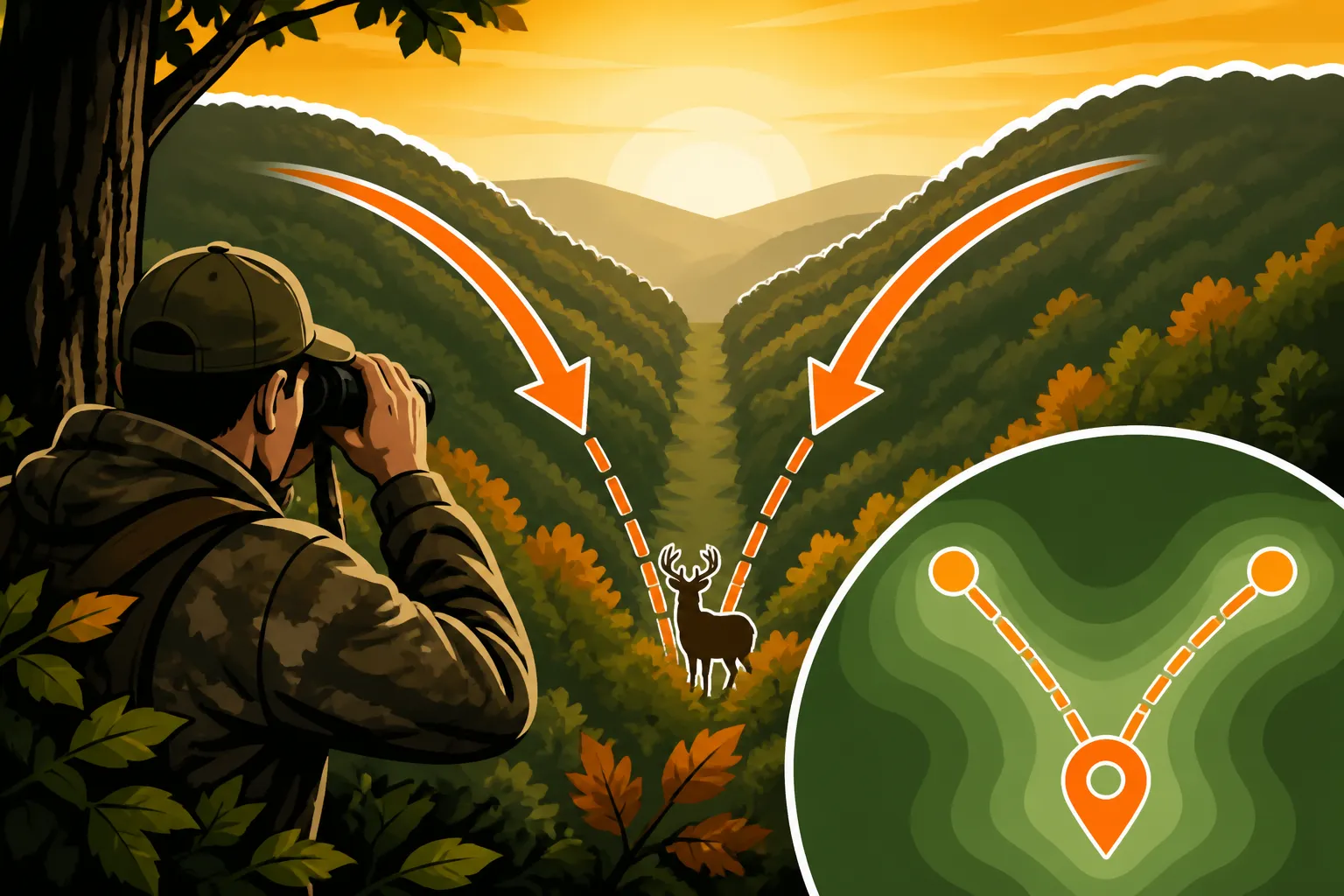
Imagine two deep hollows running roughly parallel to each other. Between these hollows, there's often a narrow ridge, a subtle bench, or even just a less severe saddle that connects the higher ground. Instead of traversing the steep, brushy sides of a hollow or dropping all the way to the bottom and climbing out, deer will naturally opt for this higher, more level, and often less obstructed path. This natural constriction forces their movement into a predictable, concentrated lane – a funnel. These aren't always grand, obvious features; sometimes it's just a slightly less steep section of hillside that creates a "soft funnel" where two hollows start to converge or diverge. The key is recognizing these subtle transitions in terrain where deer don't have many alternative routes to choose from. Think of it as a natural choke point that forces deer into a smaller area, making them more visible and predictable for the hunter.
These funnels are distinct from, say, a field edge funnel or a timbered pinch point on flat ground. In West Virginia, the elevation changes and dense cover amplify their importance. A deer trying to move from one side of a ridge to another might navigate down into one hollow, cross its bottom, and climb out the other side. This is energetically costly and exposes them to more varied wind currents. A funnel between two hollows, on the other hand, allows them to maintain a consistent elevation as much as possible, often staying within or just below the ridge line that separates the hollows, taking advantage of more stable wind patterns along the contours. They're looking for that sweet spot where they can move freely while still benefiting from the security of the deep terrain on either side. These natural travel corridors are often covered in mature hardwoods, providing acorns in the fall, or interspersed with thick undergrowth, ensuring concealment.
Scouting for Success in West Virginia Funnels
Finding these prime funnels isn't always obvious from the road, or even from a quick walk in the woods. It takes dedicated scouting, both from the comfort of your home with maps and with boots on the ground, getting to know the terrain intimately. This foundational work is what truly separates consistent hunters from those who just stumble into success.
Using Topographical Maps and Satellite Imagery
Before you ever set foot in the woods, the best place to start is with detailed topographical maps and satellite imagery. Tools like GoHunt's mapping features are invaluable for this. Look for areas where contour lines pinch together between two larger, more open (or deeply etched) hollows. You're searching for those subtle saddles, benches, or narrow strips of ridge line that connect larger landmasses or provide an easier transition across difficult terrain. Pay close attention to how these features interact with potential bedding areas (often thick, south-facing slopes or dense clear-cuts) and feeding areas (oak flats, agricultural fields, or even rich bottomland browse). Deer travel routes almost always connect these vital resources. A great map will show you elevation changes, water sources, and different timber types, all of which contribute to deer movement. For a deeper dive into pre-season planning, consider checking out our guide on Scouting West Virginia Public Land Before Season. This kind of virtual scouting allows you to eliminate unproductive areas and narrow down your focus before expending precious energy in the dense woods.
Boots-on-the-Ground Reconnaissance
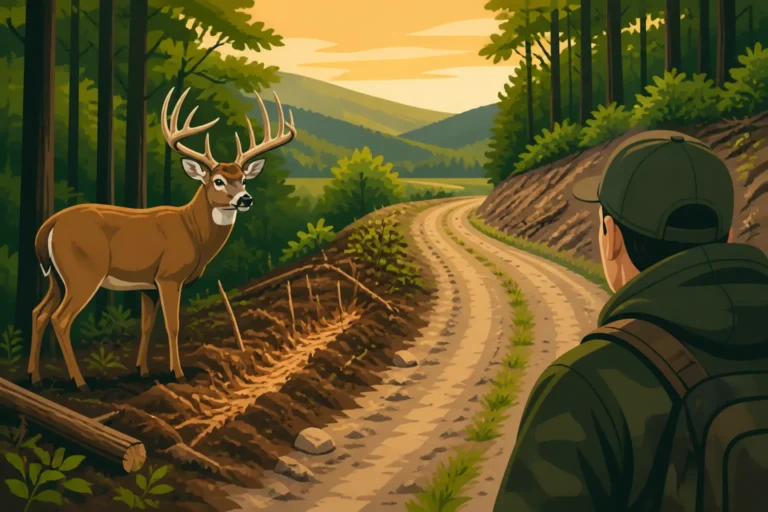
Once you've identified potential funnel locations on your maps, it's time to hit the woods. This is where the real detective work begins. Walk the predicted travel routes. Look for definitive deer sign: fresh tracks, especially multiple sets converging, rub lines, and active scrape lines. A rub line indicating a buck's travel from one hollow to another is a goldmine of information, confirming your funnel theory. Pay attention to how deer are actually moving through the area. Do they cross a specific downed log? Do they step over a certain rock outcropping? These micro-funnels within the larger funnel can be critical for stand placement. Also, don't overlook old, faint trails. If conditions have been dry for a while, fresh tracks might be scarce, but well-worn paths often reveal long-term travel patterns.
It’s crucial to understand how deer utilize these funnels during different times of the year. Early season, they might be moving between specific food sources and bedding. During the rut, these funnels become superhighways for cruising bucks looking for does. Later in the season, they might connect thermal bedding cover to late-season food sources like persistent acorns or browse. The more you walk these areas, the better you'll understand the nuances of deer movement here. Keep an eye out for changes in vegetation or elevation that might create an even tighter pinch point. For tips on identifying fresh activity, our article on Reading West Virginia Mud for Fresh Deer Movement can provide valuable insights.
Strategic Setup: Stands, Blinds, and Wind
Once you’ve identified a promising funnel and confirmed deer activity, the next critical step is to strategically set up your ambush point. In West Virginia’s challenging terrain, this is not just about finding a good tree; it’s about mastering the wind, understanding thermals, and minimizing your intrusion.
Mastering Wind and Thermals
In mountainous terrain, wind is rarely a simple, consistent direction. Thermals play a huge role, especially during morning and evening hours. As the sun rises, air warms and begins to move up the slopes (updrafts). In the evening, as the air cools, it starts to sink down into the hollows (downdrafts). This means a funnel between two hollows might have a completely different wind direction at 8 AM than it does at 5 PM, even if the "prevailing" wind direction remains the same at higher elevations. You need to position your stand or blind to account for these shifts, ensuring your scent is carried away from the anticipated deer travel path during your prime hunting window. Often, this means setting up slightly above the funnel in the morning (letting your scent rise) and slightly below it in the evening (letting your scent fall).
Furthermore, the narrowness of the funnel itself can create its own micro-wind currents, swirling and unpredictable. Using a wind checker constantly is not a suggestion; it's a necessity. Consider having multiple stand locations for different wind conditions. Sometimes, a stand on the very top of the narrow ridge separating the hollows can be effective if the thermals are consistent, allowing your scent to dissipate over the hollows. However, often a slightly downwind position, perhaps 50-70 yards off the main trail, will be safer. Our comprehensive guide on Wind and Thermals on a Steep Ridge offers an even deeper understanding of these critical factors in West Virginia.
Choosing Your Ambush Point: Treestands vs. Ground Blinds
The choice between a treestand and a ground blind depends heavily on the specific funnel, available cover, and your hunting style.
- Treestands: For bowhunting in particular, a treestand offers an elevated advantage, allowing your scent to rise above deer and providing a better vantage point over thick cover. Look for a sturdy tree that offers natural concealment, either from existing foliage or a cluster of smaller trees. Consider trees that are slightly off the main trail, giving you time to react. You want a tree that allows for quiet entry and exit, minimizing disturbance to the funnel itself. Often, an oak or a larger hardwood with good branching structure will serve the purpose. Remember to always prioritize safety when hanging a stand, especially on steep terrain. Our guide on Hanging a Stand on a Steep Allegheny Ridge provides excellent safety and setup tips.
- Ground Blinds: Ground blinds can be highly effective in areas where suitable trees are scarce or where dense undergrowth provides ample natural cover to blend in. They are also excellent for rifle hunting or when hunting with youth. When using a ground blind in a funnel, it’s critical to brush it in thoroughly so it disappears into the environment. Position it with a solid backdrop to break up your silhouette and ensure any light coming through the blind doesn't silhouette you. Again, consider your entry and exit routes, as deer might approach from any direction within the funnel. For more on this, check out Using a Ground Blind on West Virginia Public Land. Regardless of your choice, ensure your setup allows for clear shooting lanes to cover the primary deer movement paths within the funnel.
| Setup Type | Pros | Cons | Ideal Use Case |
|---|---|---|---|
| Treestand | Elevated advantage, scent disbursement, better visibility, stealthy vertical movement. | Requires suitable tree, more physically demanding, less mobile. | Bowhunting, areas with good tree cover, when needing to see over dense undergrowth. |
| Ground Blind | Concealment, weather protection, comfortable for long sits, good for rifle/youth. | Limited visibility, requires excellent brushing in, scent can pool. | Rifle hunting, thick cover, open areas with little elevation, adverse weather. |
Tactics for Hunting Funnels Effectively
You've found your funnel, set up your ambush, and now it's time to hunt. But even with the perfect spot, success often comes down to timing and a few tactical considerations that are especially relevant in West Virginia's challenging environment.
Timing Your Hunt: Peak Activity Periods
Funnels are productive throughout the hunting season, but their effectiveness can peak at specific times.
- Early Season (Archery): During the long West Virginia archery season, deer are often predictable, moving between specific bedding and feeding areas. Funnels connecting these resources are ideal, especially those leading to known acorn flats or water sources. Deer are less pressured, making them more likely to stick to the most convenient routes.
- The Rut: This is prime time for funnels. Bucks are cruising constantly, checking every possible travel corridor for does. A funnel between two hollows becomes a veritable highway for rutting bucks. Positioning yourself to intercept a buck as he travels this path, potentially using calls, can be incredibly effective. Our article, Hunting the Rut in Mid-November, offers great strategies for this peak period.
- Late Season: As food sources dwindle and temperatures drop, deer become highly focused on remaining food and thermal cover. Funnels connecting late-season food sources, like standing beans or hard-to-reach browse, to dense conifer thickets for thermal bedding, can be excellent. Pay attention to how deer move into and out of these areas, especially after a cold front. If you're wondering about specific food sources, check out Late-Season Food Sources for West Virginia Whitetails.
Integrating Calling Strategies
Funnels are also fantastic locations to employ calling strategies. The acoustics of hollows can carry sound surprisingly well, and the constricted nature of a funnel means a deer investigating a call is likely to pass close by.
- Rattling and Grunting: During the rut, rattling antlers can mimic a buck fight, drawing in curious or territorial bucks. In thick West Virginia cover, you don't always need to go full force. Sometimes, a lighter, shorter sequence is all it takes. For details on how to adjust your volume, refer to Rattling Volume in Thick Laurel Cover. Grunt calls, especially a tending or social grunt, can be incredibly effective when a buck is cruising a funnel. A single grunt can stop a deer in its tracks or even draw it in closer. For tips on using these effectively in dense woods, see Grunt Calls in Mature West Virginia Timber.
- Doe bleats: These can attract both does and bucks, especially early in the season or when you're targeting does for meat.
Weapon Choice and Movement
While funnels are excellent for all weapon types, your approach might differ slightly.
- Archery: The close quarters of a funnel make it ideal for archery. Accuracy is paramount, and your ability to draw undetected is key. Our guide, Bowhunting West Virginia's Long Archery Season, has additional tips.
- Firearms: For those hunting during West Virginia's Buck Gun Season or using West Virginia Muzzleloader Tactics, a funnel often provides clearer shooting lanes than the wider expanses of a general hillside. The concentrated movement means you're more likely to get a shot opportunity as deer pass through. Be mindful of shot angles and backstops, especially in undulating terrain.
Ultimately, hunting funnels between two hollows is about understanding deer behavior and capitalizing on their desire for efficiency and security. By thoroughly scouting, setting up smartly with the wind in mind, and timing your hunts, you’ll find yourself with far more consistent encounters in the beautiful, yet challenging, West Virginia woods.
Disclaimer
Hunting is an inherently dangerous activity. Always prioritize safety, understand and follow all West Virginia hunting regulations, and ensure you have proper training and equipment. The advice provided here is for informational purposes only and should not replace professional guidance or personal judgment.