Sabot Versus Conical for Deer
Man, picking out the right bullet for your muzzleloader can feel like stepping into a whole different world compared to centerfire rifles, can't it? There's all this talk of sabots and conicals, and if you're new to the black powder game or just looking to optimize your setup for West Virginia's deer season, it's easy to get lost in the jargon. This guide is going to break down the differences between sabots and conical bullets, explain their strengths and weaknesses, and help you figure out which one might be the best fit for your specific hunting style and the wild, wonderful terrain we all love.
The Muzzleloader Hunter's Dilemma: Sabots or Conicals?
For many of us who hunt deer with a muzzleloader in West Virginia, the big question often boils down to bullet choice. It’s not just about picking a brand; it’s about understanding the fundamental differences in projectile design and how those differences impact performance in the field. This decision can seriously affect your accuracy, terminal performance, and overall confidence when that big buck finally steps out.
A Quick Primer on Muzzleloader Ammunition
When you first dive into muzzleloading, it's easy to feel overwhelmed by the sheer variety of components available. Beyond the powder and primer, the projectile itself is where a lot of the magic, and indeed the confusion, happens. We're talking about two primary categories: sabots and conical bullets. Both are designed to take down deer effectively, but they go about it in very different ways, each with its own set of advantages and quirks that are important to grasp before heading afield.
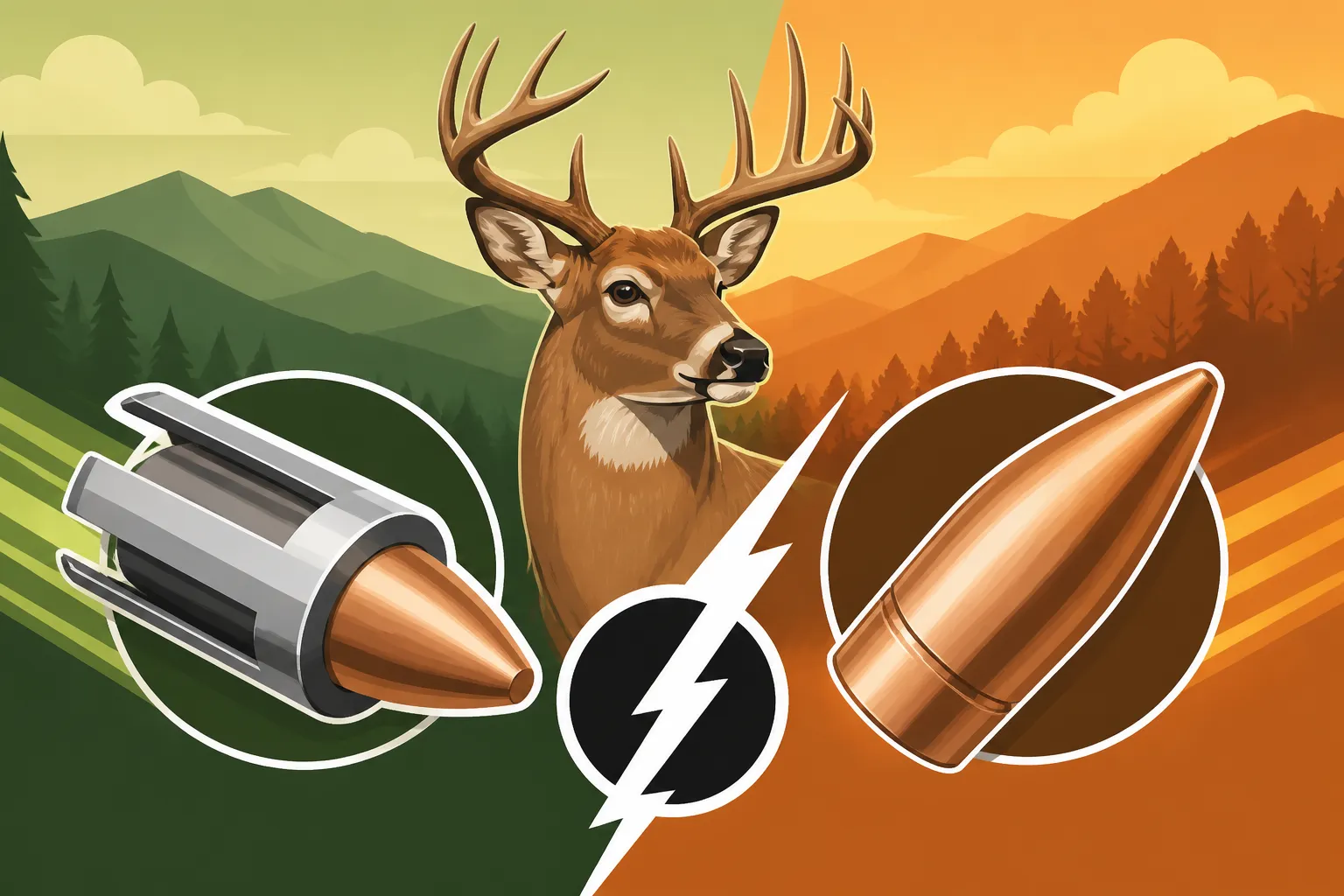
The basic difference comes down to how the projectile fits and interacts with your rifle's bore. Sabots utilize a plastic sleeve to carry a smaller, typically jacketed bullet down the barrel, essentially turning your muzzleloader into a single-shot, high-performance rifle. Conical bullets, on the other hand, are solid lead or lead alloy projectiles that are designed to fit snugly into the rifling of your barrel directly, without a plastic sleeve. This fundamental design difference dictates everything from how you load, to how far you can shoot accurately, to the kind of impact you can expect on your quarry. Understanding these core mechanics is the first step to making an informed decision for your Muzzleloader Deer Hunting in West Virginia adventures.
In the diverse landscapes of West Virginia, where one hunt might involve a long shot across a powerline cut and the next a close-quarters encounter in a rhododendron thicket, your bullet choice can really matter. You might find yourself in the Eastern Panhandle needing a flat-shooting option for open agricultural fields, or deep in the Monongahela National Forest where heavy-hitting power for close timber shots is paramount. The type of terrain you typically hunt, along with the average shot distance you anticipate, should heavily influence whether you lean towards the modern precision of a sabot or the traditional punch of a conical bullet. It's not just a matter of preference; it's about matching your gear to the challenges of our state's varied hunting grounds.
Sabots: Modern Accuracy for Longer Shots
Sabots are often considered the modern choice for muzzleloader hunters, especially those looking to extend their effective range and achieve accuracy comparable to centerfire rifles. The word "sabot" itself comes from the French word for "shoe," which is a pretty apt description for the plastic cup or sleeve that cradles a smaller-diameter bullet as it travels down your muzzleloader's bore. This design allows for a sleek, aerodynamically efficient bullet—often the same kind of jacketed, expanding projectile you'd find in a high-powered rifle cartridge—to be shot from a larger caliber muzzleloader, like a .50 or .54. The plastic sabot grips the rifling, imparting spin, then falls away shortly after exiting the barrel, leaving the bullet to fly to its target.
The primary advantage of sabots is their remarkable accuracy and flatter trajectory, particularly at longer distances. Because they can utilize precisely manufactured jacketed bullets, often with superior ballistic coefficients, sabots allow hunters to make shots that would be incredibly challenging, if not impossible, with traditional conical bullets. This makes them a favorite for hunters running modern inline muzzleloaders, which typically feature faster twist rates designed to stabilize these types of projectiles. When you're trying to Zeroing a Rifle for Mixed Distances, sabots usually offer a more consistent and predictable flight path, which is a huge confidence booster when deer season is on the line.
These modern projectiles truly shine in scenarios where a longer shot might present itself. Imagine hunting a sprawling food plot or a reclaimed surface mine bench where deer might be feeding at 150 yards or more. In areas like the Eastern Panhandle, where open farmland is common, or along vast powerline cuts, a sabot gives you the confidence to ethically take that shot. Their ability to deliver precision and energy retention at extended ranges makes them a formidable choice for hunters who prioritize a flatter shooting bullet capable of reaching out further than traditional options. Many hunters swear by them for their consistent performance when aiming for a clean kill.
However, sabots aren't without their drawbacks. The plastic sabot itself can be finicky; different brands and styles might fit your specific barrel's bore tighter or looser, impacting accuracy. Sometimes, they can leave plastic fouling in the rifling, requiring more diligent cleaning between shots or after a hunt. Furthermore, while the bullet itself is often highly effective, on very close shots, some jacketed bullets designed for higher velocities might expand too rapidly or even fail to expand if velocities drop too low, though this is less common with modern muzzleloader-specific designs. For those who value simplicity and minimal bore interference, the plastic component can be a point of contention.
Conical Bullets: Traditional Power Up Close
Conical bullets represent the more traditional side of muzzleloader ballistics. These are solid projectiles, usually made of lead or a lead alloy, that are designed to be loaded directly into the bore without a plastic sabot. They are typically slightly oversized for the bore, relying on the force of loading to "swage" them down into the rifling grooves, or they might have an expanding skirt (like a Minié ball) that flares out from the gas pressure upon firing to grip the rifling. Think of them as a solid chunk of metal impacting the target, often with significant energy transfer.
The main advantage of conical bullets lies in their heavy hitting power and the sheer mass they carry. Being solid lead and bore-sized, they tend to create a larger wound channel and transfer a tremendous amount of energy upon impact, which can be incredibly effective on deer, especially at closer ranges. Many traditional muzzleloader enthusiasts appreciate the historical feel of shooting conicals, harkening back to the days of black powder hunting without modern plastic components. They're also often more forgiving on bore irregularities or older barrels that might not be perfectly smooth, as the soft lead can conform to the rifling more readily.
Conical bullets truly excel in dense, close-quarters West Virginia cover, such as the thick laurel patches or steep hollows found in our mountainous regions. If you're still-hunting the dark timber of the Monongahela or setting up in a natural funnel between two hollows, shots are likely to be within 75-100 yards, sometimes much closer. In these scenarios, the deep penetration and bone-crushing power of a heavy conical bullet can be absolutely devastating. They offer a certain primal satisfaction, delivering a powerful punch that can anchor a deer even if it's quartering away or behind a shoulder. They're a classic choice for a reason when you're Hunting Steep Allegheny Ridges or focused on more intimate encounters.
However, conicals do have their limitations, primarily concerning their ballistic performance at longer distances. Due to their less aerodynamic shape and heavier weight for their diameter, conical bullets generally have a much more pronounced trajectory curve than saboted bullets. This "rainbow" effect means that range estimation becomes critically important, and slight errors can lead to significant drops at distances beyond 100 yards. They also tend to be less inherently accurate at those longer ranges, making them less ideal for open country hunting where shots might stretch out. For the traditionalist who enjoys the challenge and wants to maximize impact up close, they are fantastic. But if your hunt frequently involves longer shots, a conical might leave you wanting more precision.
Choosing Wisely for Your West Virginia Hunt
Deciding between sabots and conical bullets isn't about one being inherently "better" than the other; it's about choosing the right tool for the job. Your specific hunting conditions in West Virginia, combined with your muzzleloader's characteristics and your personal preferences, should guide your decision. It's a blend of science, experience, and what gives you the most confidence when that moment of truth arrives.
Matching Bullet to Muzzleloader: Twist Rate is Key
One of the most crucial factors in determining which projectile will perform best in your muzzleloader is its barrel's twist rate. This refers to how quickly the rifling inside the barrel rotates the bullet. Twist rate is usually expressed as a ratio, like 1:28" (meaning the bullet completes one full rotation in 28 inches of barrel travel) or 1:48". Generally, heavier, longer projectiles (like many saboted bullets) require a faster twist rate (a smaller number, like 1:28") to stabilize them in flight. Lighter, shorter, or more traditional projectiles (like many conicals) often perform better with slower twist rates (a larger number, like 1:48" or 1:60").
It's a common frustration for muzzleloader hunters to discover that their chosen bullet simply won't shoot accurately, and often, the culprit is a mismatch with the barrel's twist rate. If you try to shoot a long, heavy sabot out of a slow-twist barrel, it might wobble or "keyhole" (hit the target sideways), leading to terrible accuracy. Conversely, a short, light conical might over-stabilize or simply not group well from a fast-twist barrel designed for sabots. Before you even buy a box of bullets, find out your muzzleloader's twist rate (it's usually stamped on the barrel or listed in the owner's manual). This single piece of information will narrow down your options significantly and prevent a lot of wasted time and frustration at the range.
Once you know your twist rate, you can start looking at bullet manufacturers' recommendations. Many bullet boxes will indicate the ideal twist rate for that particular projectile. If your muzzleloader has a fast twist (1:28" or 1:32"), you're probably going to have excellent results with saboted bullets, as modern inline rifles are typically designed with these rates in mind. If you have an older or more traditional muzzleloader with a slower twist (1:48" or slower), heavy conicals or round balls will likely be your best bet for consistent accuracy. Don't fight your barrel's design; work with it to achieve the best possible performance.
Terrain and Typical Shot Distance
Your West Virginia hunting strategy and the type of terrain you frequent should heavily influence your bullet choice. Are you primarily hunting the dense, steep ridges and hollows of the Allegheny Mountains, where shots are almost always under 100 yards, often much closer, and a deer could disappear into thick cover in seconds? Or do you spend most of your time on the edges of agricultural fields, logging cuts, or vast public land expanses like those found in the Potomac Highlands, where a 150-yard shot isn't out of the question?
For those rugged, close-quarters environments where you're Hunting Steep Allegheny Ridges or trying to get a deer to stop in a small clearing within a thick hollow, a heavy conical bullet often makes a lot of sense. The ballistic limitations of a conical aren't as relevant when your shots are consistently close. What is relevant is its ability to punch through bone and muscle with significant energy. You want something that hits hard and quickly puts a deer down, minimizing the chance it runs into impenetrable cover. Moreover, when you're navigating rough terrain, you might appreciate the simplicity of a single, solid projectile and slightly less cleaning required than with some saboted loads.
Conversely, if you've done your scouting, perhaps with a mapping tool like GoHunt to analyze aerial photos, and know you'll be set up overlooking a large field, a powerline, or a long creek bottom, then a sabot is likely the superior choice. The ability to achieve greater accuracy and a flatter trajectory at ranges beyond 100 yards will be a distinct advantage. If you're Reading Aerial Photos for Eastern Panhandle Deer to find good field edges, you'll want the precision that sabots offer. Being able to confidently place a shot at 120 or even 150 yards means you might get an opportunity on a deer that would be out of reach with a conical. This strategic matching of ammunition to terrain is a hallmark of a prepared West Virginia hunter.
| Feature | Saboted Bullets | Conical Bullets |
|---|---|---|
| Description | Jacketed bullet in a plastic sabot | Solid lead or alloy, bore-sized projectile |
| Accuracy | Generally excellent, especially at longer ranges | Good at closer ranges, often less precise at distance |
| Trajectory | Flatter, less drop | More pronounced arc, significant drop at range |
| Effective Range | Longer (100-200+ yards, depending on setup) | Shorter (75-125 yards generally) |
| Twist Rate | Favors faster twists (e.g., 1:28", 1:32") | Favors slower twists (e.g., 1:48", 1:60") |
| Recoil | Typically moderate | Can be heavy due to bullet mass |
| Fouling | Plastic and powder fouling | Lead and powder fouling |
| Cleaning | Might require more specific cleaning for plastic | Usually simpler, less material-specific |
| Ideal Terrain | Open fields, powerline cuts, longer sightlines | Dense woods, steep hollows, close cover |
Hunter Preference and Confidence
Beyond the technical specs and terrain considerations, one of the most underrated factors in choosing muzzleloader ammunition is your own personal preference and confidence. Ultimately, the best bullet is the one you shoot most accurately and feel most comfortable with. If you dread the heavy recoil of a big conical, you might flinch, leading to poor shots. If you struggle to achieve consistent accuracy with sabots in your rifle, then their theoretical advantages are moot.
Spend time at the range with different options. Try a few different sabot brands, experimenting with various bullet weights and powder charges. Do the same with a couple of conical bullet styles. Keep meticulous notes on your groups. What you'll likely find is that your specific muzzleloader has a preference, a combination of powder, primer, and projectile that it just loves to shoot. This often isn't the most expensive option, or the one advertised as the "best," but rather the one that consistently puts holes close together on paper. Your experience during Muzzleloaders for a West Virginia December will be much better if you know your gun and load intimately.
Confidence in your equipment is paramount for ethical hunting. If you're second-guessing your bullet choice when that big West Virginia buck steps out, it can lead to hesitation or a rushed shot. By investing time at the range, trying different loads, and understanding the capabilities and limitations of your chosen projectile, you build that critical confidence. Whether it's the modern precision of a sabot or the traditional punch of a conical, knowing your setup inside and out allows you to focus on the shot placement and execute a clean, ethical kill. After all, the goal is always a quick and humane harvest.
Regulations and Checking WVDNR
Finally, a quick but critical point: always double-check the latest West Virginia hunting regulations before you head afield. While the general rules for West Virginia Legal Firearms for Deer Hunting are pretty consistent, specific details regarding muzzleloader ammunition types are usually covered. The good news is that both sabots and conical bullets are generally legal for deer hunting during the muzzleloader season in West Virginia. There aren't typically specific restrictions on one over the other.
However, it's always smart to be aware of any local or area-specific rules that might pop up, particularly in certain Wildlife Management Areas or in areas designated as Chronic Wasting Disease (CWD) containment zones. While CWD regulations usually focus on carcass transport, it's good practice to be informed about all specific local guidelines. A quick check of the West Virginia Division of Natural Resources (WVDNR) website or their annual hunting regulations booklet will ensure you're always in compliance. This will also cover other important considerations such as Keeping Powder Dry in Wet Snow, which can impact any muzzleloader projectile. Knowing the rules and having a solid bullet choice in mind when Scouting West Virginia Public Land Before Season means one less thing to worry about when the season opens.
Disclaimer
This article is for general informational purposes only and does not constitute professional advice. Laws, prices and regulations vary by location and change over time. Consult a qualified professional for guidance on your specific situation.