When West Virginia Coyotes First Arrived
It’s a question many West Virginia hunters and landowners ponder: when exactly did coyotes, these adaptable and often elusive canids, first arrive in our beautiful Mountain State? For generations, the only wild canids most folks knew were red and gray foxes, maybe an occasional stray dog. Then, seemingly out of nowhere, these new, bigger, more vocal predators started showing up. This shift wasn't a sudden explosion, but a gradual infiltration that truly changed the ecological landscape of West Virginia. Understanding their arrival helps us grasp their current presence and what it means for our wildlife and hunting heritage.
A Newcomer to the Mountain State: The Early Days of West Virginia Coyotes
For centuries, West Virginia’s forests and farmlands were dominated by the native red and gray foxes as the primary small to medium-sized predators. Larger predators like wolves and mountain lions had been extirpated long before, leaving a void at the top of the food chain. This ecological niche, however, wouldn't stay empty forever. The coyote, a creature of the western plains and deserts, began a remarkable eastward expansion across the North American continent, a journey that eventually brought them to our Appalachian hills.
The first confirmed sightings of coyotes in West Virginia are a bit shrouded in anecdote, but official records and biological surveys generally pinpoint their initial, verifiable presence to the mid-to-late 1970s. Before this time, if you saw something that looked like a coyote, it was almost certainly a mistaken identity with a lanky German Shepherd or a hybrid dog. These early pioneers were likely solitary individuals or small family groups, cautiously exploring new territories, perhaps filtering in from neighboring states like Ohio or Pennsylvania where they had already established footholds. Imagine the surprise of an old-timer trapper finding a track he'd never seen before, or a deer hunter glimpsing a canine that just didn't quite fit the description of any fox he knew. These were the whispers and first confirmations of a new species taking root.
It wasn't like they arrived en masse in a single year; it was a slow, steady trickle. These initial waves weren't necessarily recognized as a significant biological event by everyone. Many likely dismissed them as anomalies. But year after year, the sightings became a little more frequent, the tracks a little more common. What started as scattered reports in the western and northern counties eventually began to spread, hinting at the robust and adaptable nature of these animals. Hunters, keenly observant of the natural world, were often the first to notice these subtle shifts in local wildlife.
Tracking Their Trails: Migration Patterns and Expansion Across West Virginia
The journey of the coyote into West Virginia wasn't a direct march but a strategic, opportunistic expansion. Originally, coyotes were concentrated in the prairies and arid regions of the American West. As human settlement fragmented landscapes and removed larger predators like wolves, coyotes found new opportunities to expand their range. Their migration eastward was facilitated by a combination of factors, including the clearing of forests for agriculture, which created more open and edge habitats similar to their ancestral homes, and the absence of natural competitors.
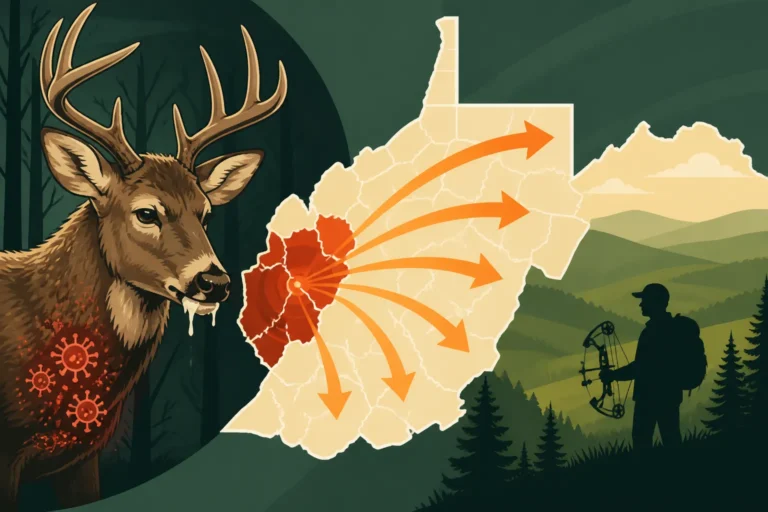
In West Virginia, the coyotes likely arrived primarily from two directions: the north and the west. From states like Ohio and Pennsylvania, where populations were already booming, coyotes moved into West Virginia’s northern panhandle and along the Ohio River Valley. These river corridors and agricultural lands provided relatively easy travel routes and abundant food sources. Simultaneously, coyotes were also expanding south and eastward through Kentucky and Virginia, potentially pushing into West Virginia's southern and eastern counties over time. This dual front of colonization allowed them to quickly explore and establish themselves across the varied terrain of the Mountain State. You can see how this spread might correlate with areas that offer specific types of cover or food sources, much like how deer move. Tools like those found on GoHunt can help you visualize these landscape features today.
The spread wasn't uniform. Areas with more fragmented forests, interspersed with fields and human development, likely saw earlier and faster colonization. The deep, unbroken expanses of the Monongahela National Forest might have been slower to be fully populated, at least initially. However, coyotes are incredibly adaptable, capable of thriving in everything from suburban fringes to rugged mountain wilderness. Over time, even these remote, high-elevation areas became part of their expanding territory. Hunters who once rarely, if ever, saw a coyote in their favorite deer woods in the Hunting Potomac Highlands Public Land or Hunting Ohio River Valley Bottomland would soon report seeing them regularly.
By the 1980s and 1990s, coyotes were firmly established in many parts of West Virginia. Their distinctive howls, once foreign, became a common sound in the predawn and twilight hours. This rapid establishment underscores their remarkable ability to adapt to new environments and exploit available resources, making them a permanent fixture in our state’s ecosystems.
Why the Mountain State Welcomed Them: Factors Driving Coyote Colonization
The success of coyotes in colonizing West Virginia can be attributed to several key ecological and anthropogenic factors. They didn't just stumble into the state; they found an environment ripe for their proliferation.
Firstly, the most significant factor was the absence of competition from larger predators. As mentioned, wolves and mountain lions were long gone from West Virginia. This created an "empty niche" at the top of the mesopredator food chain. Coyotes, being generalists and opportunists, readily filled this role, preying on deer fawns, rabbits, rodents, and even domestic livestock when available. Without larger predators to keep their numbers in check, their populations could grow relatively unhindered. This allowed them to move into and dominate various habitats without intense competition.
Secondly, habitat changes played a crucial role. While West Virginia is known for its rugged mountains and dense forests, significant land use changes occurred over the past century. Logging, mining, and agricultural expansion created a mosaic of clearings, edge habitats, and reforested areas. This "edge habitat" is exactly what coyotes thrive in – offering dense cover for denning and travel, adjacent to open areas for hunting prey. Fields of corn, hay, and soybeans provide abundant rodent populations, and even the deer population, rebounding strongly, offered a reliable food source in the form of fawns. These habitat alterations inadvertently rolled out a welcome mat for the incoming coyotes.
Thirdly, their incredible adaptability and reproductive success ensured their rapid spread. Coyotes are not picky eaters; they'll consume almost anything from berries and insects to roadkill and small game. This diverse diet allows them to survive through lean times and exploit whatever food sources are most abundant. Furthermore, they have flexible social structures, from solitary individuals to pair bonds and small packs. They also have high reproductive rates, often having larger litters when prey is abundant or populations are low, a phenomenon known as "compensatory reproduction." This means that even with some hunting pressure, their numbers can quickly bounce back. Hunters understand this resilience when considering Coyote Calling in West Virginia Farm Country or Predator Calling West Virginia Ridgelines.
Finally, the human landscape itself contributed. While often seen as a nuisance, human activity paradoxically aided their spread. Roads and utility corridors can act as travel routes, and rural residential areas provide new food opportunities like discarded pet food or small domestic animals, even if these are not their primary diet. Their stealth and intelligence allowed them to exist close to human settlements often undetected, further assisting their establishment.
Living with the Locals: The Coyote's Established Presence in West Virginia
Today, coyotes are firmly entrenched across all 55 counties of West Virginia. What began as a few scattered sightings decades ago has blossomed into a widespread, healthy population that has fundamentally altered the state’s ecological dynamics. They are no longer a novelty but a permanent fixture in our wildlife community, from the suburban outskirts of Charleston to the deep backcountry of Randolph County.
Their presence has had a noticeable impact on other wildlife, particularly deer. While adult, healthy deer are rarely taken by coyotes, fawns are a primary food source, especially in the spring and early summer. This can influence fawn survival rates and, consequently, the overall deer population dynamics in certain areas. It's an ongoing topic of discussion among deer managers and hunters alike. Coyotes also prey on smaller game species, such as rabbits and groundhogs, and can compete with foxes for resources. While foxes are still present, their numbers or distribution may have been subtly affected in areas with high coyote densities.
For hunters, coyotes represent both a challenge and an opportunity. Many hunters have adapted their strategies to account for coyotes, knowing that controlling their numbers can potentially benefit deer and turkey populations. Predator hunting has become a popular pursuit for some, providing year-round action and a chance to hone skills. Predator Hunting in West Virginia has become a key method for many. Others simply learn to live with them, accepting them as part of the wild landscape. Understanding How Many Coyotes West Virginia Has or their West Virginia Coyote Range and Density can inform hunting strategies, whether you're targeting coyotes themselves or other game that might be impacted by their presence.
The West Virginia Division of Natural Resources (WVDNR) recognizes coyotes as a valuable component of the ecosystem, but also manages them as a species that can be hunted and trapped year-round. This liberal season reflects their widespread abundance and the ongoing need for population management. For hunters looking to engage with this cunning animal, remember to consult the West Virginia Small Game Season Rules and verify specific regulations for methods and locations. Using tools like GoHunt, you can map out public lands and potential coyote hotspots, helping you understand terrain and access points that might hold these intelligent predators. The coyote's arrival story in West Virginia is a testament to nature's resilience and constant evolution, and they are now as much a part of the Mountain State as the deer, turkey, and black bears we cherish.
| Decade of First Confirmed Sightings | Geographic Spread & Status | Key Factors Contributing to Spread | Hunter Impact Observations |
|---|---|---|---|
| 1970s | Initial scattered sightings, primarily western/northern WV | Absence of large predators, habitat fragmentation | Mostly anecdotal, confusion with dogs, occasional sightings |
| 1980s | Established in western/northern counties, pushing eastward | High reproductive rates, adaptable diet, expanding deer herds | Increased sightings, some perceived impacts on fawns/small game |
| 1990s | Widespread establishment across most of the state | Continued habitat changes, lack of hunting pressure initially | Growing recognition as a significant predator, increased predator hunting interest |
| 2000s – Present | Present in all 55 counties, robust populations | Extreme adaptability to diverse habitats (urban to rural) | Integral part of ecosystem, managed through year-round hunting/trapping |
Disclaimer
This article is for general informational purposes only and does not constitute professional advice. Laws, prices and regulations vary by location and change over time. Consult a qualified professional for guidance on your specific situation.