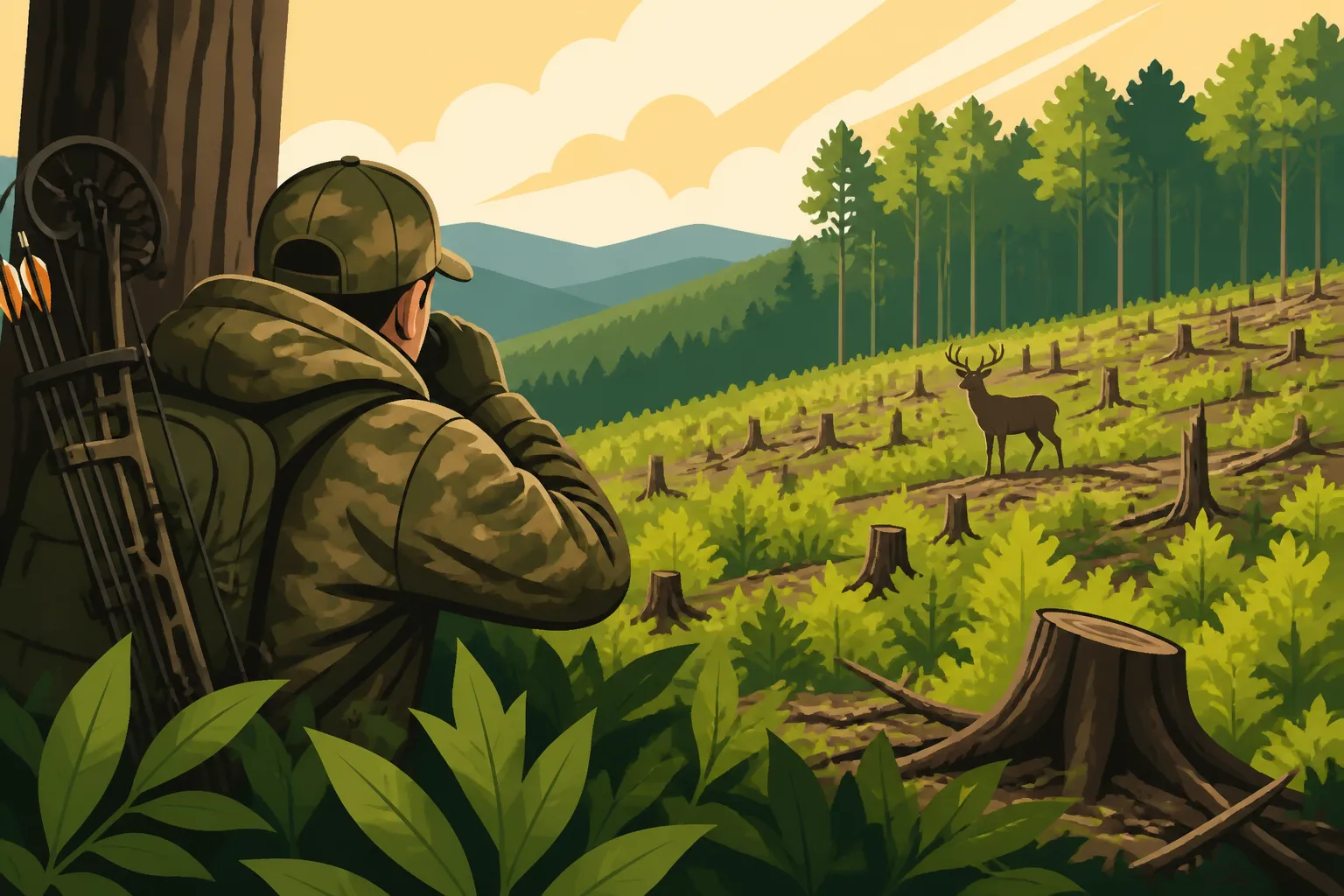
Hunting a Clear-Cut Regrowth Edge
Trying to make sense of a clear-cut, with its tangle of downed timber, impenetrable briars, and seemingly chaotic growth, can feel overwhelming for any West Virginia hunter. Many folks just see a mess and walk right by, but they're missing out on some of the best deer hunting opportunities our state offers. This guide is all about demystifying the clear-cut regrowth edge, showing you exactly why deer love these spots, and equipping you with the tactics and knowledge to turn these dense areas into productive hunting grounds.
Understanding Clear-Cut Dynamics and Deer Behavior
Clear-cuts are a fundamental part of forestry management in West Virginia, whether on public lands like the Monongahela National Forest or private timber tracts. What many hunters don't realize is that these areas, initially barren and uninviting, quickly transform into wildlife havens, particularly along their edges. Understanding this ecological succession and how deer interact with it is key to successful hunting.
The Life Cycle of a West Virginia Clear-Cut
When an area is clear-cut, all or most of the trees are harvested, leaving behind a relatively open landscape. At first, it looks like a logging operation, with stumps, slash, and exposed soil. But Mother Nature doesn't wait long. Within months, sunlight floods the forest floor, triggering a massive burst of new growth. Pioneer species like blackberry, sumac, aspen, and various herbaceous plants quickly colonize the area. This initial phase, often lasting 3-7 years, is characterized by dense, low-growing vegetation.
As the years progress, these plants grow taller and thicker, creating incredible bedding cover and browse. After about 10-15 years, the hardwood saplings begin to dominate, shading out some of the understory, but still providing a thick canopy. It's during this early to mid-regrowth phase, when the clear-cut transitions from a chaotic mess to a dense, food-rich jungle, that the edges become prime deer habitat. Later, as the clear-cut matures into a young forest, its value to deer as a primary bedding or feeding area might lessen, but the edges often retain their importance as travel corridors and transition zones. This dynamic process means that a clear-cut you hunted five years ago might offer entirely different opportunities today, requiring you to constantly adapt your approach and keep up with what the forest offers.
Why Deer Gravitate Towards Regrowth Edges
Deer are creatures of cover and convenience. A clear-cut regrowth edge offers the best of both worlds, creating a natural magnet for them. Think about it: inside the dense regrowth, there's a buffet of nutritious browse — tender shoots, leaves, and berries that sprout up in the sunlight. Deer can spend hours munching away, completely hidden from view. But they also need to travel, to access water, other food sources like acorns in mature timber, or simply to move between bedding and feeding areas. The edge of that thick regrowth provides a perfect transition.
It's like a natural border patrol. Deer can step out of the dense cover for a quick look around, scent the wind, and then slip back into safety in a heartbeat. These edges are often linear, creating easy travel corridors or "funnels" that deer utilize daily. They offer concealment, food, and security, all in one compact zone. This is why you'll often find more deer sign right along the perimeter of a clear-cut than deep inside it, or even far out in the mature woods. It’s where the benefits of both habitat types converge, creating a highly efficient living space for deer. This preference for edges extends beyond just clear-cuts; deer often utilize any sharp transition, like where a field meets a woodlot or a creek bottom meets a hillside.
Scouting and Locating Productive Clear-Cut Edges
Hunting clear-cut edges isn't about blind luck; it's about smart scouting. The dense nature of these areas can make casual observation tough, so you need a methodical approach, blending technology with old-fashioned boot leather.
Utilizing Aerial Imagery and Topo Maps
Before you ever set foot in the woods, the best way to start scouting a clear-cut is from your couch. Tools like GoHunt or other mapping applications with up-to-date aerial imagery are your best friends here. Look for the distinct, irregular shapes that indicate a recent or older clear-cut. Pay close attention to the edges where the lighter green of young growth meets the darker green of mature timber. What you're looking for are irregularities, fingers, points, or saddles that create natural bottlenecks or travel corridors along that edge. These are the spots where deer are most likely to enter or exit the dense cover.
Overlaying topographical maps can add another layer of insight. Are there benches, subtle draws, or saddles that intersect with the clear-cut edge? Deer, especially mature bucks, often prefer to travel contours or through the easiest path of resistance, and these topographical features can channel their movement directly along or into the clear-cut. For example, a small saddle on a ridge line that also happens to be where a clear-cut meets a mature oak flat is a gold mine. This kind of digital scouting can save you countless hours of walking and help you narrow down your on-the-ground efforts significantly. You can find similar features when reading a ridge for Eastern Panhandle deer, which can be applied to many clear-cut scenarios.
On-the-Ground Reconnaissance for Fresh Sign
Once you have a few promising spots identified on your map, it's time to hit the woods. This is where you confirm your digital scouting and read the actual story the deer are telling. Your focus should be on finding fresh sign along the edge. Look for:
- Tracks: Are there fresh deer tracks entering and exiting the clear-cut? Pay attention to their direction of travel and size. Look for clusters of tracks or well-worn trails that disappear into the thicket.
- Droppings: Fresh droppings indicate recent activity. The more droppings, the more frequent the use.
- Browsing: Inside the clear-cut, check the tips of young shoots and saplings for signs of deer browsing. Deer are quite picky, so they'll nip off the newest, most succulent growth.
- Rubs and Scrapes: During the pre-rut and rut, bucks will leave rubs on small trees and create scrapes, particularly along these transition lines. A fresh scrape line along a logging road or the mature timber side of a clear-cut edge is a huge indicator of buck activity. For deeper understanding, you might want to learn more about scrape lines along a logging road.
- Bedding Areas: While you might not want to push deep into the densest part of the clear-cut, look for signs of bedding just inside the edge, often in small pockets of cover that offer a good vantage point for deer to watch their backtrail or wind approaching danger.
Remember, this isn't just about finding any sign; it's about finding fresh sign that tells you deer are actively using that specific part of the clear-cut edge now. If you're scouting West Virginia public land before season, focusing on these clear-cut edges can give you a significant advantage.
Effective Hunting Tactics for Clear-Cut Edges
Hunting clear-cut regrowth edges requires specific tactics tailored to the dense environment and deer behavior. It's not like hunting open woods or a typical field edge. Patience, strategic positioning, and understanding deer movement are paramount.
Still-Hunting and Stand Placement Strategies
Still-hunting a clear-cut edge means moving extremely slowly, taking a few steps, and then pausing for several minutes to scan the thick cover and listen. You're not trying to cover ground quickly; you're trying to sneak up on deer that might be bedded or browsing just inside the dense regrowth. Use the wind to your advantage, moving into it or crosswind to avoid detection. Focus on glassing into the clear-cut, looking for parts of deer – an ear flick, a horizontal backline, a patch of brown hair against the green or brown tangle. A good pair of rangefinders in thick Highlands cover can be invaluable for picking apart the dense vegetation.
When it comes to stand placement, whether it's a treestand or a ground blind, you want to be positioned for observation and a shot into the clear-cut, as well as the mature timber on the other side of the edge. Look for larger, isolated trees just outside the clear-cut that offer a commanding view. Consider putting your stand on a point or finger of mature timber that extends into the clear-cut, as this gives you visibility down both sides of the edge. Similarly, setting up a ground blind just inside the mature timber, brushed in naturally, can give you a close-up shot as deer transition. Think about access and egress, too. Can you get to and from your stand without blowing deer out of the clear-cut? This is crucial, especially when trying to pinpoint treestand setups in Monongahela National Forest. A well-placed stand can also capitalize on situations when you're hunting a funnel between two hollows that also borders a clear-cut.
Dealing with Wind and Thermals in Varied Terrain
West Virginia's topography, especially around clear-cuts which are often on slopes or ridges, makes understanding wind and thermals absolutely critical. Wind direction can be highly unpredictable near steep terrain and dense cover. Always hunt with the wind in your favor, either directly in your face or quartering. However, thermals – the rising and falling air currents – can complicate things. In the morning, as the sun warms the earth, thermals tend to rise up the slopes. In the evening, as the air cools, they tend to fall down the slopes.
This means a stand that's perfect in the morning might be terrible in the evening, as your scent could be carried right into the clear-cut where deer are moving. Try to position yourself so that your scent cone is blowing away from the primary deer travel routes and bedding areas. If you're hunting a clear-cut on a ridgetop, the wind might be more consistent, but in a hollow, it can swirl. Pay close attention to how wind and thermals on a steep ridge behave, and don't be afraid to adjust your hunt plan if the conditions aren't right. Carry a small powder bottle or milkweed seeds to constantly check micro-currents.
The Role of Scrapes and Rubs on the Edge
Clear-cut edges are natural magnets for buck sign, especially during the pre-rut and rut. Bucks often establish territories and communicate through rubs and scrapes, and these edges provide the perfect billboard. Look for rub lines running parallel to the clear-cut edge, where bucks are defining their travel paths and marking their presence. These rubs, scraped clean of bark, are often found on saplings and small trees that border the thick cover.
Scrapes, on the other hand, are typically found on the mature timber side of the clear-cut edge, sometimes just a few feet in, or along a subtle logging road that parallels the regrowth. Bucks will paw away the leaves to expose bare earth, then urinate into it, often beneath an overhanging branch they've licked and chewed. Fresh scrapes are a clear signal of active buck movement. If you find a series of fresh rubs and scrapes along a clear-cut edge, you've hit a jackpot. This is a primary travel route for a buck, likely between bedding in the clear-cut and feeding or breeding areas elsewhere. Positioning a stand near such a scrape line, especially during the peak of hunting the rut in mid-November, can be incredibly effective. Consider using a rattling or grunting call from these positions, as bucks may be rattling and grunting in West Virginia in response to perceived competition.
Gear Considerations for Clear-Cut Environments
Hunting clear-cuts isn't just about strategy; it's also about having the right gear. The dense, often rugged nature of these areas demands equipment that can withstand abuse, provide comfort, and give you an edge in thick cover.
Clothing and Footwear for Dense Cover
Forget your quiet, soft shell gear designed for open timber. Hunting clear-cuts means pushing through briars, tangled branches, and often muddy or wet ground. You need durable, abrasion-resistant outer layers. Heavy-duty brush pants or chaps are almost a necessity to protect your legs from thorns and snags. Layering is key, as you'll likely work up a sweat busting through the thick stuff, then cool down quickly on stand. Consider moisture-wicking base layers and insulation that performs well even when damp, like wool or synthetics.
Footwear is equally crucial. You'll be traversing uneven terrain, climbing over downed logs, and potentially wading through mud or shallow water. A pair of sturdy, waterproof boots with excellent ankle support and aggressive traction is non-negotiable. Look for boots designed for rugged hiking, maybe even with a slightly higher ankle to prevent debris from getting in. If you're spending a lot of time still-hunting in wet conditions, rubber boots can keep you dry and scent-free. Choosing the right pair of boots for West Virginia hollows and ridges will make a huge difference in your comfort and endurance.
Optics and Weapons for Close-Quarters and Longer Shots
In a clear-cut environment, shots can be incredibly close, sometimes just a few yards, but a deer could also slip out onto a logging road or into a small opening at 100 yards. This demands versatility from your weapon and optics.
For archery hunters, a compound bow or crossbow is ideal. You'll want a bow that's maneuverable in tight spaces and can deliver a fast, ethical shot. Ensure your broadheads are sharp and capable of punching through any potential brush you might encounter. If using a crossbow, verify that crossbow rules during West Virginia archery season are understood. For gun hunters, a rifle chambered in a common deer caliber like a .30-06, .308, or even a .30-30 can be effective. Consider a scope with a lower magnification range (e.g., 1-4x or 2-7x) for quick target acquisition in dense cover, but still capable of reaching out if needed. A choosing a rifle caliber for West Virginia deer guide can help you make an informed decision. Some hunters prefer straight-wall cartridges in pistol-caliber carbines for their quick handling and effectiveness at shorter ranges.
Binoculars are also vital. While you might think "thick cover, no need for binos," the opposite is true. Quality binoculars, like an 8x or 10x power, allow you to pick apart the dense regrowth, spotting a flicker of an ear or the horizontal line of a deer's back that you'd otherwise miss.
Table: Pros and Cons of Hunting Clear-Cut Edges
| Feature | Pros | Cons |
|---|---|---|
| Deer Density | High concentration of deer for food and cover | Deer are extremely wary due to dense cover and inherent safety |
| Visibility | Clear observation into and out of thick cover from the edge | Limited visibility deep into the clear-cut; difficult to track wounded game |
| Travel Routes | Natural funnels and transition zones for deer movement | Deer movement can be unpredictable due to numerous entry/exit points |
| Hunting Pressure | Often overlooked by hunters due to difficulty and dense terrain | Can still experience pressure if the clear-cut is easily accessible |
| Physical Demands | Can be easier than pushing deep into dense growth | Requires sturdy gear, good physical condition, and patience for still-hunting |
| Sign Identification | Concentrated rub and scrape lines, abundant tracks | Sign can be overwhelmed by general animal activity; tricky to distinguish fresh |
Disclaimer
Please be aware that hunting regulations, seasons, and licensing requirements can change. Always consult the most current West Virginia Division of Natural Resources (WVDNR) official regulations before planning any hunting trip. This guide is for informational purposes only and should not be considered legal advice or a substitute for official WVDNR resources.