Rabbit Hunting West Virginia Fencerows
Trying to hunt rabbits in West Virginia can sometimes feel like chasing ghosts, especially when they vanish into the thickest cover imaginable. You spend hours walking, kicking brush piles, and just when you think you've found a spot, poof – they're gone. It's frustrating when you know those cottontails are around, but actually getting a shot at one feels like hitting the lottery. This guide is all about demystifying one of the best spots to find them: the humble, yet incredibly productive, fencerow. We're going to dive deep into how to find, hunt, and successfully bag rabbits along West Virginia's fencerows, transforming those elusive bunnies into a delicious meal.
Understanding West Virginia's Rabbit Habitat: Why Fencerows are Key
West Virginia's landscape is a patchwork of mountains, valleys, forests, and farms. While rabbits might seem like they'd be everywhere, they truly thrive in specific kinds of transitional habitat. Fencerows, those often-overlooked strips of brush and timber separating fields and properties, are absolute goldmines for cottontails. They provide everything a rabbit needs to survive and flourish, making them prime hunting spots.
The Allure of the Fencerow: Cover, Food, and Travel Corridors
Imagine a rabbit's daily life. They need safe places to hide from predators like coyotes, foxes, and hawks. They need a consistent food supply, and they need ways to move between feeding areas and bedding areas without being exposed. Fencerows deliver on all three fronts, often simultaneously. They’re like mini-highways lined with impenetrable fortresses.
These linear strips of vegetation typically consist of briars, multiflora rose, honeysuckle, sumac, small cedars, and sometimes even downed trees. This dense, tangled growth is almost impossible for larger predators to penetrate quickly, giving rabbits a crucial advantage. On one side, you often have agricultural fields, pastures, or natural clearings offering abundant food sources like clover, grasses, and crop remnants. On the other side, there might be another field, a woodlot edge, or a creek bottom. This creates a perfect edge habitat, which is precisely where rabbits love to be. They can feed openly at dusk and dawn, then quickly dart back into the thorny sanctuary of the fencerow if danger arises.
Identifying Prime Fencerow Features for Rabbits
Not all fencerows are created equal, and knowing what to look for can significantly improve your success. The ideal fencerow isn't just a thin line of weeds; it's a diverse linear habitat with specific characteristics. Look for fencerows that are wide—at least 6-10 feet across, if not more—and that connect different types of habitat. For instance, a fencerow running between a standing cornfield and a thick woodlot, or separating an old pasture from a dense creek bottom, is far more likely to hold rabbits than a thin strip of grass along a manicured field.
Also, pay close attention to any breaks or additional cover within the fencerow. Old brush piles, downed logs, rock walls, or even old farm equipment left to rust are all fantastic rabbit magnets. These provide additional layers of protection and preferred bedding sites. Think about what offers the most security. Thorns are excellent, but an additional hollow log or a dense thicket of greenbrier takes it to another level. Consider checking the general health of the rabbit population in an area. You can learn more about West Virginia Squirrel and Rabbit Populations to get a better sense of regional trends.
Scouting Fencerows for West Virginia Rabbits
Effective rabbit hunting often begins long before you ever step into the field with a shotgun. Scouting is crucial, especially in West Virginia's varied terrain where prime habitat can be surprisingly localized. Knowing what to look for and when to look for it will save you countless hours of unproductive walking.
Pre-Season Reconnaissance: Reading the Landscape
Before the season even opens, take the time to drive or walk through potential hunting areas. This is where tools like GoHunt's mapping features can be incredibly useful. You can identify promising fencerows, especially those that border different crop types or connect to other prime rabbit habitats like old orchards or fallow fields. Look for areas with a mix of cover and food sources. A fencerow next to a winter wheat field or an unharvested soybean field could be a rabbit superhighway.
During the late summer and early fall, when vegetation is still fairly thick, try to spot areas where rabbits might be feeding or traveling. Pay attention to how fields transition into thicker cover. Does the fencerow offer continuous escape routes, or are there gaps that might force a rabbit into the open? Also, consider hunting pressure. Areas that are easily accessible might see more hunters, while those a bit off the beaten path could hold more undisturbed rabbits. If you're on public land, using these tools to identify less-traveled spots can be a game-changer.
Fresh Sign: Droppings, Cuttings, and Tracks
Once you're in the field, it's all about reading the fresh sign. Rabbit droppings are small, round pellets, often found in clusters where rabbits have been feeding or resting. The fresher the droppings, the darker and softer they'll be. Older droppings will be lighter and harder.
Look for "cuttings," which are plant stems or bark that rabbits have nipped off cleanly with their sharp incisors. These are usually small, at a low height, and often found around preferred food sources like clover or succulent weeds along the fencerow edge. If you find a patch of clover with numerous fresh clippings, you know you're in a hotspot. Another excellent sign, especially after a fresh dusting of snow or a light rain, is tracks. Rabbit tracks are distinctive, with two larger hind feet leaving prints ahead of the two smaller front feet. Fresh tracks leading into or out of the fencerow are undeniable proof of current rabbit activity. Knowing how to interpret these signs is key to success, whether you're Reading West Virginia Mud for Fresh Deer Movement or looking for rabbit sign.
Essential Gear for Fencerow Rabbit Hunting
Rabbit hunting in West Virginia's fencerows isn't usually a gear-intensive endeavor, but having the right equipment can make a significant difference in comfort, safety, and success. You're going to be pushing through some nasty stuff, so durability and protection are paramount.
Shotgun Selection and Ammunition Choices
For rabbit hunting, a lightweight, fast-swinging shotgun is generally preferred. The vast majority of shots will be quick, close-range flushes in thick cover. A 20-gauge or 12-gauge shotgun is ideal, with many hunters opting for the lighter 20-gauge for its ease of carry and less recoil. Over/unders, side-by-sides, pumps, or semi-automatics all work well, though a pump or semi-auto provides a quicker follow-up shot. Choke selection is important too; an Improved Cylinder or Modified choke will provide a good pattern for the typical 10-25 yard shots you'll encounter. You can learn more about specific shotgun choices in our guide to Best Shotgun Gauge for West Virginia Grouse, which has many transferable tips for rabbit hunting.
When it comes to ammunition, #6 or #7.5 lead shot is standard for rabbits. The smaller shot size provides a denser pattern, which is crucial for hitting fast-moving targets in tight spaces. You want enough pellets to ensure a clean kill without over-penetrating. Always carry enough shells, but don't overdo it – remember you'll be walking and pushing brush. A small pouch on your belt or a shell holder in your vest should suffice.
Dressing for the Briars: Protection and Mobility
This is perhaps the most critical gear consideration for fencerow hunting. West Virginia fencerows are notorious for their thorns, briars, and thick tangles. You absolutely need protective clothing. Think heavy-duty brush pants or chaps, preferably made from canvas, briar-proof nylon, or waxed cotton. These will protect your legs from punctures and scrapes. Don't skimp here; a cheap pair of pants will be shredded after one good fencerow. Many hunters opt for specific brush pants like those detailed in our guide on Brush Pants for West Virginia Laurel Thickets.
For your upper body, a durable long-sleeved shirt and a tough hunting vest are essential. The vest, ideally, should have plenty of pockets for shells, a game bag in the back, and be made of blaze orange for safety. Warm layers underneath are key for cooler days, as you’ll be exerting energy but also standing still occasionally. Good quality, waterproof boots with ankle support are also a must for navigating uneven terrain and wet conditions. Check out options for Boots for Walking West Virginia Ridges for ideas on what stands up to rugged terrain.
Tools for the Field: From Bags to GPS
Beyond your shotgun and attire, a few other items will enhance your hunt. A game bag or an upland hunting vest with an integrated game pouch is vital for carrying your harvested rabbits. Carrying them by hand is a quick way to lose one or get covered in blood and dirt.
A good GPS unit or a reliable hunting app on your phone (like GoHunt) is incredibly helpful, especially if you're exploring new areas or hunting on public land. It helps you keep track of your location, mark hot spots, and navigate back to your vehicle. While GoHunt is excellent for mapping, make sure you have a backup plan or downloaded maps if you're in an area with spotty cell service. A small, sharp knife for field dressing, a bottle of water, and some snacks round out your basic kit. Remember, you're often covering a good bit of ground, so a light day pack can be useful to carry these items, similar to what you might use for Packs for a Day on Public Land.
Effective Tactics for Working West Virginia Fencerows
Successfully hunting rabbits in fencerows requires a combination of persistence, smart strategy, and often, teamwork. Rabbits are masters of evasion, and getting them to break cover for a clean shot is the ultimate goal. Whether you're hunting solo or with a group, adapting your approach to the specific fencerow and situation is key.
Solo Hunter Strategies: The Stop-and-Go Approach
Hunting fencerows alone can be highly effective if you employ the right technique. The "stop-and-go" method is a classic for a reason. Instead of walking continuously down the fencerow, move 10-15 yards, then stop dead still for 15-30 seconds. Rabbits often won't bolt immediately; they'll hold tight, hoping you walk past. When you stop, they might get nervous, thinking they've been spotted, and this hesitation can often cause them to flush. It's surprising how many rabbits will bolt when you stand still after moving for a bit.
As you walk, try to kick or stomp at dense patches of briars, multiflora rose, or brush piles within the fencerow. Sometimes, a physical disturbance is what it takes to get them moving. Be ready for quick shots. When a rabbit bursts out, it's usually at full speed. Focus on getting your gun up smoothly and swinging through the target. Remember, the goal is often to get them to run along the fencerow, giving you a slightly longer, clearer shot before they dive back into cover or cross into a field. This solo approach is particularly useful when you're exploring different small tracts of land.
Hunting with a Partner or Small Group: Driving and Blocking
When you have one or two partners, fencerow hunting becomes even more productive and strategically diverse. One common and effective method is to have "drivers" walk through the fencerow, while "blockers" position themselves at the end or at strategic openings along the fencerow.
The drivers move slowly and methodically, kicking every dense patch of cover and making noise to push rabbits forward. Communication between drivers is vital to ensure a consistent push. The blockers, meanwhile, wait patiently at the anticipated escape points. This could be where the fencerow ends, where it narrows into a less dense section, or where it meets another cover type. Often, rabbits will run the length of the fencerow to escape, giving the blockers prime opportunities for shots. This strategy is incredibly effective for pushing rabbits out of substantial cover. When engaging in this type of hunting, always be mindful of safety, especially concerning shot angles. Deer Drives With Three or Four Hunters provides excellent advice on safe group hunting techniques that can be adapted for small game.
The Role of Dogs: Beagles and Basset Hounds
For many, rabbit hunting isn't complete without a good dog. Beagles, in particular, are the quintessential rabbit hounds, bred for their incredible scenting ability and persistent chase. A well-trained beagle can dramatically increase your success rate and add an undeniable joy to the hunt.
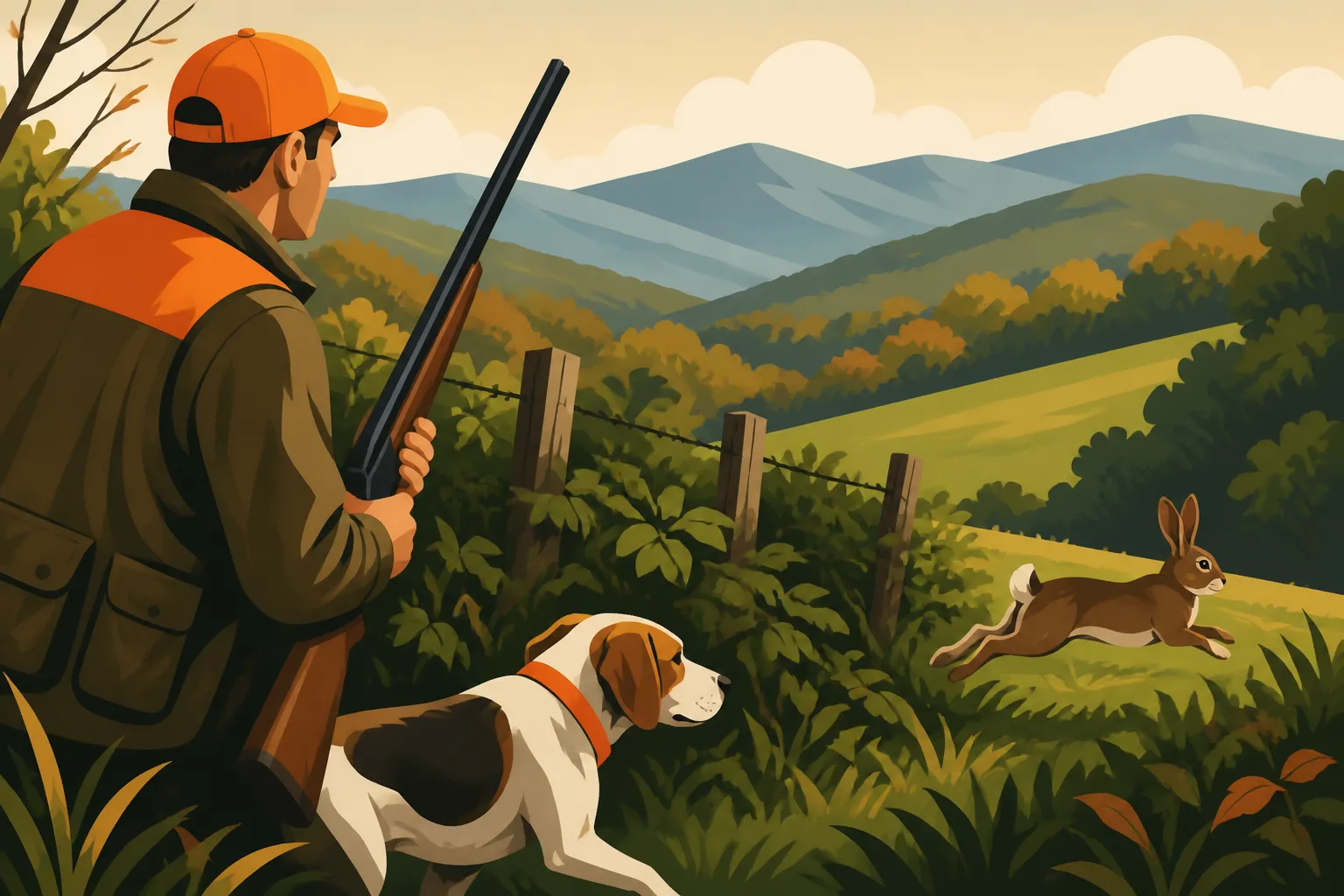
When hunting with beagles, the strategy shifts. You're no longer just pushing; you're listening. The dogs will pick up a rabbit's scent and "jump" it, meaning they'll start barking on the trail, often with a distinct "chop" when they're hot on the scent. Once a rabbit is jumped, it typically runs in a large circle, often returning to its original starting point or a nearby piece of cover it knows well. Hunters position themselves strategically around the fencerow or thicket, listening to the dogs, and anticipating where the rabbit will reappear. It's a thrilling game of cat and mouse, or rather, dog and rabbit. Our detailed guide on Running Beagles on West Virginia Cottontails offers even more in-depth information on this rewarding method. Basset Hounds, with their exceptional noses and slower pace, can also be very effective, carefully untangling scent trails and pushing rabbits out of the thickest cover.
Navigating Public and Private Land Fencerows
West Virginia offers diverse opportunities for rabbit hunting, but understanding the rules and etiquette for both public and private land is crucial. While public lands provide open access, private lands often hold undisturbed populations of rabbits, especially along their fencerows.
Gaining Private Land Access for Fencerow Hunting
Securing permission to hunt private land is often the best way to find excellent rabbit hunting. Farmers and landowners, especially those with agricultural fields, are often amenable to rabbit hunters because rabbits can cause crop damage. However, you can't just assume. Always ask first.
Start by identifying potential properties using maps, including those on services like GoHunt that show property boundaries and ownership information. Then, approach landowners respectfully, well in advance of the season, and during non-peak hours when they're not busy with farm work. Dress neatly, introduce yourself, state your intention clearly, and be polite. Offer to share your harvest, help with a small chore, or simply leave your contact information. Emphasize that you are a responsible hunter and will respect their property, close gates, and be mindful of livestock. Mentioning that you'll be focusing on nuisance animals like rabbits can also be a selling point. Our guide on Knocking on Doors in Eastern Panhandle Farm Country provides detailed advice on how to approach landowners and secure permission, tips that apply universally across West Virginia.
Finding Fencerows on West Virginia Public Land
West Virginia boasts a significant amount of public hunting land, including national forests and numerous Wildlife Management Areas (WMAs). While these areas might not always have the classic farm-field fencerows, many still feature similar linear cover types that function just like fencerows for rabbits.
Look for edges between clear-cuts and mature timber, old logging roads lined with brush, powerline cuts, or the edges of reclaimed surface mines. These areas often develop the dense, low-growing vegetation that rabbits prefer. Even within large tracts of timber, you can find "micro-fencerows" along old stone walls or fallen timber lines that create dense linear cover. Use online mapping tools provided by the West Virginia Division of Natural Resources (WVDNR) or services like GoHunt to identify these transitional zones. While the competition might be higher on public land, diligent scouting can reveal hidden gems. Always remember to check West Virginia Small Game Season Rules for specific dates and bag limits applicable to WMAs and other public hunting grounds.
Safety and Etiquette in the Fencerow
Hunting is a privilege, and with it comes the responsibility to ensure safety for yourself and others, and to maintain ethical conduct. This is especially true when hunting in fencerows, which can be near homes, roads, and other hunters.
Staying Safe: Blaze Orange and Situational Awareness
Safety is paramount, and wearing blaze orange is not just a good idea, it's often legally required in West Virginia during certain seasons. Even when it's not legally mandated for small game, it's highly recommended to wear a blaze orange vest or hat, especially when hunting with others or in areas where deer hunters might be present. This drastically increases your visibility to other hunters and ensures you're easily spotted if you take a fall in thick cover. You can confirm the specific requirements by checking How Much Blaze Orange West Virginia Requires.
Always know your target and what is beyond it. Fencerows often run alongside roads, buildings, or other private property where you do not have permission to hunt. Be acutely aware of your surroundings, especially your backstop, before taking any shot. Never shoot at sound or movement; positively identify your target as a rabbit before pulling the trigger. Keep your gun's safety on until you're ready to shoot, and always carry your firearm in a safe manner, muzzle pointed in a safe direction.
Respecting Property and Wildlife: Ethical Hunting
Beyond safety, ethical hunting practices are essential for preserving the tradition and ensuring continued access. When hunting on private land, strictly adhere to the landowner's rules. This includes sticking to the agreed-upon hunting areas, closing all gates, not disturbing livestock, and leaving no trash behind. Being a good steward of the land is the best way to maintain good relationships with landowners.
For all hunting, whether public or private, practice fair chase principles. Don't take shots that are beyond your effective range, and always strive for clean, humane kills. If you wound a rabbit, make every effort to track and recover it. Respect bag limits, which are in place to ensure sustainable wildlife populations. Checking West Virginia Small Game Season Rules will always provide the most up-to-date information on limits and seasons. By following these guidelines, you're not just a successful hunter; you're a responsible conservationist and a good ambassador for the hunting community.
Table: Common Rabbit Signs in West Virginia Fencerows
| Sign Type | Description | Indicates | Season Best Observed |
|---|---|---|---|
| Droppings | Small (1/4"-3/8"), round, dark pellets found in clusters. | Active feeding, resting, or travel corridor usage. Fresher = more recent. | Year-round |
| Cuttings | Cleanly clipped plant stems or bark, often at ground level. | Rabbit feeding activity. Look for preferred plants like clover or tender shoots. | Late Summer to Winter |
| Tracks | Distinctive pattern: two large hind prints leading, two smaller front prints behind. | Recent rabbit movement, especially visible after snow or light rain. | Fall/Winter |
| Runs/Trails | Small, worn paths through dense vegetation in the fencerow. | Established travel routes for rabbits moving between cover and food. | Year-round, clearer in dormant season |
| Beds | Shallow depressions in thick grass or under brush, often lined with fur. | Rabbit resting or bedding areas. Less common to find directly. | Year-round, especially colder months |
| Burrows/Holes | Small holes (4-6" diameter) in banks or under roots. | Escape routes or dens for protection, though rabbits primarily use dense surface cover. | Year-round |
Disclaimer
Hunting carries inherent risks, including but not limited to injuries from firearms, falls, or wildlife encounters. Always consult the latest regulations from the West Virginia Division of Natural Resources (WVDNR) before hunting. This guide is for informational purposes only and does not supersede official hunting laws or safety guidelines. Practice responsible firearm handling, wear appropriate safety gear, and ensure you have all required licenses and permits.