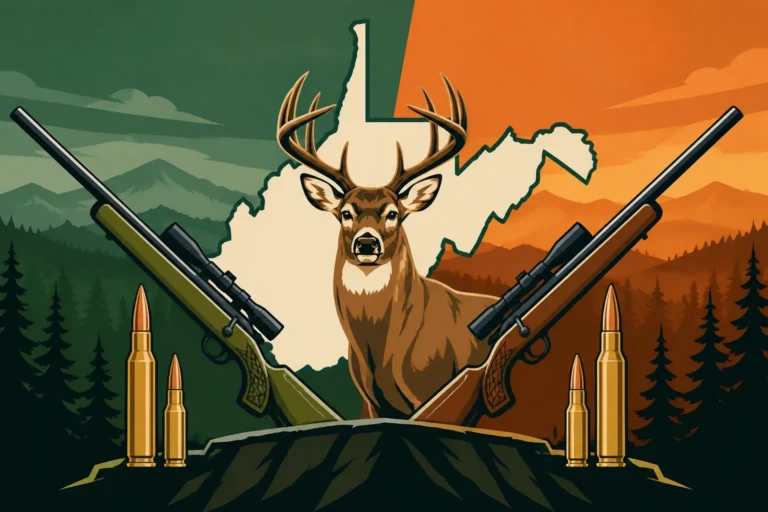
Best Rifle Caliber for West Virginia Deer
Choosing the right rifle caliber for deer hunting in West Virginia can feel like a real head-scratcher. With all the options out there, from classic old-timers to sleek new designs, it’s easy to get overwhelmed trying to figure out what will perform best on our rugged mountains, through thick timber, and across those occasional open fields. This guide is here to cut through the noise, helping you understand which calibers are truly suited for the Mountain State’s whitetails and why, so you can head into the woods with confidence.
Understanding West Virginia Deer Hunting Terrain and Conditions
West Virginia isn't like hunting the wide-open plains of the Midwest or the vast timber of the Pacific Northwest. Our landscape is truly unique, a beautiful but challenging mix of steep grades, dense forest, and pockets of agricultural land. This diverse topography plays a huge role in determining what rifle caliber might be "best" for your hunt.
The Mix of Steep Ridges and Thick Cover
Picture this: you're scaling a steep ridge in Monongahela National Forest, trying to get into a saddle between two peaks. One minute, you're looking into a rhododendron thicket where you can barely see 30 yards, and the next, you break out onto a clear-cut edge or a gas well pad clearing where a shot could easily stretch to 200 yards. This is the reality of hunting West Virginia. Most of your shots are going to be inside 100 yards, often much closer, especially if you're Still-Hunting Cranberry WMA Ridges or working through dense laurel. However, there are certainly places, particularly in the Eastern Panhandle around farmlands or along powerline cuts, where longer shots are absolutely a possibility. A caliber that can handle both scenarios, or at least one that excels at the most common scenario you'll encounter, is key.
Shot Distances and Target Sizes
West Virginia whitetails, while robust, aren't giant elk. A well-placed shot with a moderately powerful cartridge is more than sufficient. The critical thing isn't brute force, but sufficient energy and bullet construction to penetrate and do its job within the deer's vital zone. Given the prevalence of shorter shots, over-penetration or excessive bullet fragmentation can sometimes be a concern, though rarely a major one. What you really want is a bullet that expands reliably at lower velocities (for close shots) and can still hold together for deeper penetration on a quartering-away shot. Understanding these nuances helps you choose not just a caliber, but also the right ammunition for that caliber.
The Impact of Cold and Wet Weather
Our seasons can be brutal, from crisp, clear fall days to freezing rain and heavy snow in December. Cold-Weather Sitting Strategy in the Mountains demands good gear, but it also means you need a rifle and caliber you can handle confidently even when your hands are numb or your vision is obscured by falling precipitation. A rifle that's easy to manipulate, doesn't kick like a mule, and that you've practiced extensively with in less-than-ideal conditions will always be more effective than a powerhouse magnum you're afraid to shoot. When it's wet, you want a bullet that won't deform prematurely passing through light brush, though no bullet is truly "brush-bucking." Reliability in adverse conditions is a testament to practice and proper gear maintenance, including your ammunition choice.
Popular Rifle Calibers and Their Suitability for West Virginia Deer
Let's talk about the specific tools for the job. There's a reason some calibers have been around for generations, and there's also a place for the newer, high-tech options.
Classic Brush Guns and Their Enduring Appeal
For decades, if you hunted West Virginia, you probably did it with a lever-action .30-30 or a similar "brush gun." There's a reason for that. These rifles are often light, quick to shoulder, and deliver plenty of punch for deer at typical woods ranges.
- .30-30 Winchester: This old warhorse is still an absolute deer killer. Perfect for shots under 150 yards, which, let's be honest, covers the vast majority of deer encounters in our thick woods. It's got moderate recoil, making it easy to shoot accurately, and the bullet performs wonderfully on West Virginia whitetails. If you're hunting in heavy cover, like Hunting a Funnel Between Two Hollows or tracking through thick laurel, a .30-30 with a good soft-point bullet is incredibly effective. It's a fantastic choice for deer drives with three or four hunters where quick, close shots are common.
- .45-70 Government: While perhaps a bit much for deer, the .45-70 is another classic lever-action cartridge that has a dedicated following. It hits incredibly hard at close range and is sometimes favored for its versatility if a hunter might also pursue black bear in the same area. It's certainly a viable option for deer, but many hunters find its recoil a bit stout for extended shooting sessions, which can impact accuracy.
Versatile All-Around Performers
These calibers offer a great balance of power, trajectory, and recoil, making them excellent choices for nearly any West Virginia deer hunting scenario. They can handle a close shot in the timber but also reach out if you find yourself on a Glassing a Powerline Cut at Last Light.
- .30-06 Springfield: The venerable .30-06 is arguably the most versatile hunting cartridge ever devised. It can handle anything that walks in North America, including our deer and bear. With a wide range of bullet weights available, you can tailor your load to anything from thick woods to more open country. Recoil is manageable for most adult shooters, and its long-range capabilities mean you're covered if that deer steps out at 250 yards. It's a reliable workhorse.
- .270 Winchester: Often debated against the .30-06, the .270 Winchester is a fantastic deer cartridge, known for its flat trajectory and excellent terminal performance on whitetails. It shoots a bit flatter than the .30-06 with lighter bullets, making it a favorite for those longer shots. Recoil is usually a tad lighter than the .30-06, which can translate to better accuracy for some shooters. It's plenty of gun for any deer in West Virginia and very capable for black bear as well.
- .308 Winchester: If the .30-06 is the classic, the .308 is its slightly more compact, equally capable cousin. It delivers similar performance to the .30-06 in a shorter action, leading to lighter, handier rifles. Recoil is often perceived as slightly less than the .30-06, and it's renowned for its inherent accuracy. For West Virginia hunting, the .308 is an outstanding choice, whether you're still-hunting or sitting in a treestand on a steep Allegheny ridge. This caliber is a common answer to ".308 Versus .270 for Whitetails" discussions, both being excellent choices.
Modern Cartridges for Precision and Mild Recoil
The hunting world has seen some excellent advancements in cartridge design, offering impressive ballistic performance with less recoil. These are especially great for new hunters, youth, or anyone who prefers a softer-shooting rifle without sacrificing effectiveness.
- 6.5 Creedmoor: This relative newcomer has taken the hunting world by storm, and for good reason. The 6.5 Creedmoor is incredibly accurate, has a very flat trajectory, and perhaps most importantly, offers very mild recoil. Despite its smaller diameter, the long, high ballistic coefficient bullets of the 6.5 Creedmoor carry plenty of energy to dispatch West Virginia whitetails effectively, even out to longer ranges. It's an excellent choice for hunting Steep Allegheny Ridges where precise shot placement can be critical due to uneven terrain. Many hunters find it ideal for both deer and smaller black bears.
- 7mm-08 Remington: This is a fantastic, often overlooked, cartridge that offers a superb blend of power and mild recoil. Essentially a .308 necked down to accept 7mm bullets, it provides a flatter trajectory than the .308 with less recoil, making it a joy to shoot. The 7mm bullets have excellent sectional density, meaning they penetrate very well on deer and even larger game like black bear. For someone looking for a versatile, easy-to-shoot cartridge that's deadly on West Virginia whitetails, the 7mm-08 is a stellar option.
- .243 Winchester: While on the lighter side, the .243 Winchester is a popular deer cartridge, especially for youth and smaller-framed hunters due to its exceptionally light recoil. With proper bullet choice (heavier, bonded bullets are best for deer), it is certainly capable of taking West Virginia whitetails cleanly. However, shot placement becomes even more critical with this caliber, and many experienced hunters prefer something with a bit more punch for larger bucks or less-than-ideal angles. It often comes up in discussions like "Is a .243 Enough for West Virginia Whitetails?", and the answer is usually "yes, if you shoot it well and pick your shots."
Straight-Wall Cartridges for Specific Zones
West Virginia currently has fairly liberal firearms regulations for deer hunting, meaning most traditional rifle calibers are perfectly legal statewide. Unlike some other states that have specific "straight-wall cartridge only" zones for deer hunting, West Virginia doesn't generally impose such restrictions. So, while cartridges like the .350 Legend or .450 Bushmaster are gaining popularity elsewhere for their straight-wall compliance, they aren't typically a requirement here. However, they are still legal to use and can be very effective, often in lever-action or bolt-action platforms. They provide serious knockdown power at closer ranges, similar to a shotgun slug, and have mild to moderate recoil depending on the specific cartridge. If you prefer the aesthetics or feel of these calibers, they will certainly do the job on a West Virginia whitetail. You can find more details about general rules in West Virginia Legal Firearms for Deer Hunting.
Here’s a quick overview of some popular calibers for West Virginia deer:
| Caliber | Typical Deer Range (Yards) | Recoil (Relative) | Pros for WV Deer | Cons for WV Deer |
|---|---|---|---|---|
| .30-30 Winchester | 50-150 | Low-Moderate | Excellent for thick cover, fast handling, sufficient power, classic feel | Limited effective range compared to modern cartridges |
| .243 Winchester | 50-250 | Very Low | Extremely mild recoil, great for youth/recoil-sensitive, very accurate | Requires precise shot placement, bullet choice is critical for penetration |
| 7mm-08 Remington | 50-300+ | Low-Moderate | Excellent balance of power/recoil, flat trajectory, great penetration | Less common than .308/.270, ammo might be slightly less available |
| .308 Winchester | 50-300+ | Moderate | Accurate, compact rifles, excellent terminal performance, widely available ammo | Can be slightly less flat-shooting than .270/6.5 Creedmoor at very long ranges |
| .270 Winchester | 50-350+ | Moderate | Flat trajectory, great for longer shots, plenty of power for deer/bear | Recoil can be noticeable for some, especially in lighter rifles |
| .30-06 Springfield | 50-350+ | Moderate-High | Extremely versatile, powerful, wide range of bullet weights, reliable performance | Recoil can be stout for some, rifles can be longer/heavier |
| 6.5 Creedmoor | 50-300+ | Low | Highly accurate, mild recoil, excellent ballistic performance for its size | Newer cartridge, some traditionalists are skeptical, requires good bullet construction |
Factors Beyond Caliber: Shot Placement and Bullet Construction
While the caliber itself is important, it's really just one piece of the puzzle. Two other elements are absolutely critical for ethical and effective deer hunting: where you hit the deer, and what the bullet does once it gets there.
The Supreme Importance of Shot Placement
I cannot stress this enough: shot placement trumps caliber every single time. A perfectly placed shot with a .243 Winchester is infinitely more effective than a poorly placed shot with a .30-06. Knowing your rifle, understanding bullet trajectory, and practicing consistently are far more important than squeezing out a few extra foot-pounds of energy. In the varied and often challenging terrain of West Virginia, being able to put your bullet precisely where it needs to go, whether it’s a quick shot through a small window in the timber or a steady hold across a hollow, is what ensures a clean, ethical kill. No matter how powerful your rifle is, if you don't hit the vitals, you're likely going to have a long, difficult blood trail, if you recover the deer at all. Focusing on marksmanship, perhaps by using scouting tools like GoHunt to visualize shot opportunities, will pay dividends.
Matching Bullet Type to the Game
Once you’ve picked your caliber, don’t just grab the cheapest box of ammo off the shelf. Bullet construction is a huge factor in terminal performance. For West Virginia whitetails, you want a bullet that will expand reliably upon impact to create a good wound channel, but also retain enough weight and integrity to penetrate deeply into the vitals, especially if you encounter a quartering shot.
- Soft-Point/Cup-and-Core Bullets: These are traditional hunting bullets that perform well at typical deer hunting velocities. They expand readily and transfer energy efficiently. For calibers like the .30-30, these are still excellent.
- Bonded Bullets: Brands like Federal Fusion, Nosler AccuBond, and Hornady InterBond use a process to bond the lead core to the copper jacket. This helps the bullet retain more weight, leading to deeper penetration, which can be a huge advantage on larger deer or less-than-ideal shot angles.
- Monolithic/Copper Bullets: Bullets made entirely of copper, like Barnes TSX or Hornady CX, retain nearly 100% of their weight, providing exceptional penetration. They expand widely to create a good wound channel. These are excellent choices, particularly for hunters who prefer to reduce lead in venison or for those seeking maximum penetration.
- Controlled Expansion: Many modern bullets are designed for "controlled expansion," meaning they expand to a certain diameter but then hold together to drive deep. This is often the ideal scenario for deer, providing both energy transfer and penetration.
Always test different bullet types in your rifle to see what shoots most accurately. What performs well in one rifle might not in another.
Recoil Management and Shooter Confidence
Let's be real: recoil can affect your shooting. A flinch is an unconscious reaction to anticipated recoil, and it's a deer hunter's worst enemy. If you're using a rifle that kicks so hard you dread pulling the trigger, you're not going to shoot it well. This is where calibers like the 6.5 Creedmoor, 7mm-08 Remington, or even a .243 shine. Their mild recoil allows for more comfortable practice sessions, which in turn builds confidence and improves accuracy.
Even with more powerful calibers like the .30-06 or .270, ensure your rifle fits you well, and consider adding a good recoil pad or a muzzle brake if recoil is an issue. The goal isn't to pick the most powerful gun, but the most powerful gun you can shoot accurately and comfortably. A hunter with a mild-recoiling rifle who can consistently place shots precisely is far more lethal and ethical than a hunter with a magnum that they flinch from every time. Don't be afraid to choose a "smaller" caliber if it means you'll hit your target.
Making Your Final Choice and Ethical Considerations
So, how do you finally decide which caliber is truly best for you and your West Virginia deer hunting adventures? It boils down to a blend of personal preference, capability, and responsible hunting.
Personal Comfort and Practice
The single "best" rifle caliber for West Virginia deer hunting is the one you are most proficient and comfortable with. This isn't about what your buddy shoots or what the latest hunting magazine raves about. It's about what feels right in your hands, what you can shoot accurately under pressure, and what you’ve practiced with enough to trust completely. If you can consistently put your shots into a 3-inch group at 100 yards with your chosen rifle and ammunition, you're in great shape for hunting West Virginia whitetails. Don't underestimate the power of confidence that comes from regular practice, perhaps utilizing mapping tools like GoHunt to identify safe shooting ranges or scouting spots.
Consider things like:
- Recoil tolerance: As discussed, if it hurts to shoot, you won't shoot it well.
- Rifle weight and size: Are you carrying it up and down steep ridges all day, or sitting in a blind? A lighter, handier rifle might be preferable for active hunters. Slings for a Long Monongahela Forest Walk can also make a difference.
- Familiarity: Do you already own a rifle in a certain caliber that you know and love? Often, that's your best bet.
Ethical Considerations for Clean Kills
As responsible hunters, our primary goal is a quick, ethical kill. This means using a caliber and bullet combination that delivers sufficient energy to dispatch a deer efficiently. While a .223 Remington can kill a deer, most experienced hunters in West Virginia would advise stepping up to something with more bullet mass and energy, like a .243 Winchester at minimum, and preferably something in the .270, 7mm-08, .308, or .30-06 range. These calibers provide a greater margin of error in shot placement and bullet performance, ensuring that even if the shot isn't absolutely perfect, the deer is still likely to be recovered quickly.
It's about having enough power to do the job without being excessive. The deer in West Virginia are tough, but they aren't bulletproof. Adequate penetration, expansion, and energy transfer are the keys to a clean kill. Remember, a bigger hole doesn't always mean a deader deer; a well-placed, expanding bullet is what truly matters.
Checking Regulations and WMA Rules
Always, always double-check the current West Virginia hunting regulations before heading afield. While general rifle calibers for deer are pretty consistent, rules can change. For example, some specific managed hunts or wildlife management areas (WMAs) might have unique restrictions. It's rare, but it happens. Make sure your chosen caliber and ammunition are compliant. You can usually find this information readily on the official West Virginia Division of Natural Resources (WVDNR) website or in their annual hunting regulations summary. Staying informed ensures you're hunting legally and responsibly. Knowing West Virginia Legal Firearms for Deer Hunting is part of being a prepared hunter.
Disclaimer
This article is for general informational purposes only and does not constitute professional advice. Laws, prices and regulations vary by location and change over time. Consult a qualified professional for guidance on your specific situation.