Shot Size for Grouse and Woodcock
Hunting grouse and woodcock in the thick cover of West Virginia is a true test of a hunter's skill and reflexes, and a critical part of success lies in choosing the right shot size for these notoriously fast-flushing birds. It’s a common frustration for newcomers, and even seasoned hunters debate the merits of various loads. This guide will walk you through the nuances of shot selection, helping you make informed decisions for humane kills and more successful days afield in our beautiful mountains and hollows.
The Fast-Paced World of West Virginia Upland Hunting
Let's be honest, hunting grouse and woodcock isn't a leisurely walk in the park. These birds are masters of concealment and explosive flight, often found in dense, unforgiving cover that challenges both hunter and dog. The unique environment of West Virginia's uplands dictates a different approach to gear, and that absolutely includes your choice of shotgun ammunition.
Why Upland Birds are Different
Ruffed grouse are the kings of the Allegheny Highlands, exploding from thick laurel and rhododendron patches with a thunderous roar that can startle even the steadiest hunter. Your shots are usually fleeting, often within 15 to 30 yards, and frequently through a maze of branches and saplings. It's not like pass-shooting doves or sitting over a grain field for geese; these birds demand quick reflexes and an understanding of what your shotgun is doing at close range. If you've spent any time Grouse Hunting Allegheny Highlands Cover, you know exactly what I'm talking about.
Woodcock, on the other hand, are smaller, with an erratic, almost bat-like flight pattern. You'll typically find them in damp, tangled alder runs and creek bottoms, often closer than grouse, sometimes practically at your feet. Their flight is less explosive but equally challenging due to their unpredictable acrobatics. Hunting woodcock requires an even denser pattern at closer ranges, where even a slight opening in your pattern can mean a clean miss. The thickets where you find woodcock, particularly when Woodcock Hunting West Virginia Alder Runs, are infamous for eating pellets.
The Ethical Shot for Upland Birds
Beyond just hitting the bird, our responsibility as hunters is to ensure a swift, humane kill. This means delivering enough pellets with sufficient energy to the bird's vital areas. When your shot size is too large, you might not get enough pellets in the pattern to ensure multiple hits, leading to "holes" in your pattern that a bird can fly through unscathed, or worse, be hit by only a few pellets that injure rather than kill. Conversely, if your shot is too small for the range or the bird, it might lack the kinetic energy to penetrate adequately, leading to cripples.
Finding that sweet spot—the balance between pattern density (number of pellets) and individual pellet energy—is what we're striving for. For upland birds, given their relatively small size and the close-range nature of the shots, pattern density often takes precedence, but not at the expense of penetration. We want to humanely anchor that bird, not just sprinkle it with lead.
Understanding Shot Size for Grouse and Woodcock
Now let's get down to the brass tacks: what shot size is going to give you the best chance for success and an ethical kill on a West Virginia grouse or woodcock? When we talk about shot size, remember that the smaller the number, the larger the individual pellet.
Common Shot Sizes and Their Characteristics
For upland birds, most hunters will gravitate towards fine shot, typically in the range of #7.5, #8, or #9. Each has its place, and understanding their characteristics is key to making the right choice.
-
#7.5 Shot: This is often considered a good all-around upland load, especially for slightly longer shots or for grouse that might be a bit more robust. It offers a decent balance of pellet count and individual pellet energy. You'll have fewer pellets in a given shell compared to #8 or #9, but each pellet carries more punch, which can be advantageous if you find yourself taking a shot at the upper end of typical upland range, say 30-35 yards, or if your local grouse tend to be larger-bodied. For some hunters, a fast-moving grouse might feel like it needs that extra wallop.
-
#8 Shot: This is arguably the most popular and often recommended shot size for grouse. It strikes an excellent balance, providing a high pellet count for dense patterns while still retaining enough energy to effectively dispatch a grouse at typical ranges of 15-30 yards. Most hunters find #8 shot delivers that perfect blend of density and penetration needed for those quick, close-range shots through the timber. It's a reliable choice that has anchored countless birds in the thick covers we hunt. If you're new to Upland Guns for Highlands Grouse Cover, starting with #8 is a solid bet.
-
#9 Shot: When it comes to woodcock, #9 shot truly shines. These birds are smaller and are usually taken at much closer ranges, often 10-20 yards. With #9 shot, you get the maximum pellet density, creating a very tight cloud that is perfect for enveloping a small, erratically flying woodcock. While individual #9 pellets carry less energy, the sheer number of pellets ensures multiple hits on the smaller bird, leading to a quick, humane kill. It can also be excellent for very close-flushing grouse, though some hunters feel it lacks the punch for a larger, tougher bird beyond 20-25 yards.
To summarize the common choices:
| Shot Size | Pellets per Ounce (Approx.) | Typical Range (Yards) | Primary Use | Pros | Cons |
|---|---|---|---|---|---|
| #7.5 | 345 | 25-35 | Grouse, larger birds | More energy per pellet, better penetration | Fewer pellets, can create pattern holes |
| #8 | 410 | 15-30 | General Upland, Grouse | Excellent balance of density and energy | Might lack penetration on longer shots |
| #9 | 585 | 10-25 | Woodcock, very close | Maximum pattern density | Low energy per pellet, limited range |
Why Pellet Count Matters Most
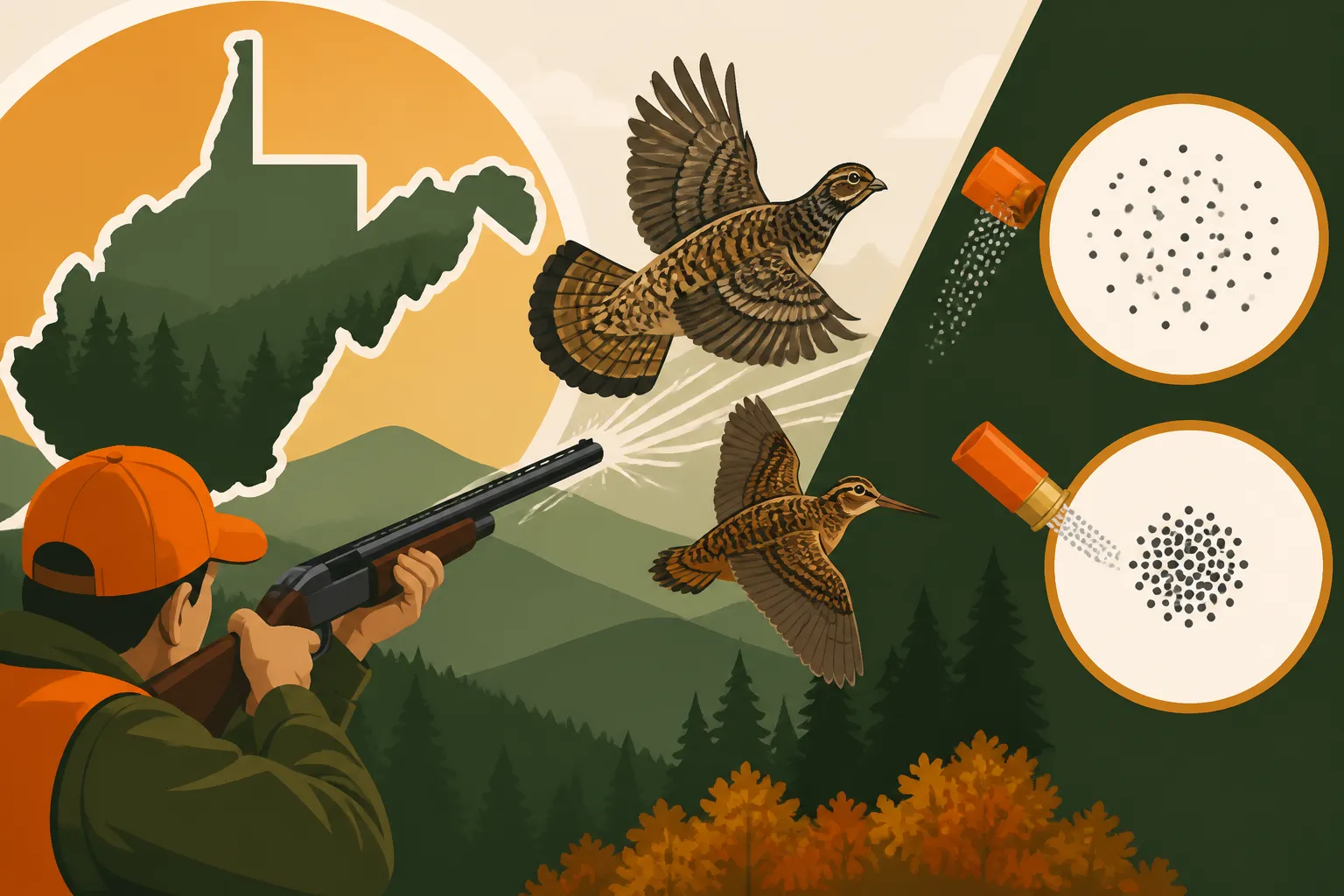
In upland hunting, particularly for birds flushing wild and weaving through dense cover, hitting the vitals is paramount. You're not looking for one magic pellet to do the job; instead, you need a dense cloud of shot that increases the probability of multiple hits on a small, fast-moving target. The more pellets in your pattern, the higher the chance of multiple pellets striking the bird, ensuring a humane kill.
Dense cover also plays a role. Pellets can be deflected by twigs, leaves, and small branches. A pattern with a higher pellet count offers a greater margin of error and a better chance that enough pellets will make it through the obstacles to reach the bird. When you're making quick, instinctive shots, having a forgiving, dense pattern is your best friend. Modern shells from reputable brands often use specialized wads or buffered shot to maintain tighter, more consistent patterns, even with fine shot. When I'm trying to decide between different shell loads or brands, I often check resources like GoHunt to see what other upland hunters are saying about performance in similar conditions. Their field reports can offer valuable insight into how different loads pattern out of various shotguns and chokes.
Choke and Patterning Considerations
Choosing the right shot size is only half the battle. To truly optimize your upland shotgun setup, you absolutely must consider your choke selection and, perhaps most importantly, pattern your shotgun. Neglecting these steps is like buying a Ferrari but never checking the tire pressure – you're missing out on serious performance and risking a breakdown.
Matching Shot to Choke
For the vast majority of West Virginia upland hunting, especially for grouse and woodcock, open chokes are king. We're talking about Cylinder, Skeet, or Improved Cylinder. These chokes allow the shot pattern to open up quickly, providing a wider spread at the close ranges where most grouse and woodcock are flushed and shot. This wider pattern increases your chances of hitting a fast-flushing bird before it disappears behind the next tree or into a thicket.
Using a tighter choke, like Modified or Full, with fine shot at close range can actually be detrimental. Instead of a nice, even spread, you might end up with a very dense core of shot and large gaps or a "doughnut" effect in the pattern, making it harder to connect. The goal is to achieve an even, widespread pattern at 15 to 25 yards, which is where most of your shots will occur. An open choke with #8 or #9 shot generally achieves this beautifully. Many upland hunters swear by a double-barrel shotgun set up with an Improved Cylinder in the first barrel and a Light Modified or Modified in the second, offering versatility for both close and slightly longer shots. This is a common setup for hunters using 20 Gauge Doubles for Aspen Cover.
The Importance of Patterning Your Shotgun
I cannot stress this enough: you have to pattern your shotgun with your chosen loads. Every shotgun is a unique beast, and what shoots well out of one gun might not be ideal for another, even if they're the same make and model. Just like you wouldn't go deer hunting without zeroing your rifle, you shouldn't go upland hunting without knowing how your shotgun patterns.
To pattern your gun, grab some large sheets of paper or cardboard – at least 30×30 inches, preferably larger. Set them up at typical upland ranges, say 20 and 30 yards. Shoot at the center of the target with your preferred choke and a variety of your chosen shot sizes and brands. You're looking for an even distribution of pellets across the target, with no noticeable holes or gaps that a bird could slip through. Pay attention to the density of the pattern and how consistently it centers around your point of aim. This process can be a bit tedious, I know, but it’s invaluable for building confidence in your setup. Sometimes I'll even consult a platform like GoHunt for tips on patterning or to see if other hunters have found a particular load performs exceptionally well out of a certain choke. Their user reviews and expert articles often dive deep into the performance of specific ammunition brands. Don't be afraid to try different manufacturers of the same shot size; sometimes a particular brand's wad or powder charge just works better with your specific gun. This attention to detail can drastically improve your success rate and ensure clean kills.
Field Scenarios and Making Your Choice
Making the final call on shot size often comes down to the specific conditions you anticipate and a bit of personal preference. Knowing how to adapt in the field, or at least how to prepare for a "mixed bag" day, can make all the difference.
The "Mixed Bag" Approach
It’s a common scenario in West Virginia: you might be hunting prime grouse cover, but you know there are also woodcock in the damp bottomlands nearby. Or perhaps you're walking an area where both species are intermingled. What do you do?
In this situation, many hunters opt for a versatile middle-ground load, typically #8 shot. As discussed, #8 shot provides an excellent balance of pellet density and energy, making it effective for both grouse and woodcock at close-to-medium ranges. While it might be a bit more than strictly necessary for a woodcock at 10 yards, it's certainly preferable to being under-gunned for a grouse flushing hard at 25 yards. Another strategy, especially if you're using a double-barrel shotgun, is to load different shells in each barrel. You might put a #9 shot in the first barrel for those super close woodcock or tight-flushing grouse, and then follow up with a #8 or even a #7.5 in the second barrel for a longer follow-up shot or a bird that gets out a bit further. This strategy, combined with understanding your Choke Choice for Fast Flushes, offers maximum flexibility.
Trusting Your Setup and Confidence
Ultimately, the best shot size is the one you have practiced with, patterned, and have confidence in. There's no magic bullet, only diligent preparation. Practice quick mounts and swings with your shotgun, mimicking the rapid-fire action of an upland flush. Know your effective range with your chosen load – don't try to stretch shots beyond what your pattern can humanely accomplish. Many upland hunters find wearing a good Upland Vests With Water Capacity is essential, not just for carrying shells but for being comfortable on long walks.
Don't overthink it in the heat of the moment. The most important thing is to get the gun on the bird and make a clean shot. If you've done your homework, patterned your gun, and chosen a reliable load, you can step into the cover with confidence, knowing you're well-prepared for whatever our wild West Virginia uplands throw your way. Before I head into the woods, I like to double-check my gear choices and read reviews on trusted sites like GoHunt to make sure I'm confident in my setup, from my Boots for Walking West Virginia Ridges to my choice of shells.
Disclaimer
This article is for general informational purposes only and does not constitute professional advice. Laws, prices and regulations vary by location and change over time. Consult a qualified professional for guidance on your specific situation.