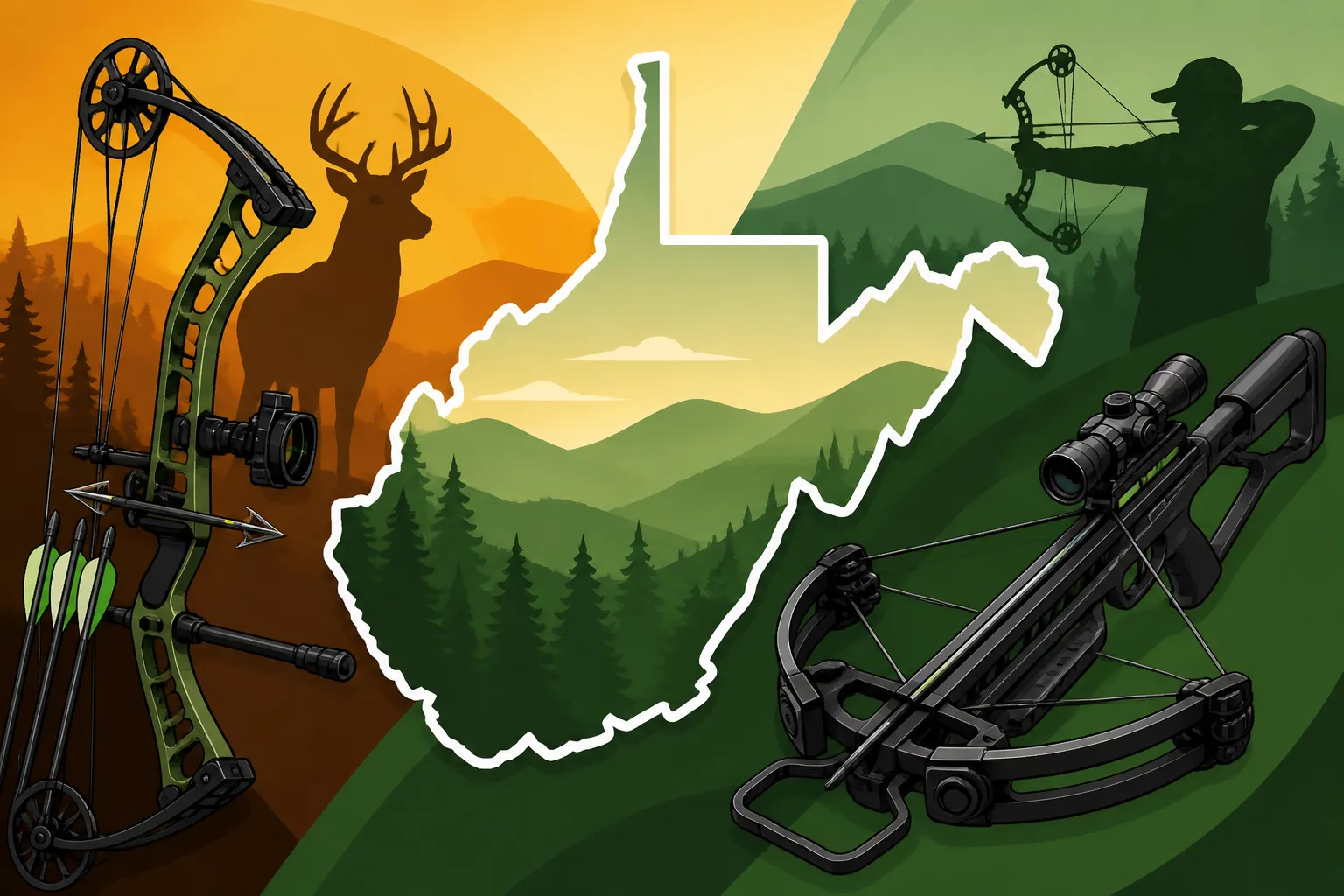
Bow and Crossbow Setups for West Virginia
Hunting in West Virginia, especially with a bow or crossbow, presents a unique set of challenges that can leave even seasoned hunters scratching their heads. The Mountain State's rugged terrain, unpredictable weather, and dense cover demand specific gear choices and setup strategies. This comprehensive guide will walk you through everything you need to know to optimize your bow or crossbow for success in West Virginia's diverse hunting environments, helping you navigate those steep hollows and thick woods with confidence.
Understanding West Virginia's Terrain and Its Impact on Archery
West Virginia isn't called the Mountain State for nothing. Its topography is a wild mix of steep inclines, deep hollows, and dense, unforgiving cover. This isn't flatland hunting where long-range shots are the norm. Here, encounters are often close, fast, and demand precision under pressure. Understanding these unique landscape features is the first step in setting up your archery equipment for success.
Steep Ridges and Hollows
The sheer verticality of West Virginia's hunting grounds is arguably its most defining characteristic. You'll spend a lot of time climbing, descending, and traversing steep slopes, and this drastically affects how you carry your gear, how you set up your shot, and even how far an arrow might travel. An arrow shot slightly downhill or uphill behaves differently than one fired on flat ground, requiring adjustments to your aiming point, even at relatively close distances. Moreover, quiet movement is paramount; a bow or crossbow that constantly bumps against brush or clanks with loose accessories will quickly give away your position.
Navigating these slopes often means walking in silence for miles, and heavy, cumbersome gear quickly becomes a liability. Your bow needs to be light enough to carry all day without undue fatigue, yet robust enough to handle the inevitable bumps and scrapes it will endure. When setting up a treestand on a steep ridge, your shooting lanes might be drastically different than what you're used to, with downward angles being very common. Practicing shots from elevated positions and varying angles is crucial to prepare for these real-world scenarios.
Considering the unpredictable nature of scent and thermals on steep ground is also key. Wind and thermals on a steep ridge can swirl in ways that seem to defy logic, often carrying your scent directly to game you thought was safely downwind. Wind and Thermals on a Steep Ridge delves into this in more detail, but your setup should allow for quick, quiet adjustments if you need to shift position.
Dense Cover and Laurel Thickets
West Virginia is renowned for its thick, almost impenetrable cover, particularly the dense laurel and rhododendron thickets that blanket many mountainsides. These areas provide excellent bedding and security cover for deer and bears, but they can be a nightmare for bowhunters. Shots are often measured in yards, not tens of yards, and clean shooting lanes can be hard to come by. A compact bow or crossbow can be a huge advantage here, allowing you to maneuver through brush without catching limbs or string.
When hunting these dense areas, your shooting opportunities often arise quickly, in small windows through the foliage. This means your draw must be smooth and silent, and your sight picture acquired almost instantaneously. Any accessory that snags or creates noise is detrimental. Think minimalist – every piece of gear on your bow or crossbow should serve a direct purpose without adding bulk or potential for interference.
Furthermore, the dense cover impacts arrow flight. While a perfectly clear shooting lane is ideal, often you're shooting through small gaps. Your arrow and broadhead combination needs to be forgiving and stable, minimizing any deflection if it glances a twig. This is where precise tuning and broadhead selection become incredibly important, ensuring your arrow flies true despite potential minor contact.
Weather Fluctuations
The Mountain State's weather is famously fickle. A warm, sunny morning can quickly turn into a cold, rainy, or even snowy afternoon, especially during the archery season that stretches into December. Your bow and crossbow setup needs to be able to withstand these rapidly changing conditions without compromising performance. This means waterproof components, durable finishes, and materials that don't warp or become noisy in extreme temperatures.
When it's raining or snowing, wet strings and cables can affect arrow speed and accuracy if not properly maintained. Sight pins can become obscured by water droplets, and optics on crossbows can fog up. Choosing durable, weather-resistant materials for your strings, cables, and accessories is not just a luxury; it's a necessity. You don't want your equipment failing you when that trophy buck steps out in a late-season snow flurry.
Moreover, cold weather hunting means wearing more layers, which can affect your draw cycle with a bow or how you shoulder a crossbow. Ensure your clothing allows for a full, uninhibited draw and proper anchor point. Practicing in your hunting clothes, including bulky layers, is essential to confirm your setup still feels natural and performs consistently. Cold-Weather Sitting Strategy in the Mountains highlights the importance of being prepared for these conditions.
Choosing the Right Bow for West Virginia Hunting
For many, bowhunting is a deeply personal endeavor, and the choice of bow is a big part of that. Whether you prefer the modern efficiency of a compound or the traditional challenge of a recurve or longbow, West Virginia's terrain and hunting styles will influence what features and characteristics will serve you best.
Compound Bow Features
Compound bows are the workhorses of modern archery, offering speed, accuracy, and a significant "let-off" that makes holding at full draw much easier. When selecting a compound for West Virginia, consider a few key features. Axle-to-axle (ATA) length is crucial. Shorter ATA bows (around 28-32 inches) are generally more maneuverable in tight spots and dense cover, making them ideal for navigating laurel thickets or shooting from small treestand setups. However, longer ATA bows (33+ inches) can be more forgiving and stable for longer shots, though those are less common in thick mountain woods. The balance between maneuverability and stability is key for the varied West Virginia landscape.
Another important factor is brace height. A longer brace height (7 inches or more) generally results in a more forgiving shot and can be slightly quieter, which is a huge advantage in the quiet woods. Shorter brace heights (under 6 inches) tend to be faster but less forgiving of shooting imperfections. Given the often-close, high-pressure shots in West Virginia, a more forgiving bow can mean the difference between a hit and a miss. The bow's overall weight is also critical. A lighter bow is easier to carry up and down steep grades all day, especially when you're packing other gear. Look for bows that incorporate lightweight but strong materials like carbon risers.
Finally, draw weight and let-off are paramount. Choose a draw weight you can comfortably and consistently pull, even when cold or tired. West Virginia's legal minimum draw weight is 35 pounds, but most hunters prefer something higher for ethical and effective harvesting. A high let-off (75-90%) allows you to hold at full draw longer, which is invaluable when a deer is quartering away slowly or needs to take one more step to clear an obstruction. This extra time can be the difference in making a clean, ethical shot.
Recurve and Longbow Appeals
For the traditional archery enthusiast, West Virginia offers some of the most challenging and rewarding environments. Recurves and longbows, with their inherent simplicity and lack of let-off, demand a higher level of skill and discipline. The appeal often lies in the connection to the hunt and the primitive challenge. When choosing a traditional bow for the Mountain State, draw weight is paramount. You need to be able to draw smoothly and silently, holding at full draw long enough for a shot, without the benefit of let-off. This usually means a lighter draw weight than a compound hunter might choose.
Accuracy with a traditional bow is all about consistency – consistent anchor, consistent release, and consistent form. The heavy cover and steep terrain mean shots will almost always be close, typically within 20 yards, often much closer. This plays into the strengths of traditional archery, where instinctive shooting at short distances can be highly effective. The compact nature of many recurves and longbows also makes them easy to carry through dense brush and offers minimal snag points.
Traditional bows are also generally much quieter than compounds, with fewer moving parts to create noise. This stealth factor is a significant advantage in West Virginia's often-pressured public lands where game can be extremely wary. The simplicity of these bows also means less to go wrong in the field, making them very reliable even in harsh weather conditions. If you're considering a traditional setup, invest heavily in consistent practice to master the art of shooting instinctively under hunting conditions.
Draw Weight and Let-Off
Understanding and correctly choosing your draw weight and let-off is foundational to an effective and ethical bow setup, especially in the challenging environment of West Virginia. For a compound bow, draw weight refers to the peak amount of force required to pull the string back. While the legal minimum in West Virginia is 35 pounds, most adult hunters typically use 60-70 pounds. The key isn't just pulling it back once, but doing so smoothly, repeatedly, and quietly, even when you're cold, tired, or contorted in a treestand. If you struggle to draw your bow back fluidly, particularly in a hunting situation, you risk alerting game or making a rushed, inaccurate shot.
Let-off, unique to compound bows, is the percentage of peak draw weight that is relieved once the bow is at full draw. For instance, a 70-pound bow with 80% let-off means you're only holding 14 pounds at full draw. This dramatically increases the time you can hold at full draw, allowing you to wait for the animal to turn for a better shot, clear an obstruction, or settle down after being alerted. In West Virginia's thick woods and rolling terrain, deer often present fleeting opportunities, or they might move slowly through cover. High let-off, typically 75-90%, is incredibly valuable here, reducing muscle fatigue and improving your ability to make a precise shot under pressure.
For traditional bows, there is no let-off; you're holding the full draw weight at all times. This makes selecting a manageable draw weight even more critical. Many traditional archers opt for draw weights between 40-55 pounds, focusing on achieving smooth, consistent form over raw power. The ability to hold steady for the shot, even for a few seconds, is paramount. Regardless of your bow choice, always prioritize a draw weight that allows for perfect, quiet form under hunting conditions over one that simply maximizes speed.
Crossbow Considerations for Mountain State Hunters
Crossbows have become increasingly popular in West Virginia, offering a unique blend of rifle-like accuracy and traditional archery challenge. They provide a stable shooting platform, which can be particularly advantageous in the varied terrain and often close-quarter scenarios found here. However, choosing the right crossbow setup involves specific considerations, from legalities to optics and bolt selection.
Legalities and Equipment
Before diving into crossbow specifics, it's crucial to be aware of West Virginia's specific regulations regarding their use. Crossbows are generally legal during the entire archery season, but it's always wise to check the current regulations published by the West Virginia Division of Natural Resources (WVDNR) to ensure compliance. Just like compound bows, there are typically minimum draw weight requirements to ensure ethical harvest. Also, understanding Crossbow Rules During West Virginia Archery Season can help clarify any specific nuances.
When it comes to the equipment itself, compactness is a major factor for West Virginia. A narrower, shorter crossbow will be much easier to maneuver through thick brush, climb into a treestand, or sit comfortably in a ground blind. While powerful, wider crossbows might deliver more speed, the practical benefits of maneuverability often outweigh the marginal gains in velocity when hunting in tight West Virginia cover. Look for models with an axle-to-axle width under 15 inches when cocked, as these will be far less cumbersome.
Cocking mechanisms are also important. Manual rope cockers are common and reliable, but crank-cocking devices can be a real back-saver, especially if you need to decock and recock multiple times in a cold, windy stand or if you have any physical limitations. Integrated crank systems are often quieter and more streamlined, reducing the chance of snags or fumbling. Given the physical demands of West Virginia hunting, an easier cocking mechanism can significantly enhance your hunting experience.
Scope and Optics Selection
Unlike traditional bows, crossbows almost universally benefit from a quality scope, which significantly enhances accuracy. For West Virginia hunting, the ideal crossbow scope needs to be durable, clear, and feature a reticle optimized for archery ranges. Most crossbow shots will be within 40 yards, so extreme magnification isn't necessary. A fixed power scope (like 3x or 4x) or a low-power variable scope (1.5-5x or 2-7x) is usually more than sufficient. The key is clarity and light gathering ability, especially during those low-light hours at dawn and dusk when deer are most active.
Many crossbow scopes come with multiple aiming points or a ballistic reticle designed to compensate for arrow drop at various distances. These are incredibly useful, allowing you to quickly switch between 20, 30, and 40-yard aiming points without manual adjustment. Make sure to zero your scope properly at the suggested distances and verify the additional aiming points by shooting at those respective ranges. Environmental factors like temperature and humidity can slightly alter arrow trajectory, so periodic checks are a good idea.
Consider illuminated reticles for low-light conditions. A dim, red or green illuminated reticle can make all the difference in picking out your aiming point in a dark hollow or as evening settles in. Ensure the illumination settings are subtle and don't create glare. Finally, ensure the scope is waterproof and fog-proof – West Virginia weather is notorious for turning quickly, and you don't want your optics compromised when that critical moment arrives.
Bolt and Broadhead Matching
The bolt and broadhead combination is the true business end of your crossbow setup, and getting it right for West Virginia game is paramount for ethical and effective hunting. For bolts, consistency is king. Choose bolts that are straight, spine-matched to your crossbow's power, and have consistent weight. Heavier bolts generally carry more kinetic energy and penetrate better, which is desirable for deer and especially larger game like bears. However, overly heavy bolts will have more drop and a slower trajectory. A good balance of weight and speed is usually found in bolts ranging from 400-450 grains total weight, including the broadhead.
Broadhead selection is a topic of much debate, but for West Virginia's dense woods and potentially close shots, durability and reliability are key. Fixed-blade broadheads are known for their strength and consistent flight, especially at typical crossbow velocities. Ensure your fixed blades are razor-sharp and the ferrule is sturdy. Mechanical broadheads can offer larger cutting diameters and typically fly with field-point accuracy, but some designs can be less reliable if they impact bone or pass through thick hide at extreme angles. If you choose mechanicals, opt for robust designs with strong blade retention systems.
Regardless of whether you choose fixed or mechanical, broadhead tuning is non-negotiable. Every broadhead, even "field point accurate" mechanicals, should be shot and verified for accuracy with your specific crossbow and bolt combination. Even minor inconsistencies can lead to significant misses in the field. Test your broadheads at all your intended hunting distances, ensuring they group tightly and impact in the same spot as your field points. This meticulous preparation is what separates consistent success from frustration in West Virginia's hunting grounds.
Critical Archery Accessories for West Virginia
Beyond the bow or crossbow itself, a selection of critical accessories can make or break your West Virginia hunting experience. These aren't just add-ons; they are vital components that enhance accuracy, improve safety, and ensure you're prepared for the unique demands of the Mountain State. From aiming systems to quiet stabilization and arrow management, each piece plays a role in your overall effectiveness.
Sights and Rests
For compound bows, your sight and arrow rest are two of the most critical components for accuracy. A high-quality bow sight typically features multiple pins, allowing you to quickly switch between distances like 20, 30, and 40 yards. In West Virginia, where shot distances are often variable and opportunities fleeting, having these predetermined aiming points can be invaluable. Look for sights with bright, clear fiber optic pins that gather plenty of light for those low-light conditions prevalent in dense cover or at dawn/dusk. Adjustable pin brightness is a bonus, preventing pins from being too bright and washing out your target.
While multi-pin sights are common, single-pin adjustable sights (sliders) are also popular, especially for hunters who prefer a clean sight picture and dial-in exact distances. However, in West Virginia's fast-paced hunting, manually adjusting a slider can take precious seconds you might not have. Evaluate your hunting style and typical shot scenarios to decide which is best for you. Either way, ensure your sight is durable, waterproof, and securely mounted to withstand the bumps and jostles of mountain hunting.
Your arrow rest provides the launchpad for your arrow, and its consistency is paramount. Drop-away rests are incredibly popular for compound bows, as they provide full containment of the arrow during the draw cycle and then drop completely out of the way for a fletching-friendly, clean launch. This full containment is excellent for navigating brush and preventing your arrow from falling off the rest if you need to maneuver. Biscuit-style rests are also a good, simple, and reliable option, offering 360-degree containment. Choose a rest that is robust, silent, and offers consistent arrow support through the entire shot sequence.
Stabilizers and Quivers
Stabilizers, for compound bows, are often overlooked but can significantly improve accuracy and reduce noise. In West Virginia, where precise shot placement and stealth are paramount, a good stabilizer can make a difference. Stabilizers serve two main purposes: to balance the bow, making it easier to hold steady on target, and to dampen vibration and noise after the shot. A well-balanced bow feels more comfortable at full draw and allows for a more consistent aiming process, which is critical when a deer pauses briefly in a small shooting lane.
Length and weight of a stabilizer are largely personal preference, but for hunting, many opt for shorter (6-12 inch) front-mounted stabilizers that don't add too much bulk or get in the way. Some hunters also use back-bar stabilizers for even better balance. Experiment to find what feels best and provides the most stability for your setup. Beyond stability, vibration dampening is key. A quieter bow means less game spooked, especially if you miss or hit a non-lethal shot and want to minimize disturbance for a follow-up.
Your quiver is essential for carrying arrows safely and quietly. For West Virginia hunting, a bow-mounted quiver that holds your arrows securely and close to the bow's riser is generally preferred. This keeps your arrows readily accessible and minimizes snag points when moving through thick brush. Look for quivers with good hood protection for your broadheads and a silent locking mechanism. Some hunters prefer hip quivers or backpack quivers, but having arrows attached to your bow allows for the fastest follow-up shots without extra movement. Ensure the quiver is lightweight and doesn't significantly alter the balance of your bow.
Release Aids and Finger Tabs
The interface between you and your bowstring – whether it's a mechanical release aid or a traditional finger tab – is critical for a clean, consistent release, which directly impacts accuracy. For compound bow hunters, a high-quality release aid is almost universally used. These devices attach to your wrist or hand and connect to the bowstring, allowing for a precise, repeatable release every time. There are several types:
- Index finger releases: These are the most common, operated by pressing a trigger with your index finger. They are quick to use and very intuitive, making them a great choice for hunting situations where speed and simplicity are valued.
- Thumb releases: These releases are operated by depressing a thumb button. Many hunters find them to promote a more consistent back tension release, which can lead to increased accuracy.
- Back tension/hinge releases: These are advanced releases that require a specific rotational movement to fire, promoting a surprise release. While excellent for target archery, they can be more challenging to master for hunting, especially under pressure.
For West Virginia hunting, an index finger release or a thumb release that you've practiced extensively with is generally the most practical. Choose a model that fits your hand comfortably, operates silently, and is durable enough for field conditions. Always carry a backup release, if possible, as a malfunction could ruin a hunt.
Traditional archers using recurves or longbows rely on finger tabs or shooting gloves to protect their fingers and provide a smooth release from the string. A good tab or glove reduces string friction, allowing for a cleaner string separation and more consistent arrow flight. Leather or synthetic materials are common, with different layers and thicknesses available. The key is finding one that is comfortable, provides good protection, and allows for a consistent feel on the string. Practicing with your chosen tab or glove regularly is essential, as even minor changes can affect your point of impact.
Tuning Your Setup for West Virginia Conditions
A perfectly matched bow or crossbow and its accessories mean nothing if they aren't properly tuned. Tuning is the process of adjusting your equipment to ensure your arrow flies perfectly straight and consistently hits where you aim. In West Virginia, where shot opportunities can be small and unforgiving, a meticulously tuned setup is your best friend. This means not just getting your field points to fly, but ensuring your broadheads impact the same spot.
Paper Tuning and Walk-Back Tuning
Paper tuning is often the first step in optimizing a compound bow. It involves shooting an arrow through a sheet of paper at a close distance (typically 5-10 yards) and observing the tear created by the fletching and arrow shaft. A "perfect" tear looks like a small, clean hole, indicating the arrow is flying perfectly straight out of the bow. If the paper tears show the fletching hitting high, low, left, or right, it indicates adjustments are needed to your arrow rest, nocking point, or even cam timing.
For West Virginia hunting, where consistency is paramount, getting a perfect or near-perfect paper tear is crucial. It ensures your arrow leaves the bow cleanly, minimizing any potential for erratic flight. This becomes even more critical when shooting through small gaps in dense cover, where a slightly wobbly arrow could easily glance off a twig. While paper tuning is an excellent starting point, it's a static test and doesn't account for the human element or longer distances.
That's where walk-back tuning comes in. This method complements paper tuning by evaluating arrow flight at longer distances and helps confirm your sight pins are aligned. You start by shooting at a target at 20 yards with your 20-yard pin. Then, without adjusting your sight, you walk back to 30, 40, and 50 yards, aiming at the same spot on the target using your 20-yard pin. If your arrows consistently group vertically below your aiming point at longer distances, your sight is well aligned. If they drift left or right, it indicates a need for horizontal adjustments to your sight or rest. Walk-back tuning confirms that your arrow is not only flying straight but also consistently launching from your bow without any unwanted lateral forces. This comprehensive approach is vital for ensuring ethical shots across the variable distances you might encounter in the West Virginia woods.
Broadhead Tuning for Accuracy
Broadhead tuning is arguably the most critical aspect of your archery setup for hunting in West Virginia. It doesn't matter how well your field points fly if your broadheads don't impact the same spot. Broadheads, with their larger surface area and blades, create aerodynamic drag and can fly differently than field points, especially if there's any inconsistency in your bow's tune or your arrow's flight. Ethical hunting demands that your broadheads fly with pinpoint accuracy, delivering maximum energy to the target.
To broadhead tune, start by ensuring your field points are grouping consistently at various distances (20, 30, 40 yards). Once you're confident in your field point accuracy, switch to your hunting broadheads. Shoot them at the same distances, aiming at the same spot. Ideally, your broadheads should group right alongside your field points. If they hit consistently left, right, high, or low of your field points, adjustments are needed.
For minor discrepancies, you might adjust your arrow rest in minute increments (e.g., small shifts left/right or up/down). For more significant issues, you might need to adjust cam timing on a compound bow, or even consider different broadhead designs that are more compatible with your setup. Fixed-blade broadheads often require more extensive tuning than mechanicals, but once tuned, they are incredibly reliable. Never assume a "field point accurate" mechanical broadhead will fly perfectly until you've tested it repeatedly. Hunting West Virginia's deer and bears demands the highest level of broadhead accuracy, ensuring clean kills in challenging conditions.
Chronographing for Arrow Speed
While speed isn't the only factor in ethical hunting, knowing your arrow's exact velocity and kinetic energy can be incredibly beneficial for West Virginia hunters. Using a chronograph allows you to measure your arrow's speed (feet per second, or FPS), which in turn helps you calculate kinetic energy (KE) and momentum. KE is a measure of an arrow's ability to penetrate, which is crucial for broadheads to pass through hide, muscle, and bone for a quick, ethical kill.
Understanding your arrow speed is especially helpful for refining your sight pin gaps. If your bow manufacturer or sight instructions suggest certain gaps based on a theoretical FPS, chronographing your actual speed allows you to precisely dial in your pins. This becomes vital when you're shooting from a treestand at various angles or need to make a quick decision on an animal that might be slightly outside your typical 20 or 30-yard pin. Knowing your exact speed also helps predict arrow drop at longer distances, making you more confident in those critical shots.
For example, if you're planning on hunting larger game like black bears in West Virginia's liberal bear season, having sufficient kinetic energy is paramount. While typical deer setups often suffice, ensuring your arrow has enough punch for a bear's thicker hide and heavier bone structure is a responsible step. Generally, 45-55 ft-lbs of KE is considered suitable for deer, with 60+ ft-lbs often recommended for bears. Chronographing your setup allows you to confirm you're meeting these ethical benchmarks. West Virginia's Black Bear Comeback means more opportunities, and more responsibility, for hunters.
Safety and Regulations Specific to Archery in West Virginia
Safety is paramount in any hunting endeavor, and West Virginia has specific regulations and terrain features that necessitate extra vigilance for bow and crossbow hunters. Understanding these rules and adopting best practices will not only keep you safe but also ensure you stay on the right side of the law.
Blaze Orange Requirements
One of the most common questions for archers revolves around blaze orange requirements, particularly when seasons overlap. In West Virginia, during any firearms deer season, all hunters, whether using a firearm or archery equipment, are required to wear at least 400 square inches of blaze orange or blaze pink outerwear as an outer garment. This usually applies to the buck gun season and muzzleloader season. However, during the archery-only portions of the season, blaze orange is generally not required. This distinction is crucial for bowhunters who rely on stealth and camouflage.
This means you need to be acutely aware of the overlapping seasons. If you're bowhunting in November when buck gun season is also open in your county, you must wear blaze orange. However, if you're hunting in the early archery-only period in October, you can wear full camouflage. The purpose of blaze orange is to increase visibility to other hunters and prevent accidental shootings, especially important in crowded public land areas. West Virginia's Deer Season Structure Explained outlines these overlaps.
Always check the current WVDNR hunting regulations pamphlet before each season to confirm the exact dates and requirements for your specific county and game species. There can be nuances, especially with early antlerless seasons or youth hunts. Don't assume; verify. While blaze orange might feel like it compromises your concealment, it's a non-negotiable safety measure during those specific periods and ensures a safer hunting environment for everyone in the woods.
Treestand Safety
Treestands are incredibly effective for bowhunters in West Virginia, offering an elevated vantage point that improves visibility and helps with scent control. However, they are also a leading cause of hunting accidents. Falls from treestands can result in serious injury or death, making treestand safety an absolute priority. The most critical piece of equipment for any treestand hunter is a full-body safety harness. This is not optional; it is essential. You should be connected to the tree from the moment your feet leave the ground until they return.
Beyond the harness, proper installation and maintenance of your treestand are vital. Always inspect your stand, straps, and hardware before each use. Check for wear, rot, or damage, especially after a season of being exposed to West Virginia's harsh weather. Make sure the tree you choose is healthy and strong, free from decay or dead limbs. Use a haul line to raise and lower your bow and other gear once you're safely secured in the stand. Never climb with equipment in hand.
When hunting West Virginia's steep terrain, finding a perfectly level treestand setup can be challenging. Practice shooting from various angles, including steep downward shots, while in your harness. Ensure your safety harness doesn't restrict your movement too much to prevent you from getting a shot. Furthermore, plan your entry and exit routes carefully, especially in the dark. Uneven terrain and dense cover can make finding your stand difficult and increase the risk of a fall. Treestand Setups in Monongahela National Forest provides practical advice for these challenging environments.
Public Land Rules
West Virginia boasts an impressive amount of public hunting land, including the vast Monongahela National Forest and numerous Wildlife Management Areas (WMAs). While these offer incredible opportunities, they also come with specific rules and regulations that bow and crossbow hunters must adhere to. Ignoring these rules can lead to fines, loss of hunting privileges, or even more severe penalties.
Key rules often include restrictions on ATV use, camping, and the placement of treestands and trail cameras. For instance, on many public lands, permanent treestands are prohibited, and even portable stands must be removed at the end of the season. Trail cameras often have specific labeling requirements or restrictions on where they can be placed. Knowing these rules beforehand can prevent unnecessary hassle and ensure you're a responsible public land user. Trail Camera Rules on West Virginia Public Land is a good resource to review.
Moreover, public lands can see significant hunting pressure, especially during opening weekends. While many hunters are respectful, others might not be. Being aware of your surroundings, identifying other hunters by their blaze orange (during gun seasons), and communicating when possible can enhance safety. Using mapping tools like GoHunt can help identify property boundaries and locate less-pressured areas by showing access points and terrain features that deter other hunters. Always be prepared for an encounter with other hunters, especially if you're choosing to hunt popular WMAs. Respect for other users and the land itself is paramount on public hunting grounds.
Maintenance and Field Repairs for Your Bow or Crossbow
The rugged nature of West Virginia hunting means your equipment will be subjected to bumps, scrapes, and unpredictable weather. Ensuring your bow or crossbow remains in top working order requires diligent maintenance, and being prepared for minor field repairs can save a hunt from being cut short. A well-maintained setup is a reliable setup.
String and Cable Care
Your bow's string and cables are its engine, transmitting the energy to propel your arrow. They are also subject to immense stress and wear. Regular inspection and maintenance are crucial, especially for bowhunting in West Virginia's varied conditions. Before and after every hunt, visually inspect your strings and cables for any frayed strands, cuts, or unusual wear. Pay close attention to the serving, especially where it contacts your cam or arrow nock. Any signs of damage warrant immediate attention from a qualified bow technician, as a broken string or cable can be incredibly dangerous and damaging to your bow.
Applying bowstring wax regularly is a simple yet vital maintenance step. Wax helps to protect the string fibers from moisture, UV damage, and fraying, extending their lifespan and maintaining performance. How often you wax depends on how much you shoot and the conditions you hunt in; in damp West Virginia weather, you might wax more frequently. Simply rub the wax into the strands and then use a piece of leather or your fingers to rub it in, creating friction that melts the wax into the fibers. Avoid waxing the serving, as it can make it slick and cause problems with peep rotation or D-loop slippage.
For crossbows, the same principles apply. Inspect the string and cables frequently, particularly where they engage the rail and cams. Keep the rail clean and lubricated according to your manufacturer's recommendations. This not only ensures smooth bolt launch but also reduces wear on the string. Over time, all strings and cables stretch and wear out, affecting performance. Most bow technicians recommend replacing them every 2-3 years, or sooner if heavy use or damage dictates. Don't wait until a critical moment in the field to discover a compromised string.
Minor Bow Adjustments
Even a perfectly tuned bow can experience minor shifts in performance due to string stretch, temperature changes, or accidental bumps. Knowing how to make a few basic field adjustments can keep you in the game. One common issue is a rotating peep sight, which can obscure your view at the moment of truth. Often, a slight twist of the string or cable can realign it. If it’s a persistent problem, a professional might need to re-tie it or slightly adjust cam timing.
Another common adjustment is your sight pins. If you notice your arrows consistently hitting slightly high or low at a certain distance, you might need to micro-adjust that specific pin. Small, controlled movements are key. If your arrow rest shifts slightly, causing lateral tears in paper tuning or inconsistent broadhead flight, you might need to realign it. Many rests have visual markers for precise adjustments. Having the right tools, such as an Allen wrench set, is crucial for these tasks.
For crossbows, often the most common field adjustment is related to the scope. A scope can get knocked out of zero if the crossbow takes a hard fall. Knowing how to adjust your windage and elevation turrets, even by just a few clicks, can correct a minor shift. Always carry a small multi-tool that has the appropriate bits for your scope adjustments. Familiarizing yourself with these minor adjustments in a non-stressful environment will build confidence and allow you to troubleshoot quickly if an issue arises during a hunt in the West Virginia backcountry.
Essential Field Repair Kit
A well-stocked, compact field repair kit can be the difference between a successful hunt and an early trip home. West Virginia's rugged terrain often means you're far from any help, so self-reliance is key. Your kit doesn't need to be extensive, but it should cover the most common issues. For a compound bow or crossbow, an Allen wrench set that fits every bolt on your bow is non-negotiable. Many bows use standard sizes, but double-check. A small pair of pliers or a multi-tool can be useful for minor tasks.
Spare parts are also a smart addition. Consider carrying a spare D-loop and a lighter/tool to install it, as D-loops can wear out or break. A spare peep sight, if your current one is not securely tied in, could be a lifesaver. Some hunters carry extra nocks and fletching glue for minor arrow repairs. Broadhead wrenches are essential for installing and removing broadheads safely and securely. For crossbows, a spare string or cable might be too bulky, but a small roll of serving string and a serving tool could help with minor serving repairs until you can get to a pro shop.
Beyond bow-specific items, don't forget general outdoor repair items. Electrical tape or athletic tape can be used for temporary fletching repairs, silencing rattling accessories, or even patching minor gear tears. A small bottle of string wax, a sharp knife, and a small flashlight complete a basic but effective field repair kit. The goal isn't to rebuild your bow in the woods, but to address small issues that could otherwise end your hunt. Carrying this kit will give you peace of mind, knowing you're ready for most minor mishaps the West Virginia woods can throw your way.
Bowhunting Strategies for Diverse West Virginia Habitats
West Virginia's landscape is a patchwork of distinct habitats, each requiring a nuanced approach for successful bowhunting. From dense Appalachian hardwood forests to the edges of farmlands and high mountain benches, adapting your strategy to the specific environment is key. A generic approach simply won't yield consistent results in such diverse terrain.
Still-Hunting and Spot-and-Stalk
Still-hunting is arguably the most challenging, yet potentially most rewarding, method for bowhunting West Virginia's dense cover and rugged topography. It involves moving slowly and deliberately through the woods, pausing frequently to observe, listen, and scan for movement. This isn't just walking; it's a mindful progression, taking only a few steps at a time, often taking minutes to cover a mere 20 yards. The goal is to detect deer before they detect you, making the most of the short-range encounters typical in thick timber.
Key to successful still-hunting is understanding the wind and thermals. In West Virginia's steep hollows, thermals will typically rise in the morning and fall in the evening, sometimes swirling unpredictably in between. Always move into the wind or with a quartering wind to keep your scent from blowing ahead of you. Footwear choice is also critical; quiet, flexible boots allow you to feel the forest floor and avoid crunching leaves or snapping twigs. Stealth is paramount, so a quiet bow setup is essential. This method works exceptionally well in areas like Cranberry WMA where game can be pressured and moving through thick security cover. Still-Hunting Cranberry WMA Ridges offers more insight into this tactic.
Spot-and-stalk is another highly effective method, particularly in more open areas or on field edges, but it's much harder in West Virginia's typical dense woods. It involves glassing an area from a distance to locate game, then planning a careful approach to get within bow range. This works best along logging roads, power line cuts, or the fringes of agricultural fields in the Eastern Panhandle. Using a spotting scope or good binoculars (like those you might research on GoHunt) from a high vantage point to locate deer in a distant clear-cut before planning your stalk can be very effective. It requires patience, excellent woodsmanship, and the ability to move silently and remain unseen in relatively open terrain.
Treestand and Ground Blind Tactics
Treestands are the bread and butter for many West Virginia bowhunters, offering a vital advantage in elevation. By getting above the deer's line of sight and scent cone, you increase your chances of going undetected. When hanging a stand on a steep Allegheny ridge, consider where deer will naturally travel – along benches, saddles, and funnel points between hollows. Often, deer will skirt the steepest parts, so look for slightly less severe slopes or old logging roads. Setting up your stand to overlook these travel corridors or preferred food sources (like white oak flats after a good mast crop) can be deadly.
Placement is critical. Think about prevailing wind directions for your chosen stand, and ensure you have clear shooting lanes to high-probability areas. Remember that shot angles will be steep, so practice shooting downwards. Having multiple stand locations that account for different wind directions allows you to hunt effectively regardless of the conditions. Hanging a Stand on a Steep Allegheny Ridge provides excellent guidance on this specific challenge.
Ground blinds, whether natural or manufactured, are another excellent option, especially in areas where treestands are impractical or less effective. This could include open field edges in the Eastern Panhandle, dense laurel thickets where visibility from above is limited, or on public lands with specific treestand rules. When using a manufactured blind, brushing it in thoroughly with natural foliage is crucial to help it blend in. Set it up well in advance if possible, allowing game to become accustomed to its presence. For public lands, Using a Ground Blind on West Virginia Public Land offers valuable tips on effective deployment. The key with ground blinds is to maintain absolute silence and stillness, as deer are often very close and can easily detect movement or noise at ground level.
Calling and Decoying
Calling and decoying can add an exciting dimension to West Virginia bowhunting, especially during the peak of the rut. Understanding when and how to use various calls can significantly increase your chances of drawing a buck into bow range. Grunt calls, mimicking the sounds of a buck, are highly effective during the pre-rut and rut phases. Short, soft grunts can pique a buck's curiosity, while more aggressive grunts might challenge a dominant buck. In the thick West Virginia timber, rattling antlers can also work wonders, especially in areas with a good buck-to-doe ratio. Rattling and Grunting in West Virginia details these techniques.
Decoys, while not as widely used in West Virginia's dense cover as in more open country, can still be effective in specific scenarios. A buck or doe decoy placed strategically on a field edge or in a power line cut can draw in curious deer, providing a visual focal point that distracts them from your position. The key is proper placement – position the decoy so an approaching deer will present a good shot opportunity. Always be aware of other hunters when using decoys, particularly during gun seasons.
The success of calling and decoying depends heavily on the timing and situation. During the peak of Hunting the West Virginia Rut in November, bucks are actively seeking does and are more responsive to calls and decoys. However, overcalling or using calls at the wrong time (e.g., aggressive rattling in early October) can spook deer. Observe deer behavior in your hunting area, understand the phase of the rut, and use calls and decoys judiciously to maximize their effectiveness. Practice your calls to ensure they sound realistic and natural.
Comparing Bow & Crossbow Setups
When gearing up for West Virginia's diverse hunting opportunities, hunters often weigh the pros and cons of traditional bows, compound bows, and crossbows. Each offers unique advantages and challenges, making the "best" choice highly personal and dependent on individual hunting style, physical capabilities, and preferred experience. Here's a quick comparison to help you decide which setup aligns best with your West Virginia adventure.
| Feature | Traditional Bow (Recurve/Longbow) | Compound Bow | Crossbow |
|---|---|---|---|
| Learning Curve | High (demands significant practice) | Moderate (easier to learn than traditional) | Low (similar to shooting a rifle) |
| Stealth | Very High (minimal moving parts) | High (can be very quiet with stabilizers) | Moderate (cocking noise, sometimes louder) |
| Maneuverability | Very High (compact, no accessories) | High (shorter ATA models are very agile) | Moderate (can be bulky, especially cocked) |
| Shot Range | Short (typically <25 yards) | Moderate (effective to 40-60+ yards) | Moderate (effective to 40-70+ yards) |
| Accuracy | Dependent on shooter skill | High (mechanical aids, stable platform) | Very High (scope, stable platform) |
| Holding at Draw | No let-off (full weight held) | High let-off (low weight held at full draw) | Full cock (no holding weight, locked) |
| Kinetic Energy | Good (sufficient for deer) | Excellent (very high penetration) | Excellent (very high penetration) |
| Cost | Varies widely, can be inexpensive | Moderate to High | Moderate to High |
| Maintenance | Low (simple string care) | Moderate (cams, strings, cables, accessories) | Moderate (rail, string, scope, cocking mech) |
| West Virginia Advantage | Ultimate challenge, silent, lightweight for backcountry | Versatile, accurate for varied conditions, good balance of power/stealth | Stable platform, good for longer shots (if terrain allows), minimal physical demand |
Conclusion
Choosing and setting up your bow or crossbow for West Virginia hunting is an intricate process, but one that directly impacts your success and enjoyment in the field. From understanding the unique demands of the Mountain State's steep ridges and dense cover to meticulously tuning your equipment and adhering to safety regulations, every detail matters. Whether you're a seasoned archer or new to bowhunting, taking the time to optimize your gear for these challenging conditions will undoubtedly lead to more confidence, greater accuracy, and ultimately, a more rewarding experience in West Virginia's wild lands. So, grab your gear, double-check your tune, and get ready to experience some of the finest bowhunting the Appalachians have to offer.
Disclaimer
This article is for general informational purposes only and does not constitute professional advice. Laws, prices and regulations vary by location and change over time. Consult a qualified professional for guidance on your specific situation.