Reading a Hollow for Deer Movement After Snow
There's nothing quite like waking up to a fresh blanket of snow, is there? For many hunters, myself included, that initial dusting can feel like a game-changer, often bringing a mix of excitement and apprehension. You know it’s going to be harder to move around, colder to sit, but also, suddenly, the woods are an open book. All those hidden trails, subtle crossings, and nocturnal movements that were invisible in the leaf litter are now laid bare. This guide is all about helping you read that snowy script in the hollows of West Virginia, turning a challenging condition into your greatest scouting advantage.
The Winter Canvas: What Snow Reveals About Deer
When the first snow falls, transforming the familiar West Virginia landscape into a silent, white expanse, it doesn't just change the scenery—it completely alters how deer interact with their environment, and, crucially, how we can understand their patterns. What might seem like a hindrance to some, this fresh canvas is actually one of the most powerful tools a hunter has for unlocking the mysteries of deer movement.
Why Snow Changes the Game for Hunters
For much of the archery and early gun seasons, we're relying on worn trails, rubs, scrapes, and droppings – sign that could be days or even weeks old. It’s a guessing game of "when were they here?" and "where were they going?". The frustration of sifting through damp leaves, trying to discern an old track from a fresh one, is a universal hunting experience. But then, the snow hits. Suddenly, that frustration melts away, replaced by clarity. Every step a deer takes, every browse it nips, every place it stops to paw for food, is recorded with remarkable precision.
This fresh snow tells a story that's usually impossible to read with such accuracy. You're no longer interpreting old clues; you're seeing real-time data, often just hours old. It provides an immediate snapshot of what deer are doing right now and where they're doing it. This information is gold, especially in the late season when deer patterns can shift dramatically due to pressure and changing food sources. It’s like the woods have hit a reset button, and you’re given a fresh map to follow.
Interpreting Tracks and Trails in a Snowy Hollow
Once you’re out in that snowy hollow, the first thing you'll notice are the tracks. But simply seeing tracks isn't enough; you need to become a detective, learning to interpret what those impressions are telling you. The clarity and depth of a track are your initial clues. A crisp, well-defined track with sharp edges, where the snow hasn't melted or refrozen, indicates very recent passage. If you see ice crystals forming in the track or the edges are rounded, it's older.
Next, pay attention to the stride length and the overall pattern. A deer walking casually will have a shorter, more even stride. A running deer will have a much longer, often erratic stride, with deeper depressions from its hooves. Also, observe if there's any snow displaced from the track or kicked up—this means the deer was moving quickly. You can often distinguish a larger, heavier buck from a smaller doe by the sheer size of the tracks and the depth they sink into the snow. Bucks, especially mature ones, often have a more pronounced "drag" mark between their steps as they walk, a subtle scrape in the snow from their dewclaws or a slightly stiff gait. Don't forget to look for any urine or droppings in the tracks; the warmth from fresh droppings can quickly melt a small spot in the snow, giving you another excellent indicator of very recent activity.
Unlocking the Hollow's Secrets: Where Deer Travel Post-Snowfall
West Virginia's hollows are notoriously complex, with countless micro-terrain features that can make or break a hunt. After a snowfall, these natural contours become incredibly important, as deer will predictably use the paths of least resistance and areas that offer the most shelter. Understanding these travel patterns is crucial to putting yourself in the right place at the right time.
Identifying Primary Travel Corridors
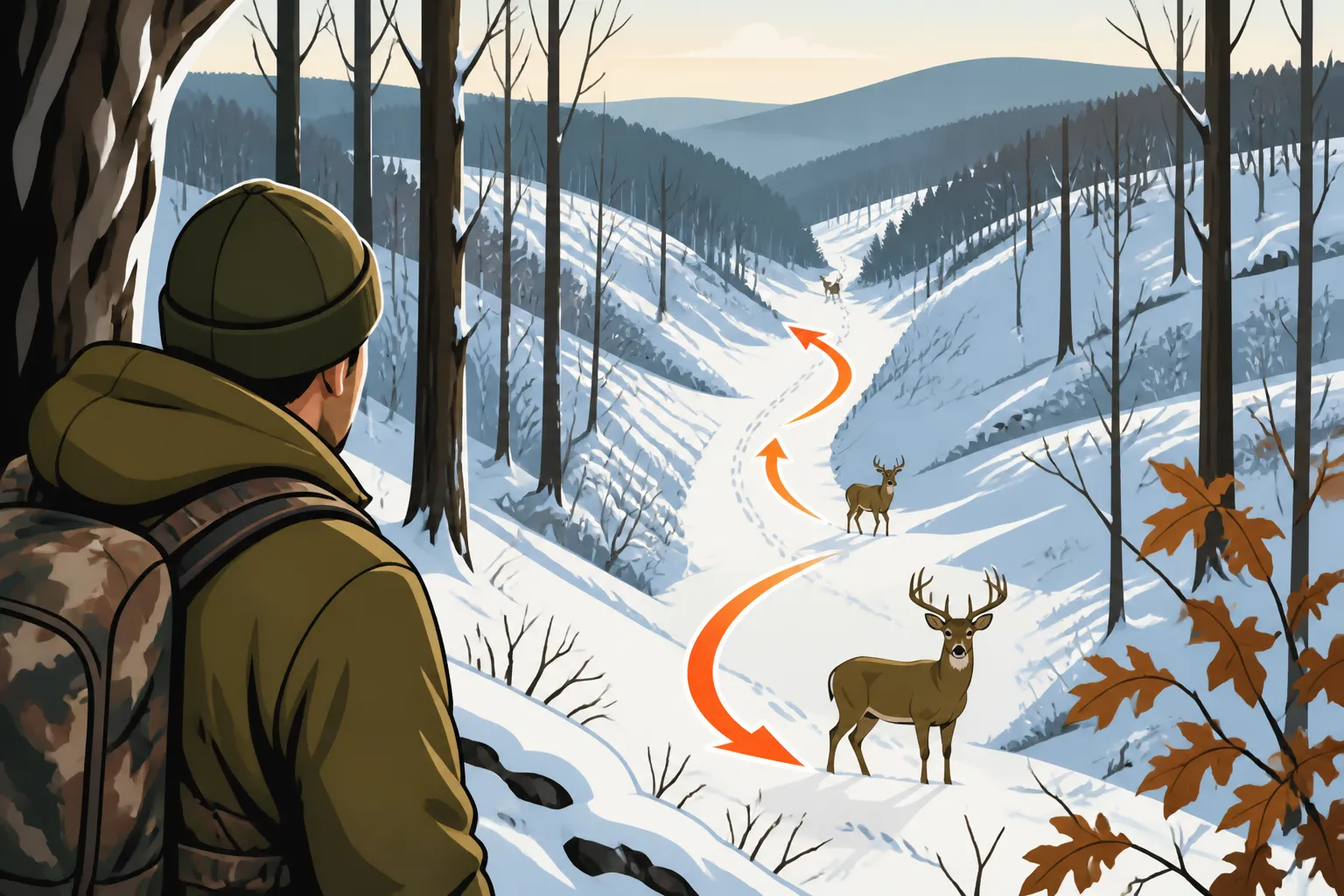
Deer, like humans, are inherently lazy. They'll almost always take the easiest route available, especially when trudging through snow. In a hollow, this means looking for trails that hug contour lines, traverse benches, or follow the flatter ground along a creek bottom. These routes, which might be almost invisible under a blanket of leaves, suddenly become prominent in the snow. A well-used travel corridor will show a succession of tracks, forming a distinct, packed-down path.
Pay close attention to where these paths intersect with each other or where they narrow due to terrain features. A steep hollow might have a less severe "lip" or a slight ridge that deer consistently use to move from one side to the other. These become natural funnels that can concentrate deer movement. Using a good mapping app, like GoHunt, can help you visualize these topographical changes even before you hit the snow. You can scout these potential funnels and pinch points from the comfort of your home, and then use the fresh snow to confirm their usage. Imagine finding a subtle saddle connecting two ridges overlooking a hollow; the snow will tell you exactly how and when deer are using it to cross. This is critical when you're Hunting a Funnel Between Two Hollows.
Locating Food Sources Under Snow
While deer are still thinking about safety and easy travel, their primary driver in cold, snowy conditions is food. Their metabolism ramps up to stay warm, and calories are king. In West Virginia hollows, identifying what persistent food sources remain available after a snowfall is paramount. Look for oak flats or scattered oak trees that may still be dropping acorns, or where deer have already been pawing through the snow to access the mast. Even if the acorns are gone, deer will revisit these spots out of habit.
Don't overlook browse, either. While not as calorie-dense as acorns, evergreen thickets of mountain laurel or rhododendron can provide both shelter and a consistent food source in a pinch. Deer will often nip at the tips of these plants. Fields of standing corn or unharvested soybeans on the edges of hollows are also major draws, especially if there's a nearby patch of timber for cover. The snow will clearly show where deer are entering these fields from the hollows, how far they're venturing in, and where they're pawing for sustenance. Learning to identify Late-Season Food Sources for West Virginia Whitetails is crucial for success.
Pinpointing Bedding Areas in Winter
Deer are masters of energy conservation, and in snowy conditions, this means seeking out bedding areas that offer maximum thermal cover and protection from the elements. In West Virginia's hollows, these often manifest as south-facing slopes, which catch more sunlight, or dense thickets of pine, hemlock, or thick mountain laurel. These evergreen stands act like natural windbreaks, insulating deer from cold winds and heavy snow.
When you're reading the snow, look for areas where multiple fresh tracks converge and then disappear into dense cover. Often, you'll find beds themselves—oval depressions in the snow, sometimes still warm if the deer has only recently left. These spots usually provide a good vantage point for the deer to observe their surroundings while remaining hidden. Pay attention to the wind direction; deer will typically bed with the wind at their back, allowing them to smell danger approaching from behind while watching ahead. Learning Where Monongahela Forest Bucks Bed can provide valuable insights into these winter patterns, even if you're not in the Mon.
Strategic Hunting in a Snowy West Virginia Hollow
Once you've done your detective work and understood the deer's movements and habits after a snowfall, it's time to translate that knowledge into a successful hunting strategy. This involves not just finding the deer, but knowing how to approach them and where to position yourself for a shot.
Still-Hunting and Tracking Techniques
Still-hunting after a fresh snow is, for many, the purest form of deer hunting. The silence the snow provides, coupled with the clear tracks, creates an intimate experience with the woods. The key is to move incredibly slowly, taking one or two steps, then stopping to scan ahead for several minutes. Your eyes should be constantly sweeping, not just for deer, but for subtle changes in the terrain, the flick of an ear, or an unusual dark spot that could be a bedded deer. The fresh snow gives you a distinct advantage in terms of visual cues.
When you pick up a fresh track, don't just follow blindly. Instead, try to anticipate where that deer is going. Is it heading towards a known food source? Is it moving from a bedding area to feed, or vice-versa? Use the wind and thermals to your advantage, especially in a hollow where these can be tricky. As you gain elevation, thermals typically rise, and as you descend, they fall. Knowing Wind and Thermals on a Steep Ridge can significantly improve your chances of getting close without being detected. Move parallel to the tracks, or slightly downwind, always looking ahead, not just at your feet. Remember, the deer made the tracks, but it's not waiting for you to catch up.
Stand Placement After a Snowfall
While still-hunting is exciting, sometimes the best strategy is to set up an ambush based on the clear patterns the snow reveals. After observing how deer are using a particular hollow, identify the most consistent travel routes, funnels, or feeding areas. A fresh snowfall can dramatically highlight these pathways, guiding your stand placement. Look for a tree that provides good cover and an unobstructed view of a convergence point – perhaps where a bedding area trail meets a path leading to a feeding ground.
Consider how the deer will approach this spot. Can you set up to intercept them before they reach their destination, or as they leave? The detailed mapping features of tools like GoHunt, combined with the real-world snow observations, allow you to identify these strategic locations with pinpoint accuracy. Mark these spots on your map, noting the wind directions that would make them ideal. Don't be afraid to move your stand if the snow reveals a completely new or more heavily used travel pattern than you anticipated. Being able to adapt and utilize new information from the snow is key. For more insights on pre-season planning that carries into the snow, check out Scouting West Virginia Public Land Before Season.
Safety Considerations in Winter Conditions
Hunting in a snowy West Virginia hollow isn't just about strategy; it's also about safety. The beautiful white landscape can hide hazards, and the cold can be unforgiving. Hypothermia is a real risk, so layering appropriately with good insulating clothing is paramount. Wool and synthetic blends are far superior to cotton in wet, cold conditions. Invest in high-quality, insulated, waterproof boots that offer good traction on slick, snowy slopes. When moving through a hollow, stream crossings can become treacherous, and fallen leaves covered by snow can be incredibly slippery.
Visibility is often excellent in snow, which is a double-edged sword: you can see deer better, but other hunters can see you better too. Always wear your blaze orange, even if it's not legally required for your weapon type or season, just to be safe. Carry a survival kit with extra warm layers, a fire starter, and a first-aid kit. Navigating back to your vehicle after dark can be much harder when snow covers familiar landmarks, so a reliable GPS unit or a fully charged phone with a mapping app is a must. If you're going deep into the backcountry, inform someone of your route and expected return time. Check out Cold-Weather Sitting Strategy in the Mountains for more tips on staying warm and safe.
Advanced Tips for Deciphering Snowy Deer Sign
Once you've mastered the basics of reading snow sign, you can start to delve into more nuanced interpretations, combining what you see on the ground with a deeper understanding of deer behavior and terrain.
Understanding Deer Behavior Post-Snow
Deer behavior is directly influenced by the severity and duration of snowfall. A light, fresh dusting might only slightly alter their patterns, making them a bit more cautious. However, heavy, persistent snow can force more significant changes. In deep snow, deer often "yard up" or concentrate in areas with easier movement, like lower elevations, sheltered benches, or dense evergreen cover where the snow isn't as deep. Their urgency to feed also increases dramatically, as they burn more calories to stay warm and navigate. You might see more daytime movement during these periods, as they need to make the most of available light to find food.
The late season, often coinciding with snow, typically sees the end of the rut in West Virginia. Bucks are no longer primarily driven by breeding; instead, their focus shifts to recovery and survival, making them just as food- and cover-oriented as does. This means finding the food and shelter is often more effective than trying to "call" a buck. Knowing these shifts in priority can help you interpret why deer are moving in certain ways and where they're headed, especially when you consider West Virginia's Chronic Wasting Disease Counties and their specific management efforts, which can impact herd dynamics.
Combining Snow Sign with Topographical Maps
The real power comes when you combine your boots-on-the-ground observations of snow sign with detailed topographical maps. Imagine seeing fresh tracks leading up a steep hollow, but then disappearing into a dense patch of timber. By overlaying this observation with a map on your GoHunt app or a physical topo map, you might discover a subtle bench or a small, flat area within that timber that you couldn't see from your vantage point. This hidden bench could be a secondary travel corridor or even a secluded bedding area that deer are using.
Digital mapping tools are invaluable here. You can mark fresh tracks, scrapes, or bedding areas you find in the snow as waypoints. Over time, these waypoints, especially those identified after multiple snowfalls, will start to reveal consistent patterns that aren't apparent on any single day. You can also use aerial photography on these apps to identify areas of thick cover, evergreen stands, or potential food sources that might be hidden by terrain from a ground perspective. This integrated approach, similar to Reading Aerial Photos for Eastern Panhandle Deer, allows you to build a comprehensive picture of deer movement within your chosen hollow, maximizing your hunting efficiency.
| Sign Type | Appearance in Snow | Interpretation |
|---|---|---|
| Fresh Track | Crisp, sharp edges, clear definition, possibly warm | Deer passed very recently (within hours), active in the area. |
| Older Track | Rounded edges, melted/refrozen, ice crystals present | Deer passed hours to a day ago; still useful, but less immediate action. |
| Paw Marks | Scraped-away snow, often with exposed leaves/ground | Deer actively feeding, likely on acorns or persistent browse. Focus on nearby cover. |
| Bed | Oval depression, often in thick cover, possibly warm | Deer bedded here recently. Look for tracks leading in/out to determine travel patterns. |
| Rub | Tree bark scraped, often on fresh snow next to trunk | Indication of buck activity; fresh snow can make old rubs seem new, check tree damage. |
| Scrape | Cleared patch of ground, often pawed and urinated on | Less common in deep snow, but if present, indicates active buck checking for does. Check freshness. |
| Droppings | Small piles, often dark, may melt snow around them | Recent feeding activity, warmth indicates freshness. Useful for aging deer presence. |
Disclaimer
Hunting is an inherently dangerous activity. This article provides general information and recommendations. Always consult the most current West Virginia hunting regulations and practice safe hunting techniques. Be aware of your surroundings, wear appropriate safety gear, and hunt ethically and responsibly. Local conditions, animal behavior, and regulations can change, so stay informed and prioritize safety above all else.