Hunting a Ridge-Top Saddle for Rutting Bucks
For many West Virginia deer hunters, the rut is the pinnacle of the season, offering those fleeting chances at a mature buck that's often otherwise a ghost. But actually intercepting one of these cruising giants can feel like pure luck. This guide dives deep into hunting one of the most consistent hotspots for rutting bucks in our mountainous state: the ridge-top saddle, helping you transform those lucky encounters into planned successes.
Why Ridge-Top Saddles Are Rutting Buck Magnets
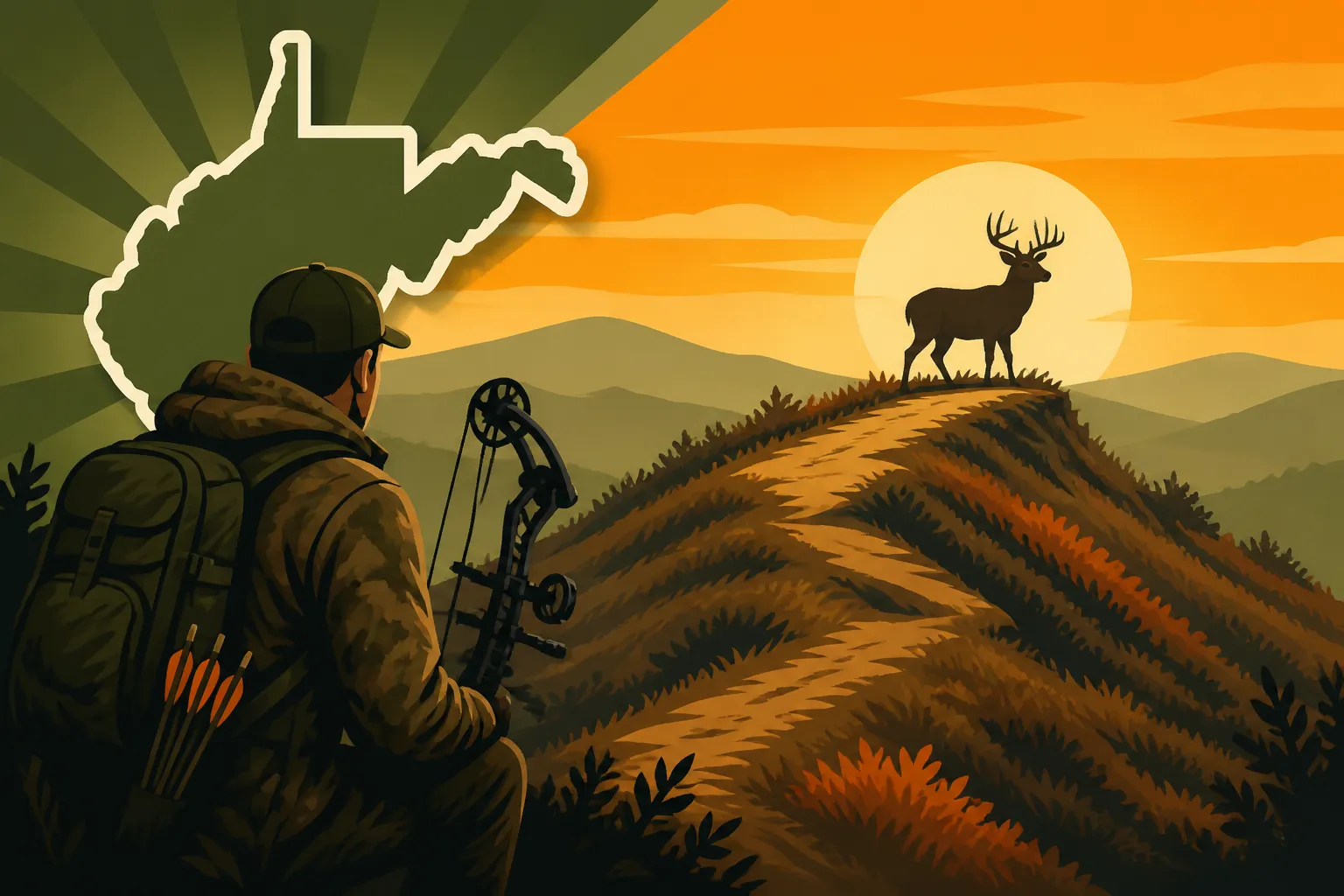
You know that feeling when you're glassing a distant ridge, or just slogging through the mountains, and you hit that dip in the terrain where everything just feels right? That's often a ridge-top saddle, and for a rutting buck, it's more than just a dip – it's a strategically vital piece of real estate. These aren't just random low points; they are natural funnels in the landscape, channeling deer movement in predictable ways, especially when bucks are on the prowl for does.
Understanding Deer Movement Patterns in West Virginia
Our West Virginia mountains are rugged, full of steep climbs and thick hollows. Deer, much like us, are creatures of efficiency. While a buck in November might cover miles, he's still going to choose the path of least resistance when he can. Ridge-top saddles offer exactly that. Imagine a buck scent-checking a ridge for does. Instead of clambering over the highest peaks, he’ll often drop into a saddle, crossing from one side of the ridge to the other, or using it as a relatively easy travel corridor along the spine of the mountain. These natural funnels concentrate deer movement, making them prime locations to set up.
During the rut, bucks are constantly moving, expanding their home ranges significantly as they search for receptive does. They'll use these saddles to transition between bedding areas, feeding zones, and other doe congregation points on different sides of a mountain. This makes a saddle an interception point, a natural choke point where the likelihood of a traveling buck passing through skyrockets. They are essentially deer highways, and during the rut, they become express lanes for bucks looking for love.
The Role of Topography and Wind
Beyond just being an easy travel route, the topography of a ridge-top saddle plays a crucial role in how deer, particularly rutting bucks, use them. In West Virginia’s often unpredictable winds, saddles create unique air currents that bucks exploit. When air currents hit a saddle, they can be squeezed and funneled through, often creating swirling winds or predictable crosswinds. A smart buck knows this and uses these turbulent airflows to his advantage, scent-checking vast areas for does without exposing himself too much. He's letting the wind do the work, carrying the scent of any deer on either side of the ridge right through his nasal passages.
The interplay of thermals, those rising and falling air currents influenced by temperature changes, is also critical. In the mornings, as the sun warms the slopes, air rises, creating updrafts. In the evenings, as the air cools, it sinks, creating downdrafts. A saddle can act as a natural conduit for these thermals. A buck might bed just below a saddle, letting the morning updraft carry scent up to him, or cruise through it in the evening with a downdraft carrying scent down into the hollows below. Understanding how these wind patterns will affect your scent, and how deer use them, is absolutely vital for successful hunting in these areas. It's a complex dance of elevation, temperature, and prevailing winds, all coming together in that little dip in the ridge.
Scouting and Locating Productive Saddles
Finding a ridge-top saddle on a map is one thing; determining if it's a productive one that rutting bucks actively use is another. Effective scouting, both from the comfort of your home and with boots on the ground, is key to narrowing down your options and increasing your odds in the field. Don't just pick the first saddle you see; dig deeper to ensure it's truly a high-traffic area.
Utilizing Topographical Maps and Aerial Imagery
Before you even lace up your boots, modern mapping tools are your best friend. Start by poring over topographical maps and high-resolution aerial imagery. Platforms like GoHunt, or even the basic WVDNR online maps, are invaluable for this initial phase. Look for obvious dips or low points between two higher elevations along a ridge line. These are your potential saddles. But don't stop there.
Once you've identified a few promising saddles, zoom in on the aerial photos. What's around them? Are there thick bedding areas on one side and a known food source or another doe bedding area on the other? Do logging roads or old timber cuts lead into or away from the saddle, suggesting natural travel corridors? You're looking for converging terrain features that would naturally funnel deer. A narrow, well-defined saddle that connects two significant land features (like a steep knob and a gentler slope leading to a creek bottom) is often more productive than a broad, ill-defined dip. Pay attention to anything that creates a "pinch point" or funnels movement. This kind of pre-season work, done virtually, allows you to scout multiple locations without disturbing the actual hunting ground. You can learn a lot by Reading Aerial Photos for Eastern Panhandle Deer long before you ever step foot on the property.
Ground Scouting for Key Sign
Virtual scouting will give you a list of promising candidates, but there's no substitute for getting out there and putting boots on the ground to confirm buck activity. This is where you verify what the maps suggest and look for the undeniable evidence that deer, particularly bucks, are using these saddles heavily. Look for rub lines, which are trees or saplings that bucks have scraped their antlers on. A consistent rub line running through or parallel to a saddle is a clear indicator of buck movement. Pay attention to the size of the rubs; larger rubs often mean bigger, older bucks.
Even more telling are scrape lines – areas where bucks paw away leaf litter, urinate, and sometimes rub an overhead branch (licking branch). Scrapes are essentially calling cards, and a series of fresh scrapes leading into or through a saddle signals active buck presence during the pre-rut and rut. Look for worn trails, not just faint deer paths, but well-used runways that show consistent traffic. These trails often run right through the lowest point of the saddle or just off to one side. You might also find fresh tracks in muddy spots or along logging roads. During your ground reconnaissance, be sure to keep an eye out for any sign that could help you predict buck movement, such as Scrape Lines Along a Logging Road or Reading West Virginia Mud for Fresh Deer Movement. While Scouting West Virginia Public Land Before Season, aim to do this during the late summer or early fall, well before the rut, to minimize your disturbance and keep your chosen saddle from becoming "pressured."
Setting Up for Success in a Ridge-Top Saddle
Once you've identified a hot ridge-top saddle and confirmed its use by rutting bucks, the next critical step is to execute a flawless setup. This isn't just about picking a tree; it's about making a strategic decision that maximizes your concealment, takes advantage of the terrain, and most importantly, accounts for the fickle winds and thermals that define mountain hunting in West Virginia.
Optimizing Stand Placement for Wind and Thermals
This is arguably the most crucial aspect of hunting a ridge-top saddle. You absolutely cannot get away with a sloppy setup. Your stand or blind placement must put you downwind or crosswind of where you expect the bucks to travel. Remember that saddles often create swirling winds. Spend time observing the wind direction and how it funnels through the saddle on different days and at different times. If you have a prevailing west wind, for example, setting up on the east side of the saddle, facing west, allows your scent to blow away from the approaching deer.
The thermals will also dictate your strategy. In the morning, as air rises, you might want to be higher up, letting your scent blow upwards and away. In the evening, as air cools and sinks, a lower setup might be better to let your scent fall into a hollow behind you. The ideal scenario is to have multiple stand locations around a saddle, allowing you to pick the best one for the day's conditions. This flexibility is key to consistent success. Consider how to best adapt your setup, especially if you're engaging in Treestand Setups in Monongahela National Forest, where terrain and wind are always a factor. Always approach and exit your stand in a way that keeps you out of the deer's primary travel routes and minimizes disturbance.
Effective Rut Hunting Strategies
Once you’re settled into your carefully chosen stand, it’s time to think about strategy. During the rut, bucks are actively cruising, often with their heads down, nose to the ground, following the scent of does. This makes them vulnerable to calling and decoying. Loud, aggressive rattling can often pique the interest of a dominant buck, making him believe there's a fight going on over a hot doe. Combine rattling sequences with aggressive grunting, especially when you think a buck might be out of sight, just over the crest of the ridge. Don't be afraid to be bold with your calls; a rutting buck is often less cautious than he would be in the early season. For more insights, delve into specific techniques like Rattling and Grunting in West Virginia.
Mock scrapes can also be highly effective. Refresh an existing scrape or create a new one, adding some buck lure or even your own scent (if you're confident in your cover scent strategy). Position a doe decoy, especially a bedded or breeding doe, in a visible spot within the saddle, facing slightly away from your stand. A buck seeing a "rival" or a "hot doe" might throw caution to the wind. The most important strategy, however, is patience. Rut hunting means long hours on stand. Bucks will move throughout the day during the rut, not just at dawn and dusk. So pack a good lunch, plenty of water, and commit to an all-day sit, particularly during the peak of Hunting the West Virginia Rut in November.
Overcoming Challenges in Mountain Saddles
Let's be real, hunting in West Virginia, especially in the mountains, comes with its own set of hurdles. Ridge-top saddles are no exception. From dealing with other hunters to the sheer physical demands of the terrain, being prepared for these challenges can make or break your hunt.
Dealing with Hunting Pressure
It's no secret that popular public lands, or even private lands near access points, can get crowded, especially during the peak rut. A productive ridge-top saddle is often a known commodity, meaning you're likely not the only one eyeing it. Hunting pressure can quickly turn a hotspot cold, as deer become nocturnal or completely abandon heavily disturbed areas. You'll often find this to be the case when facing Opening Weekend Crowds on West Virginia Public Land.
To combat this, you've got a few options. One is to go deeper. Identify saddles that require a significant hike – often an hour or more from the nearest road or trail. Most hunters won't commit to that kind of effort, leaving these more remote spots less pressured. Another strategy is to hunt weekdays. If you have the flexibility, hunting Tuesday through Thursday can drastically reduce the number of encounters with other hunters. Finally, don't be afraid to embrace adverse weather. A cold rain, snow, or even just a blustery day will send many hunters home, but a rutting buck might still be on the move, offering you a unique advantage. Persistence and being willing to put in the work to find less-traveled areas are key to Finding Ground Others Walk Past.
Access and Extraction Considerations
West Virginia's beauty comes with a price: steep, rugged terrain. Accessing remote ridge-top saddles often means a strenuous climb, sometimes in the dark. Plan your entry and exit routes meticulously. Try to use routes that keep you out of prime bedding or feeding areas, minimizing the chances of spooking deer on your way in or out. Quiet movement is paramount. Consider the physical toll this terrain will take, especially if you're packing in a stand or other gear. Using trekking poles can be a game-changer for stability and reducing fatigue on these steep grades. Don't forget, setting up a stand on these inclines requires specific techniques; consult guides on Hanging a Stand on a Steep Allegheny Ridge for best practices.
And then there's the happy problem: what happens when you actually get a buck down? Extracting a deer from a steep hollow or off a remote ridge top can be an incredibly demanding task. Think about this before you ever take a shot. Do you have a plan for Dragging a Deer Off a Steep Ridge? Will you need help? Do you have a deer cart (though these are often impractical in truly steep, rocky terrain)? Sometimes, field dressing and quartering the deer on site, then packing it out in a frame pack, is the most viable option. This saves you from having to Recovering a Deer From a Steep Hollow as a whole animal, which can be an impossible feat for a solo hunter. Being physically prepared and having an extraction plan is just as important as shot placement.
Comparing Saddle Characteristics for Rut Hunting
| Feature | High-Potential Saddle for Rut | Low-Potential Saddle for Rut |
|---|---|---|
| Definition | Narrow, well-defined dip in ridge | Broad, gradual, undefined dip |
| Connecting Points | Links bedding to feeding, or multiple doe areas | Connects less critical habitats |
| Presence of Sign | Abundant fresh rubs, scrapes, worn trails | Sparse or old sign, faint trails |
| Terrain Features | Converging points, natural pinch points | Open, sprawling, less directional |
| Wind Consistency | Predictable funneling or swirling patterns for scent checks | Erratic, less defined wind patterns |
| Hunter Pressure | Remote, difficult access | Close to roads, easy access |
| Vegetation | Mix of thick cover and travel lanes | Uniform, open timber or dense impenetrable thicket |
| Proximity to Water | Water source nearby | No immediate water source |
Disclaimer
Hunting is an inherently dangerous activity. This guide provides general information for educational purposes only and should not replace professional training or local regulations. Always prioritize safety, follow all West Virginia hunting laws, and obtain the necessary licenses and permits. Be aware of your physical limitations and environmental conditions. The author and publisher are not responsible for any incidents, accidents, or injuries that may occur as a result of using this information.