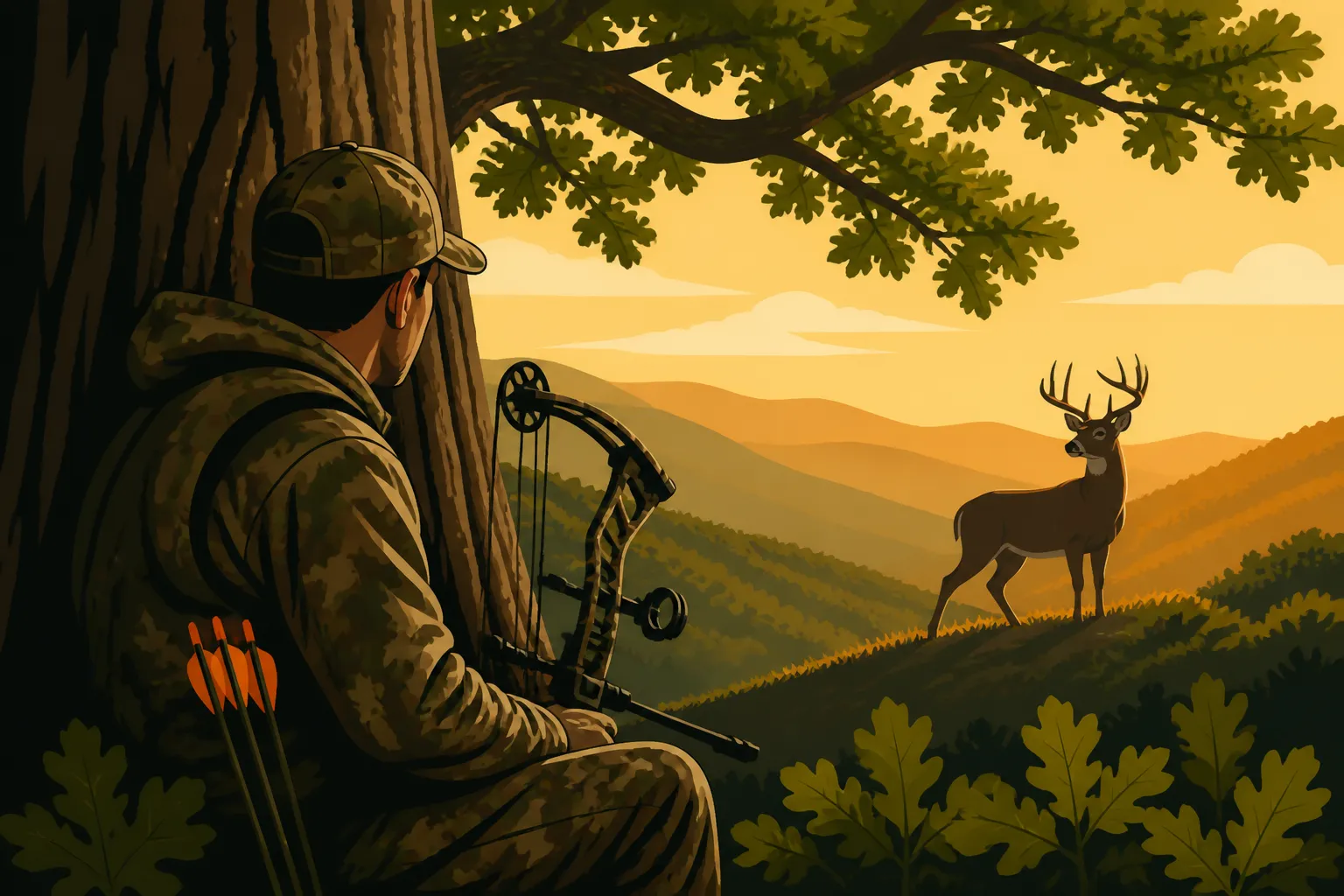
Setting Up Against a Big Oak
There’s nothing quite like walking through the West Virginia woods, scanning the canopy, and spotting that one massive oak tree. It calls to you, doesn't it? That feeling that this tree, older and grander than its neighbors, has seen countless deer pass beneath its boughs. But knowing an oak is a hot spot and actually setting up successfully against it are two different things. Hunters often struggle with how to approach such a prominent feature without spooking everything in a half-mile radius, or how to truly capitalize on its potential. This guide is all about turning that instinct into a strategic advantage, helping you understand, scout, and precisely set up against those towering giants to put deer in your freezer.
Why That Big Oak Tree is a Deer Magnet
It’s not just a hunch or some old hunter's tale; those majestic, mature oak trees truly are magnets for West Virginia's deer herd, and for very good reason. They offer a combination of irresistible food, vital cover, and often mark historical travel corridors that deer have used for generations. Understanding why they’re so important will give you a significant edge in your hunting strategy.
Understanding Acorn Production Cycles
The primary draw of a big oak, especially in the fall, is its acorns. But it's not as simple as "oak equals acorns." There are distinct differences between oak species, and their production cycles vary wildly. You've got your white oaks (like white oak, chestnut oak, swamp white oak) and your red oaks (like red oak, black oak, pin oak). White oak acorns tend to mature in a single season, dropping earlier in the fall and being less bitter, making them incredibly desirable for deer right out of the gate. Deer will often prioritize these first, gorging themselves until they're gone.
Red oak acorns, on the other hand, take two years to mature and contain more tannins, making them more bitter initially. However, this bitterness leeches out over time, and they provide a critical food source later in the season, often well into late fall and even early winter, long after the white oak acorns are gone. If you can find a big red oak still dropping fresh acorns in November, you've hit the jackpot. When you're Hunting into the Late December Archery Close, these later-dropping red oak acorns can be the absolute key to finding a deer that isn't focused solely on browse. Paying attention to what's dropping now is crucial. I’ve been fooled more times than I care to admit by just assuming a tree was producing, only to find last year's hulls underfoot. You need to verify fresh droppings.
The Shelter and Cover Factor
Beyond the delectable nuts, big oak trees, particularly those with wide, sprawling canopies, offer exceptional shelter and cover for deer. Think about a blustery November day in the mountains. A deer standing under a dense oak canopy is significantly more protected from the wind and precipitation than one out in the open. This thermal cover is especially important when temperatures drop, or a sudden cold front moves through.
Moreover, the sheer size and structure of a mature oak provide excellent visual breaks. Its thick branches and often craggy bark can help break up a deer's silhouette, allowing them to feel more secure. On a steep Allegheny ridge, where deer might bed down on benches or points, a giant oak can serve as a natural anchor for their bedding area, offering security cover and an elevated vantage point. I've often seen deer bedded within sight of a colossal oak, using its bulk to conceal their presence while they watch for danger. It's a natural fortress in the deer's world.
Historical Significance and Deer Trails
Many of the largest, oldest oaks in West Virginia have been standing for a century or more, long predating most of the current logging roads or human-made structures. These ancient trees often mark natural funnels, ridge crossings, or traditional feeding grounds that deer have utilized for generations. It's not uncommon to find deeply worn deer trails – almost like miniature cattle paths – leading directly to or past a prominent oak. These aren't just random paths; they represent historical travel routes.
These big oaks, especially those positioned on saddles, benches, or along creek bottoms, essentially become landmarks for deer. They're part of the deer's mental map of their territory. If you’re scouting a new piece of public land or even a familiar private parcel, and you stumble upon a goliath oak with a network of trails converging beneath it, you've likely found a place that deer have been using for decades, if not longer. This historical usage makes them incredibly reliable spots, even in areas with significant hunting pressure, because deer are creatures of habit. They remember those routes.
Scouting and Pinpointing the Perfect Big Oak Setup
Finding a big oak that's dropping acorns is one thing; figuring out how to hunt it effectively is quite another. It requires meticulous scouting, both before the season and in the immediate lead-up. You need to become a detective, piecing together clues to understand exactly how deer are using that particular tree.
Pre-Season Reconnaissance
Your pre-season scouting is where you lay the groundwork for success. Don't wait until opening day to find your spot. Start early, ideally in late summer, to identify prime oak stands. I like to use mapping applications like GoHunt to scan aerial photos for clusters of mature oaks, especially those near bedding areas, water sources, or funnels. Look for distinct canopy shapes that indicate older, larger trees. Once I've identified potential candidates from above, I'll put boots on the ground.
During these scouting trips, focus on whether the trees are producing. Are there acorns on the ground? Are there fresh acorn caps, or even better, chewed acorns and deer droppings? You’re looking for evidence of current activity. A big oak that should be dropping but isn't, or one that's dropping but showing no signs of deer, isn't worth your time. Sometimes, after a poor acorn year, you might have to shift your focus entirely, which is why early scouting is critical. Pay attention to how the deer are Hunting After a Poor Acorn Year in your specific area; their patterns change drastically.
Reading the Ground: Sign, Rubs, and Scrapes
Once you're physically at the big oak, it's time to read the ground like an open book. Fresh sign is your best friend. Look for clusters of deer droppings, especially those that appear wet and recent. Small, chewed-up acorn fragments are a dead giveaway that deer are feeding heavily. If you're really lucky, you might even find impressions of deer beds under the canopy.
Beyond just feeding sign, observe the surrounding area for rubs and scrapes. Bucks often leave rubs on smaller trees around active feeding areas, and a community scrape line beneath a big oak can indicate that it's a social hub during the rut. If you find multiple rubs heading into or out of the oak's orbit, it tells you bucks are actively using this spot. Fresh tracks in soft dirt or mud, particularly if you're lucky enough to be Reading West Virginia Mud for Fresh Deer Movement after a recent rain, will tell you the direction and frequency of travel. Remember, a single track means little; a well-worn path or multiple fresh tracks radiating from the oak suggests consistent usage. You might even find Scrape Lines Along a Logging Road that pass by a particularly dominant oak, indicating it's a prime stopping point.
Wind and Thermal Considerations
This is perhaps the most critical, and often most overlooked, aspect of setting up on a big oak. A perfect oak with tons of sign is useless if your scent blows right to the deer. West Virginia's mountainous terrain creates unique wind and thermal dynamics that you absolutely must understand. In the mornings, as the sun warms the earth, air begins to rise, creating an updraft (thermals rising). In the evenings, as the sun sets and the air cools, it sinks, creating a downdraft (thermals falling).
When setting up on a big oak, especially one on a ridge or a hollow, you need to anticipate these thermals. If you plan to hunt a morning sit, you’ll want to position yourself so that your scent is carried up and away from where deer are likely to approach from below. Conversely, for an evening sit, you want your scent to be carried down into the hollow, away from where deer might be coming from above. I’ve learned the hard way that ignoring Wind and Thermals on a Steep Ridge can ruin an otherwise perfect setup. Always consider the wind direction and the thermal flow when picking your exact tree and stand height. Carry a small powder bottle or milkweed seeds to test the wind often.
Strategic Setup: Making That Big Oak Work for You
Once you've identified your target oak and understood how deer are using it, it's time to execute your setup. This is where precision and minimizing your impact become paramount. You want to become part of the tree, not an obvious intruder.
Stand Placement: Angles and Concealment
Your stand placement on the big oak is critical. You're not just looking for a clear shot lane; you're looking for an angle that offers maximum concealment, minimizes movement detection, and provides an ethical shot. Often, the ideal spot isn't directly on the side where you expect deer to come from, but slightly to the side, allowing you to use the tree's trunk or a thick branch for cover as deer approach. Think about the deer's primary approach vectors – are they coming up a ridge, along a bench, or from a bottom? Position yourself to intercept them without being silhouetted.
For incredibly large oaks, a hang-on stand or even a saddle hunting setup might be more versatile than a traditional climbing stand, as their trunks can be too wide or irregular for climbers. When I'm considering Treestand Setups in Monongahela National Forest on public land, mobility and adaptability are key. You might also want to position yourself on the downhill side of the oak, especially for evening hunts, so your scent flows away. On really steep ground, you might find yourself Hanging a Stand on a Steep Allegheny Ridge where a slight angle offers much better concealment than a direct straight-on shot. The goal is to blend in completely.
Entry and Exit Routes
This is where many hunters unknowingly blow their hunts. Your entry and exit routes to and from your big oak stand are just as important as the stand placement itself. The less disturbance you create, the better. Aim to approach and leave your stand silently and invisibly. This means avoiding known deer trails, moving against the prevailing wind, and using natural topography to mask your presence.
If possible, use a creek bed, a steep hollow, or a dense thicket as a natural screen to get to your stand. Plan your route so that you’re not walking directly through a prime feeding area or bedding area. For evening hunts, if deer are likely to be moving toward the oak from a specific direction, try to exit in the opposite direction, or wait until dark to minimize your footprint. A successful exit means you can hunt that same oak again another day. The last thing you want is for a deer to bust you on your way out, knowing exactly where you came from.
Complementary Tactics
While the big oak itself is the primary draw, you can enhance your setup with a few complementary tactics, especially during the rut. If you've found rubs and scrapes near the oak, it indicates that bucks are actively cruising the area. This is a perfect scenario for incorporating calls. Subtle grunts or doe bleats can often peak the curiosity of a passing buck, bringing him closer for a shot. Sometimes, even a soft rattling sequence, used judiciously, can pique the interest of a buck, making him think another buck is checking out his feeding area.
However, be realistic about how much calling to do, especially on pressured public land. Sometimes silence and patience are your best tools. But knowing when and how to deploy Rattling and Grunting in West Virginia can certainly add another layer of effectiveness to your big oak strategy. Remember, the goal isn't to blast out calls every five minutes, but to use them sparingly and realistically to draw a deer those extra few yards.
Adapting to Conditions Around Your Oak
The West Virginia woods are dynamic, and conditions can change rapidly. What worked yesterday might not work today. A truly successful hunter knows how to adapt their strategy around their chosen big oak to maximize their chances, regardless of what Mother Nature or other hunters throw their way.
Hunting After a Rain or Snow Event
There's something magical about hunting after a fresh rain or snowfall. The woods become incredibly quiet, making it easier for you to move stealthily and, crucially, making it easier to hear deer approaching. A wet forest floor also makes it simpler to find fresh tracks and discern recent deer activity around your big oak. A hard rain can wash away old scent, essentially "resetting" the woods and potentially drawing deer back to a preferred feeding area like a productive oak.
After a fresh snow, those big oaks with their broad canopies often hold less snow on the ground directly beneath them, making it easier for deer to access fallen acorns. The snow also highlights deer movement like nothing else. You can clearly see how deer are navigating the terrain, where they're entering and exiting the feeding zone around your oak, and even where they might be bedding nearby. This is especially true when Hunting Deer After a Cold Front; deer often hit those food sources hard immediately following harsh weather. Pay attention to how deer are using the cover offered by the big oak in these conditions.
Dealing with Hunting Pressure
Let's be realistic: if you've found a magnificent oak dripping acorns, chances are other hunters have noticed it too, especially on public land. Hunting Pressure on West Virginia Public Land is a very real factor. The key here is not to abandon the spot, but to adapt your approach. This might mean hunting tighter to bedding areas, getting into your stand earlier, staying later, or hunting during less conventional times, like midday.
Consider what most other hunters are doing. Are they walking logging roads? Are they focused on easy-access areas? If so, you might need to embrace the grind, hiking deeper into the Monongahela National Forest, or finding those less obvious, harder-to-reach oaks that others walk past. Use your GoHunt maps to identify terrain features that might naturally deter other hunters – steep slopes, thick laurel patches, or areas far from established trails. Sometimes, even just being 50-100 yards off the beaten path can mean the difference between seeing a pressured deer and seeing nothing. Remember, a deer's natural instinct to feed on acorns from a prime oak is powerful, but they'll do it on their terms, usually when they feel safest. Focus on Finding Ground Others Walk Past by using overlooked access points or traversing difficult terrain.
Late Season Adjustments
As the season progresses, especially into December, the dynamic around your big oak will shift dramatically. White oak acorns will likely be long gone. Even many red oak acorns might be depleted or buried under leaf litter and snow. This doesn't mean the big oak becomes irrelevant; it just means you need to adjust your focus.
In the late season, deer are primarily concerned with survival, and that means finding calories. While the acorns might be gone, deer will still frequent areas where they found food earlier, hoping for remnants. Also, consider other food sources near the oak. Is there a persistent green patch of browse nearby? Are there evergreen thickets offering cover and some forage? Sometimes, deer will transition from acorns to other mast, like beech nuts, or to woody browse, even if it's less palatable. Identifying Late-Season Food Sources for West Virginia Whitetails that might be adjacent to or within a short walk of your once-productive oak is crucial. The old oak might still serve as a travel corridor or a staging area, even if it's no longer the main buffet.
Oak Species Acorn Production & Deer Preference
Knowing your oaks can really dial in your hunting strategy, especially when it comes to what deer are looking for and when. Here’s a quick overview to help you differentiate and prioritize.
| Oak Species Group | Acorn Maturation | Tannin Content | Deer Preference (Early Season) | Deer Preference (Late Season) | Common West Virginia Examples |
|---|---|---|---|---|---|
| White Oak Group | 1 Growing Season | Low (less bitter) | High (preferred first) | Low (depleted quickly) | White Oak, Chestnut Oak, Swamp White Oak |
| Red Oak Group | 2 Growing Seasons | High (more bitter) | Lower (eaten after white) | High (critical late-season food) | Red Oak, Black Oak, Pin Oak |
This table highlights why having both white and red oaks in your hunting area is a huge advantage, as it provides a staggered food source for deer throughout the fall and winter.
Disclaimer
Hunting is an inherently dangerous activity. Always adhere to all local, state, and federal hunting regulations, including those set by the West Virginia Division of Natural Resources (WVDNR). Prioritize safety by using appropriate gear, practicing ethical hunting methods, and informing others of your hunting plans. This guide is for informational purposes only and does not replace professional instruction or local regulations.