Predator Calling West Virginia Ridgelines
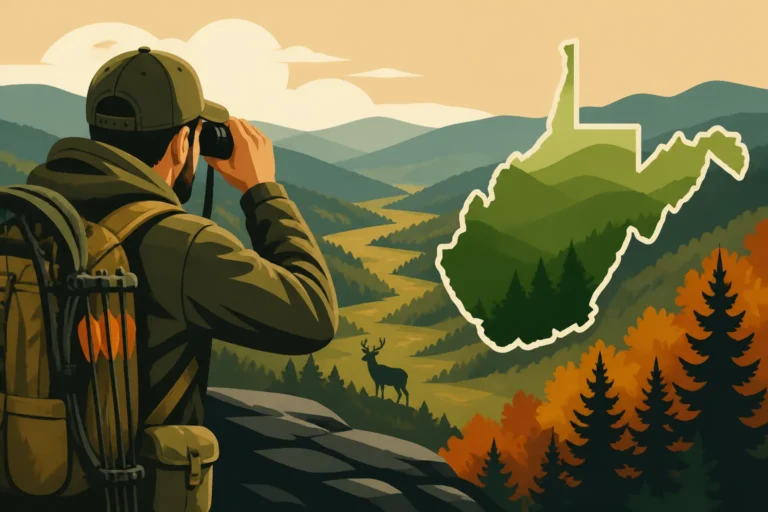
Predator hunting on West Virginia's rugged ridgelines can feel like an impossible puzzle. You trek for miles, set up in what feels like the perfect spot, only for silence to greet your calls, leaving you wondering if any predators even exist out there. This guide aims to demystify the art of calling coyotes, foxes, and other opportunistic predators on the challenging terrain of West Virginia's mountain ridges, providing you with actionable strategies to increase your success.
Understanding West Virginia Ridgeline Predators
Before you can effectively call a predator in West Virginia, you need to understand who you're calling and where they live. Our ridgelines are home to a diverse array of cunning critters, each with unique habits and preferences when it comes to traversing and hunting these elevated landscapes. It's not just about making noise; it's about making the right noise in the right place at the right time.
The Elusive Coyote: Behavior and Habitat on Ridges
Coyotes are arguably the most sought-after predator for calling in West Virginia, and for good reason—they're incredibly intelligent and adaptable. On ridgelines, coyotes often use the elevated vantage points to survey their territory, hunt, and travel efficiently. They'll frequent benches, saddles, and old logging roads that run along the contours, using the cover of thick laurel and mature timber to move unseen.
Understanding their travel patterns is key. Coyotes will often travel into the wind to catch scent, or use cross-wind thermals to detect prey. They're opportunistic feeders, and a ridgeline offers a buffet of smaller game, deer fawns, and even carrion. Knowing this helps you predict where a coyote might be coming from when you start your calling sequence. Many hunters focus on calling in agricultural areas, but the mountains hold a robust population, often less pressured. For those interested in how these adaptable animals thrive in different environments, consider delving into the tactics discussed in Coyote Calling in West Virginia Farm Country.
Fox Species: Red and Gray Dynamics
While coyotes dominate the predator landscape, West Virginia's ridgelines are also prime habitat for both red and gray foxes. These smaller canids have different behaviors that impact how you should call them. Red foxes, with their distinctive white-tipped tails, often prefer more open areas along ridge fields or sparse timber, while the more agile gray fox is a master of the dense, brushy cover found on many steep slopes.
Gray foxes are unique in their ability to climb trees, an important consideration when setting up your stand, as a curious fox might try to get above you to gain an advantage. Both species respond well to distress calls, but often with less aggression and more caution than a coyote. You'll need to be even more patient and visually keen to spot their approach, as they can ghost through cover almost silently.
Occasional Opportunists: Bobcat and Bear
While not primary targets for most predator callers, it's not unheard of to call in a bobcat or even a black bear in West Virginia. Bobcats are incredibly elusive and rarely respond to calls with the same enthusiasm as a coyote, but a persistent distress call, especially one mimicking a rabbit or bird, can sometimes pique their curiosity. They're often found in the same dense, rocky areas where gray foxes thrive, making visual detection incredibly difficult.
Black bears are also opportunistic and can be drawn in by loud, desperate distress calls, especially during periods of food scarcity. While you might not be trying to call a bear, it’s a possibility to be aware of, especially in areas with high bear populations, such as the eastern mountain counties. Always be prepared for anything when you're making sounds that mimic injured animals in the West Virginia wilderness. For a broader look at bear populations, check out West Virginia's Black Bear Comeback.
Scouting and Setup: Mastering the Ridge Top
Effective predator calling on West Virginia ridgelines isn't just about blowing on a call; it's about strategic planning before you even utter a sound. The unique topography dictates everything, from how sound travels to how a predator approaches. Neglecting thorough scouting and proper setup will almost guarantee a frustrating, unproductive hunt.
Locating Key Ridgeline Travel Corridors
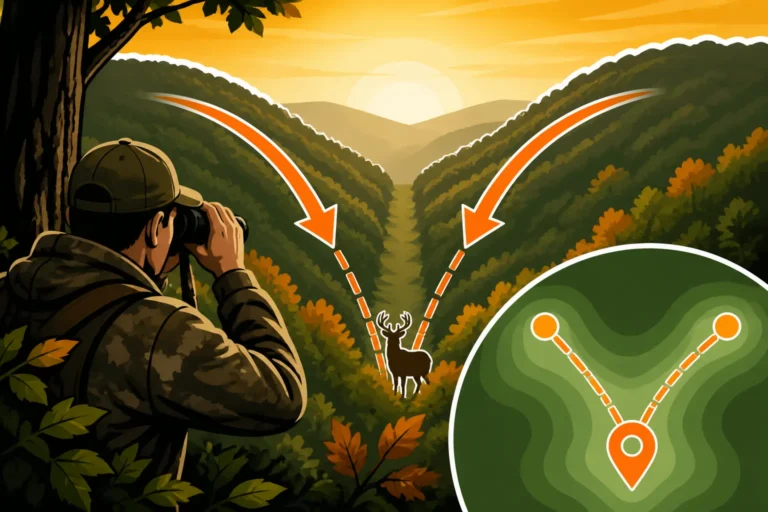
West Virginia's ridgelines aren't monolithic; they're a complex tapestry of varying terrain, from steep, rocky outcrops to gentle saddles and benches. Predators, like deer, will use the path of least resistance. Look for natural funnels, saddles between peaks, old logging roads that follow the contour, and subtle benches that act as highways for travel. These are the choke points where you're most likely to intercept a moving animal.
Using mapping apps like GoHunt can be incredibly beneficial here. You can identify elevation changes, terrain features, and potential travel routes before you even step foot in the woods. Pay close attention to areas where ridges meet or fork, creating multiple avenues of approach for a curious predator. Observing fresh tracks, scat, or even hair snagged on fences can confirm these travel corridors, letting you know the animals are actively using them. For more insights on interpreting these features, consider Reading a Ridge for Eastern Panhandle Deer.
Wind, Thermals, and Hunter Concealment
The wind and thermals are your biggest allies and potential enemies on a West Virginia ridgeline. As the sun rises, warm air flows uphill (updrafts), and as it sets, cool air flows downhill (downdrafts). Predators use their incredible sense of smell to detect danger, so playing the wind correctly is paramount. You need to position yourself so your scent is carried away from where you expect the predator to approach.
Often, this means setting up slightly off the peak of a ridge, or on a cross-slope, to manage the swirling winds that can occur in mountainous terrain. Don't be afraid to walk a little further to get into the perfect position, considering the prevailing wind and the expected thermal shift during your calling sequence. For an in-depth look at this critical factor, read up on Wind and Thermals on a Steep Ridge. Additionally, consider using natural cover like thick pines or rock formations to break up your silhouette.
Optimal Stand Locations and Angles
Your stand location on a ridgeline needs to offer good visibility without compromising your concealment. You want to see the predator before it sees you. A classic setup involves placing yourself at a point on the ridge that gives you a view of several potential approach lanes. Think about areas where the ridge opens up slightly, or where two draws meet to form a natural bowl.
The angle of approach is also crucial. Ideally, you want the predator to approach from a direction where your gun or bow is already pointed, or where you can make minimal movement to get a shot. If possible, set up with a backstop that breaks up your outline, whether it's a large tree, a rock face, or a dense thicket. Sometimes, utilizing a ground blind can be an excellent option for maximizing concealment, especially in areas with less natural cover. For tactics on deploying such a setup, refer to Using a Ground Blind on West Virginia Public Land. Remember, predators are constantly scanning, and any unnatural shape or movement will send them packing.
Advanced Calling Sequences for West Virginia's Terrain
Predator calling is as much an art as it is a science. In West Virginia's diverse terrain, a "one-size-fits-all" approach simply won't cut it. You need to adapt your calling strategy to the echoes of the mountains, the specific species you're targeting, and the hunting pressure of the area.
Adapting Distress Calls to Mountain Echoes
The steep hollows and dense timber of West Virginia's ridgelines can play tricks with sound. A loud, continuous call might echo too much, making it difficult for a predator to pinpoint the source, or worse, sound unnatural. Instead of blasting a call, consider shorter, more punctuated sequences. Use a variety of distress sounds – rabbit, bird, or even fawn – to create a realistic scenario.
Start with a loud, attention-grabbing series, then scale back to softer, more subtle sounds as you anticipate an approach. Let the natural echoes work for you by sending calls down hollows and across benches. Don't call constantly; allow for silent periods of 1-3 minutes between sequences. This gives curious predators time to investigate and move in, without feeling pressured by incessant noise. The way sound carries and distorts here is very different from flat land, so listen intently to your own calls.
Incorporating Howls and Barks for Aggressive Responses
While distress calls are your bread and butter, adding coyote howls and barks can be a game-changer, especially for territorial coyotes. A lone howl can pique curiosity, signaling another coyote in their territory. Group howls can challenge dominant coyotes, potentially drawing them in aggressively to investigate the intruders. Be cautious with these, however, as an overzealous howl can also scare off a cautious animal.
Consider starting with a lone howl, waiting for a response, and then following up with a distress sequence. Or, if you know there's an aggressive pack in the area, a challenge howl followed by some pup yips can infuriate them enough to come investigate. Using coyote vocalizations requires a deep understanding of their language and the local population dynamics. Practice these calls and observe how different populations respond. For a broader perspective on auditory tactics, even for deer, the principles of varying intensity, like discussed in Rattling Volume in Thick Laurel Cover, can apply.
Electronic Callers vs. Mouth Calls on Open Ridges
Both electronic callers and mouth calls have their place on West Virginia ridgelines. Electronic callers, such as those made by FoxPro or Lucky Duck, offer a vast library of realistic sounds, consistent volume, and the ability to project sound away from your position, drawing attention away from you. This can be a huge advantage on open ridgelines where predators have a wide field of view. The remote control allows you to remain motionless while the call operates. GoHunt's mapping features can also help you pinpoint ideal locations for setting up an electronic caller, taking into account wind and thermals for optimal sound dispersion.
Mouth calls, on the other hand, offer unparalleled realism and the ability to instantly adapt volume and tone. They're lighter, don't require batteries, and allow for very subtle, natural sounds that an electronic call might struggle to replicate. Many experienced callers prefer a combination, using an e-caller for initial loud sequences and then switching to a mouth call for quieter, more nuanced finishing sounds as the predator closes in. A great tip is to set your e-caller 50-75 yards away, forcing the predator to focus on that sound, rather than your location.
Gear and Tactics for Ridgeline Success
Hunting West Virginia's ridgelines for predators demands more than just a call and a gun. The terrain, the weather, and the cunning of your quarry require a well-thought-out gear list and a refined tactical approach to ensure success and safety.
Optics for Long-Range Detection
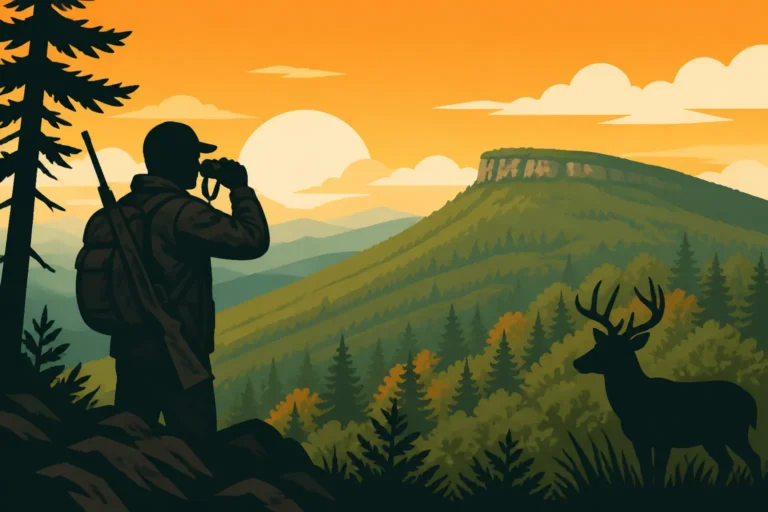
West Virginia ridgelines often present opportunities for long-range glassing, particularly when setting up on a high point overlooking a valley or another ridge. Quality optics are indispensable for spotting approaching predators before they spot you. A good pair of 10×42 binoculars, or even a spotting scope if you're planning an extended sit over a large area, can make all the difference. Look for binoculars with excellent low-light performance, as predators are most active during dawn and dusk.
When scanning, don't just look for an entire animal. Focus on movement, a flicker of an ear, or an odd color against the natural backdrop. Often, you'll spot a predator's subtle approach through the timber long before it steps into a clearing. Rangefinders are also critical, allowing you to quickly get a precise distance to potential shooting lanes and landmarks around your setup. This is especially important in the steep, broken terrain where distances can be deceptive.
Rifle and Shotgun Choices for Varying Engagements
The choice of weapon for predator calling on West Virginia ridgelines depends heavily on your anticipated shot distance and the type of cover you'll be hunting. For open ridge lines and powerline cuts, a rifle chambered in a flat-shooting caliber like .223 Remington, .22-250, or even a .204 Ruger is ideal. These calibers offer the precision and range needed for coyotes that hang up at 100-200 yards. A quality scope with variable magnification (e.g., 3-9x or 4-12x) will serve you well. For a deeper dive into rifle choices for similar terrain, consider Rifle Setups for West Virginia Deer Hunting.
In thicker, brushier areas, or for closer engagements with foxes and coyotes that might come in hot, a shotgun loaded with buckshot (e.g., #4 buckshot) or heavy lead turkey loads (e.g., #4-#5 lead) can be devastatingly effective. A 12 or 20 gauge shotgun, especially with an improved cylinder or modified choke, allows for quick, close-range shots. Many hunters prefer a shotgun for its versatility in tight spots, as it allows for a wider pattern, increasing the chance of a hit on a fast-moving target. Be sure to understand West Virginia's specific laws regarding firearms, especially if you're considering Night Hunting Rules for West Virginia Coyotes.
Decoys and Scent Control for Wary Critters
Predators use all their senses, and appealing to their sight can be a powerful addition to your calling efforts. Motion decoys, like a small, battery-operated faux rabbit or bird, can provide a visual stimulant that distracts the predator from your position and draws their attention to the decoy instead. Place your decoy 20-50 yards in front of you, slightly off-angle from where you expect the animal to approach.
Scent control is equally vital. Even with perfect wind, a slight thermal shift or a momentary lull can carry your scent directly to a wary predator. Use scent-eliminating sprays on your clothing and gear, and store your hunting clothes in airtight containers. Avoid strong-smelling foods, colognes, or even heavily scented detergents before a hunt. A clean scent profile, combined with a good wind advantage, significantly increases your chances of a successful close encounter.
Seasonal Adjustments and Overcoming Pressure
Predator hunting on West Virginia's ridgelines isn't a static endeavor; it requires adapting your approach throughout the year and recognizing the impact of hunting pressure. The same tactics that work in the dead of winter might fall flat during the summer months.
Calling Strategies Through the Breeding and Pup-Rearing Seasons
The behavior of coyotes, foxes, and bobcats changes significantly throughout the year, largely driven by breeding and pup-rearing cycles. Late fall and winter (December through February) are often considered prime time for coyote calling, as coyotes are more focused on breeding and establishing territories. This is when aggressive howls and challenge barks can be most effective. Females in heat also respond to male vocalizations, making estrus whines a potent call.
As spring arrives and pups are born (March through June), focus shifts to providing food for the young. Distress calls mimicking young animals (fawn bleats, pup yips, bird distress) become highly effective. This is also when you might encounter entire family groups. Summer (July through August) can be tougher, as cover is thick, and young animals are learning. Consider calls that mimic larger prey, as older coyotes may be teaching pups to hunt. Early fall, as pups disperse, offers another excellent window, with younger, less experienced coyotes being more susceptible to calls.
| Season | Primary Focus | Effective Calls | Typical Predator Response |
|---|---|---|---|
| Late Fall/Winter | Breeding/Territorial | Howls, challenge barks, estrus whines, distress | Aggressive, curious, territorial investigation |
| Spring (Pups) | Food for Young | Fawn bleats, pup yips, bird distress | Hunger-driven, cautious investigation |
| Summer | Mentoring/Opportunistic | Larger prey distress, subtle distress | More wary, slower approach, less vocal |
| Early Fall | Pup Dispersal/Hunger | Any distress, especially small game | Young, inexperienced animals more responsive |
Dealing with Hunting Pressure on Public Lands
West Virginia has a lot of public land, including vast tracts within the Monongahela National Forest, and while this offers incredible hunting opportunities, it also means hunting pressure. Predators on public land, especially closer to roads and popular access points, become incredibly wary of human sounds and scents. They've heard every call in the book. This is where subtle tactics and deep woods penetration become crucial.
Avoid calling the same areas repeatedly. Hunt smarter, not harder. Use mapping tools like GoHunt to find less accessible areas—steep hollows, remote benches, or ridges that require a longer, harder hike. These areas often hold less pressured animals that are more likely to respond naturally. When you do call in pressured areas, keep your sequences shorter, quieter, and more varied. Sometimes, a very soft, whimpering distress call can coax in a wary fox or coyote that has ignored louder, more aggressive sounds. Persistence and patience are key. Sometimes, the best tactic is to seek out Finding Ground That Sees Fewer Hunters.
Night Hunting Rules for West Virginia Coyotes
One of the most effective ways to hunt coyotes, especially pressured ones, is at night. West Virginia allows night hunting for coyotes on private lands, but there are specific rules and regulations you absolutely must follow. This means you can use artificial lights, including spotlights, and thermal or night vision devices to locate and target coyotes. This opens up an entirely new dimension to predator calling.
When hunting at night, the coyotes often lose some of their wariness, relying more on their hearing and less on their sight. This can make them more susceptible to calls. However, always confirm the current regulations with the West Virginia Division of Natural Resources (WVDNR) before engaging in night hunting. Understanding the specific legal firearms for West Virginia hunting, as well as the rules around Night Hunting Rules for West Virginia Coyotes and Thermal and Night Vision Rules in West Virginia, is paramount to ensure you're hunting ethically and legally. Night hunting can be incredibly exciting and productive, offering a unique challenge and a chance to tackle those educated coyotes that shy away from daylight pressure.
Disclaimer
The information provided in this guide is for informational purposes only and is not a substitute for checking current West Virginia hunting regulations. Always consult the official West Virginia Division of Natural Resources (WVDNR) hunting regulations pamphlet or website before planning any hunt, as rules and seasons can change annually. It is the hunter's responsibility to know and obey all applicable laws.