Crossbow Scopes for West Virginia Timber Ranges
Hunting in West Virginia's dense timber with a crossbow presents a unique set of challenges, from navigating the thick canopy to making precise shots in low light and at varying distances. It's a frustrating reality for many hunters, feeling like their gear isn't quite up to the task of the Mountain State's rugged woods. This guide is here to cut through the confusion and help you understand exactly what to look for in a crossbow scope to ensure you're confident and effective when that moment of truth arrives in the dense West Virginia hardwoods.
The Unique Challenges of West Virginia Timber for Crossbow Hunters
West Virginia's landscape is truly a hunter's paradise, but it's far from an easy stroll through open fields. The timber here is often thick, the terrain is unforgiving, and the conditions can change in a heartbeat. For crossbow hunters, these factors translate into very specific demands on their optics. You're not looking at 100-yard shots across a clear-cut very often; you're often in a completely different world.
Low Light and Dense Cover
One of the biggest headaches when hunting West Virginia's timber is the perpetually low light. The canopy, especially in thick stands of oak, maple, and laurel, can be incredibly dense, blocking out much of the sunlight. This means that even in the middle of a clear day, your hunting spot can feel like dusk or dawn. Deer are masters of blending in, and trying to pick out a dark brown hide against a backdrop of shadows, tangled branches, and leaf litter can be a real struggle.
Imagine setting up deep in a hollow, or tucked into a laurel thicket on a ridge. The light is dim, and a deer slips through a clearing just 25 yards away. If your scope isn't gathering enough light or your reticle isn't clear, that fleeting opportunity can vanish before you even get a good sight picture. We've all been there, squinting through a scope, wishing for just a little more clarity. This isn't about long-range precision; it's about quick, accurate acquisition in poor visibility. You need optics that excel when the sun rarely touches the forest floor.
Steep Angles and Variable Distances
West Virginia isn't called the Mountain State for nothing, and its topography directly impacts how we hunt. You'll frequently find yourself on steep ridges, looking down into hollows, or tucked into the bottom looking up at a bench. This means that a shot at what appears to be a 30-yard deer on flat ground might actually be a 25-yard shot downhill, or a 35-yard shot uphill. These angles can dramatically affect where your arrow hits if you're not accounting for them, and for crossbow hunters, it's often more pronounced due to slower arrow speeds compared to a rifle.
The timber itself also creates variable distances. A deer might appear in a small opening at 20 yards, then take a step and be partially obscured at 35. You need to be able to quickly judge these distances and have a reticle that offers appropriate aim points. Trying to range every single shot with a separate device in the heat of the moment, especially if you're trying to sneak up a steep Allegheny ridge, is just not practical. Your scope needs to make those quick distance estimations intuitive and reliable.
Durability and Reliability in Rugged Conditions
Hunting in West Virginia is an active endeavor. Whether you're making a long hike into the Monongahela National Forest Hunting grounds or scrambling down into a deep hollow, your gear is going to take a beating. Crossbows, and especially their optics, need to be able to withstand bumps, drops, branches scraping against them, and the ever-present threat of moisture. A scope that fogs up the moment the humidity rises, or that loses its zero after a rough trek, is worse than useless; it's a liability.
We've all known the frustration of a scope that just can't handle the real world. You might be climbing over blowdowns after a storm or pushing through dense rhododendron thickets, and your gear gets knocked around. A quality crossbow scope for West Virginia timber needs to be built like a tank: waterproof, fog-proof, and shock-proof. It needs to hold its zero through thick and thin, ensuring that when you finally get a shot, you can trust your equipment to perform. Hunting Steep Allegheny Ridges and similar terrain demand rugged reliability.
Key Features to Look for in a Crossbow Scope for Timber
When you're out there in the West Virginia woods, especially with a crossbow, your scope is your window to success. Picking the right one means focusing on features that directly address the challenges we just talked about. It's not about the flashiest or most powerful scope, but the one that truly enhances your ability to hunt effectively in dense, dark timber.
Magnification and Field of View
For crossbow hunting in West Virginia timber, less is often more when it comes to magnification. You're rarely taking shots beyond 50 or 60 yards, and often much closer. A scope with a fixed low power (like a 3x or 4x) or a variable power range that starts low (1.5-5x or 2-7x) is ideal. Higher magnifications severely restrict your field of view, making it incredibly difficult to track moving game or quickly acquire a target in tight cover. Imagine trying to find a deer darting through thick brush at 20 yards with a scope cranked up to 9x – it's like looking through a straw!
A wide field of view is paramount. It allows you to see more of the surrounding environment, making target acquisition faster and easier. You'll be able to spot deer entering an opening, quickly put your reticle on them, and take the shot without fumbling around. This is especially important for those quick, close-range encounters that are common when Still-Hunting Cranberry WMA Ridges or other dense public land. You need to see the whole picture, not just a small, magnified slice of it.
Reticle Design and Illumination
The reticle is the heart of your scope, and for crossbows in timber, a specialized design can make all the difference. Most crossbow scopes come with multiple aim points, often referred to as a "ballistic compensating" or BDC-style reticle. These are usually horizontal lines or dots calibrated for different yardages (e.g., 20, 30, 40, 50 yards), allowing you to quickly select the correct aim point without guessing holdover. Some modern reticles are even designed with speed adjustments to match your specific crossbow's FPS.
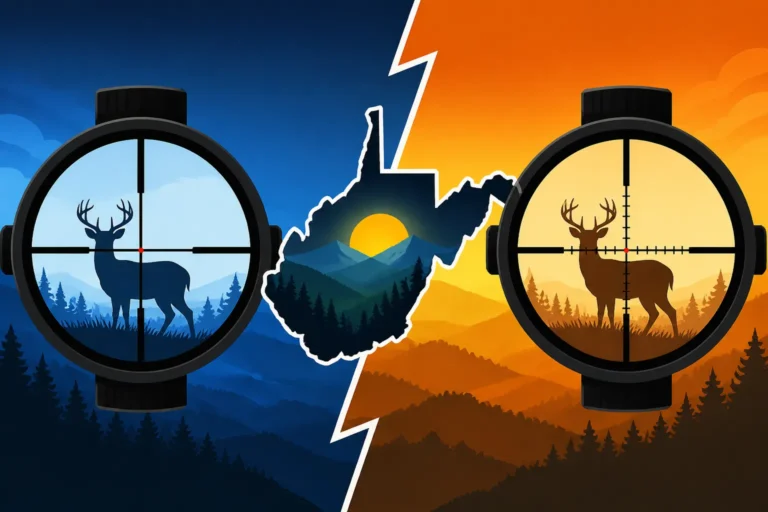
Illumination is another game-changer, especially for those low-light timber scenarios. An illuminated reticle provides a bright, crisp aiming point that stands out against a dark background, making it much easier to see your aiming point in deep shadows or at dawn and dusk. Many offer adjustable brightness settings and different color options (red or green) to suit varying conditions and personal preference. This can be the difference between making an ethical shot and losing sight of your target when you're Hunting a Steep Hollow Head at First Light.
Eye Relief and Exit Pupil
These two often-overlooked features are critical for comfortable and effective hunting, particularly with a crossbow. Eye relief is the distance your eye needs to be from the eyepiece to see a full, clear image. Generous eye relief (typically 3-4 inches) is important for safety, preventing the scope from "biting" you during recoil, but also for comfort and quick target acquisition. You don't want to be constantly adjusting your head position to find the sight picture.
The exit pupil, on the other hand, determines how much light your scope transmits to your eye. It's calculated by dividing the objective lens diameter by the magnification. A larger exit pupil (e.g., 5mm or more) means more light enters your eye, providing a brighter, clearer image in dim conditions – exactly what you need in deep West Virginia timber. Think of it as opening up a wider window; more light comes in, allowing you to see details that would otherwise be obscured by shadow. For getting a good sight picture in that crucial moment, a scope with excellent Low-Light Performance in a Scope is indispensable.
Practical Considerations and Setup Tips
Having the right scope is only half the battle; knowing how to set it up and optimize it for West Virginia's challenging timber environment is equally important. A well-mounted and properly sighted-in scope can instill confidence, while a sloppy setup can lead to missed opportunities and frustration.
Mounting and Sighting In
A scope is only as good as its mounting. For a crossbow, a solid, dependable mount is crucial. Loose rings or a flimsy base can cause your point of impact to shift, leading to accuracy issues. Invest in high-quality rings and bases that are specifically designed for the recoil and vibrations of a crossbow. Always follow the manufacturer's torque specifications for screws to ensure a secure fit without over-tightening and damaging the scope tube.
Sighting in your crossbow for timber ranges will focus on shorter distances. Start by bore-sighting (if your crossbow allows) to get you on paper. Then, head to the range and dial in your 20-yard pin or reticle line. Once your 20-yard point is perfect, move back to 30, 40, and 50 yards, adjusting your other reticle points as needed. Most crossbow scopes will have trajectory lines that are roughly calibrated for certain speeds, but you'll need to fine-tune them with your specific crossbow and arrows. It's a precise process, but essential for knowing exactly where your arrow will land in those critical moments, whether you're taking a shot at a deer moving through a Hunting a Clear-Cut Regrowth Edge or tucked into dense cover.
Weatherproofing and Anti-Fog Features
As we've already covered, West Virginia weather is notoriously unpredictable. One minute it's sunny, the next you're in a downpour or thick fog. Your scope absolutely must be able to handle this. Look for scopes that are advertised as fully waterproof and fog-proof. This usually means they are nitrogen or argon purged and O-ring sealed. This process removes all internal moisture and replaces it with an inert gas, preventing internal fogging when temperatures fluctuate.
External lens coatings are also a big deal. Many quality scopes feature hydrophobic coatings that repel water, snow, and even dirt, keeping your sight picture clear. Imagine trying to hunt during a light drizzle, and your scope lenses are instantly covered in beads of water, making it impossible to see. Investing in a scope with good weatherproofing means one less thing to worry about when the elements decide to challenge your hunt. It's especially critical for those late-season hunts where moisture and cold are constant companions. Cold-Weather Sitting Strategy in the Mountains demands reliable, clear optics.
Calibration for Specific Crossbow Speeds
Modern crossbows vary widely in their arrow speeds (Feet Per Second, or FPS). Many crossbow scopes are designed with this in mind, offering either interchangeable speed rings, adjustable turret caps, or reticles that can be calibrated to match your specific crossbow's FPS. This feature is incredibly useful because it ensures the multiple aiming points on your reticle are accurate for your setup, rather than a generic average.
Before you even mount your scope, understand your crossbow's typical arrow speed. When you get your new scope, check the instructions for how to adjust its reticle or speed settings. This might involve a simple dial on the scope body or matching a set of provided ballistic rings. Taking the time to properly calibrate your scope to your crossbow's speed will drastically improve your accuracy, building your confidence for shots at varying distances in the timber. Resources like GoHunt can often provide data or reviews on scopes that offer these specific calibration features, helping you make an informed choice that matches your particular crossbow model and arrow choice.
Recommended Scope Types for Timber Hunting
Choosing a crossbow scope means navigating a world of options, but for West Virginia timber, we can narrow it down significantly. It's not about what's biggest or brightest in a store display, but what genuinely performs in the dark, dense, and dynamic environment you'll be hunting in.
Fixed Power vs. Variable Power
Both fixed and variable power scopes have their place, but for timber hunting, the choice often comes down to personal preference and typical shot distances.
| Feature | Fixed Power Scope (e.g., 3x, 4x) | Variable Power Scope (e.g., 1.5-5x, 2-7x) |
|---|---|---|
| Pros | – Simpler design, often more durable and reliable | – Adaptable magnification for different scenarios |
| – Lighter weight, fewer moving parts | – Can zoom in slightly for more precise longer shots (within timber range) | |
| – Wider field of view at its single magnification | – Can zoom out for wider field of view at close range | |
| Cons | – Less versatile; magnification can't be adjusted | – More complex, potentially heavier |
| – Might be too much magnification for extremely close shots (under 10 yards) | – Higher cost for equivalent optical quality | |
| Best for Timber | Hunters who primarily take close-range shots (under 40 yards) in dense cover and prioritize simplicity and ruggedness. | Hunters who want the flexibility to slightly adjust for different timber openings and ranges (20-60 yards). |
For many West Virginia timber hunters, a fixed low power scope like a 3x or 4x is perfectly adequate. It offers a wide field of view, is often more robust due to fewer moving parts, and its simple operation means less to fuss with in the moment. However, a variable power scope that starts low, like a 1.5-5x or 2-7x, provides that extra bit of flexibility without sacrificing too much field of view on the low end. This might be beneficial if you occasionally find yourself in a slightly more open area or want to study a target more closely before the shot.
Budget-Friendly vs. Premium Options
Just like any piece of hunting gear, crossbow scopes come in a wide range of price points. It's tempting to grab the cheapest option, but with optics, you truly get what you pay for in terms of glass quality, coatings, and durability.
Budget-Friendly Options: These scopes typically offer basic functionality, standard glass, and perhaps less advanced coatings. They can certainly get the job done for close-range hunting, especially if your budget is tight. However, they might struggle more in low light, have less precise adjustments, and may not be as rugged or reliable in harsh weather conditions. They are a good starting point for new hunters or those with limited funds, but be prepared for potential compromises in performance.
Premium Options: Scopes in this category feature superior glass, advanced multi-coatings on all lens surfaces, robust construction (often from aircraft-grade aluminum), precise turrets, and excellent light transmission. They excel in low light, offer crystal-clear images, and are built to withstand years of abuse in the field. While the initial investment is higher, a premium scope often pays for itself in enhanced performance, confidence, and longevity. If you spend a lot of time in the West Virginia woods, a high-quality scope will make a noticeable difference in your hunting experience.
The GoHunt Advantage in Gear Research
When you're trying to decide between different scope models and features, the sheer volume of choices can be overwhelming. This is where a platform like GoHunt can really shine. While I can't recommend specific models or price points, I can tell you that online resources dedicated to hunting gear are invaluable for comparative analysis.
GoHunt, for instance, often compiles detailed product specifications, user reviews, and expert insights that can help you compare factors like light transmission, reticle options, eye relief, and weatherproofing across various brands. They might even categorize scopes by intended use, making it easier to find options specifically suited for dense timber or specific crossbow models. Before making a significant purchase, diving into such resources can help you understand the nuances between different scopes, see what other hunters are saying about their real-world performance in conditions similar to West Virginia's, and ultimately make a more informed decision tailored to your needs and budget. It's about leveraging collective experience to avoid common pitfalls in gear selection.
Disclaimer
This article is for general informational purposes only and does not constitute professional advice. Laws, prices and regulations vary by location and change over time. Consult a qualified professional for guidance on your specific situation.