Practical Range in Steep Mountain Hollows
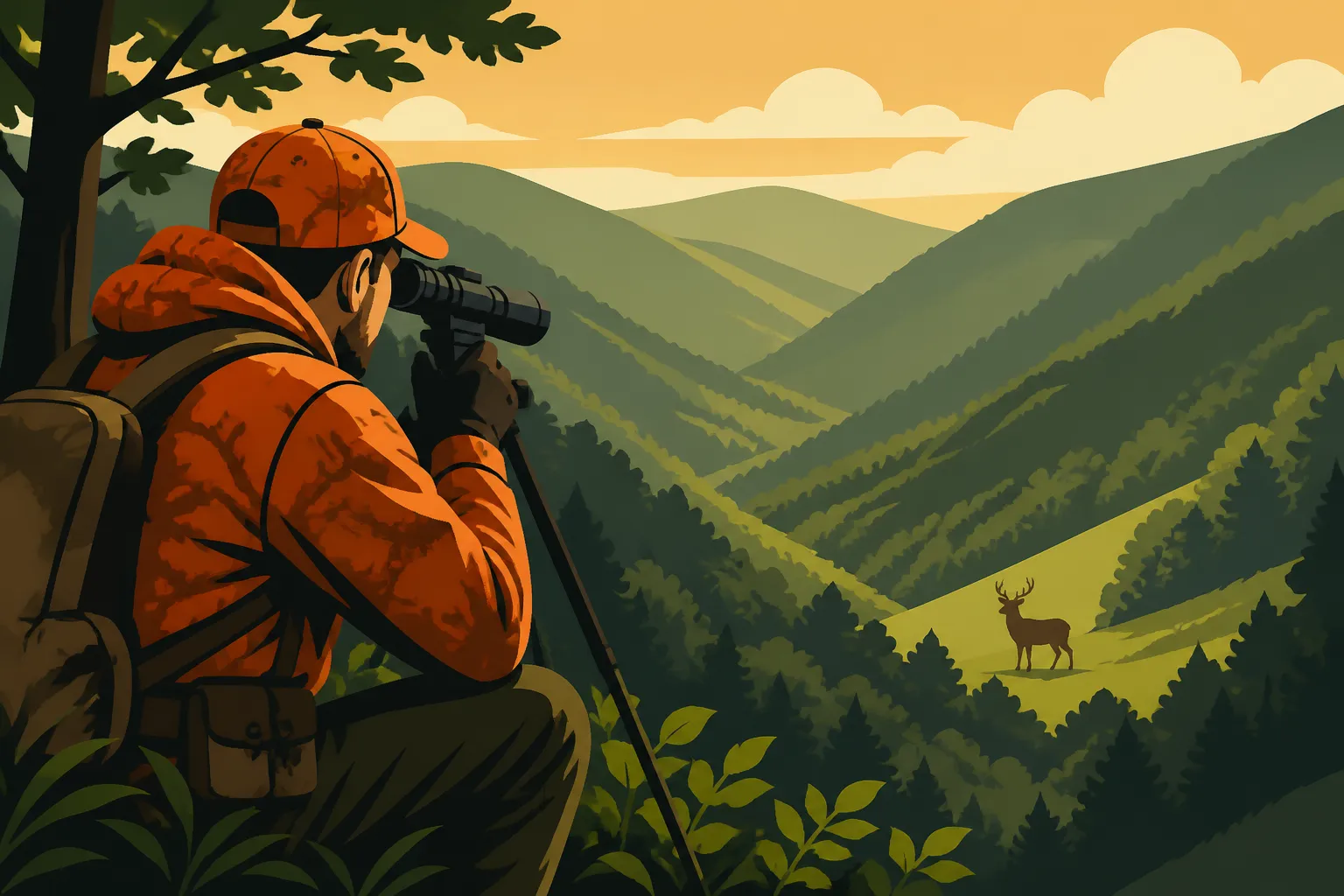
We've all been there: staring down a steep hollow or across a sharp ridge in West Virginia, a magnificent buck or a gobbler strutting seemingly within easy reach. But in the mountains, distance is a trickster. What looks like a chip shot can be a long poke due to angles, and misjudging it can lead to a missed opportunity or, worse, a wounded animal. This guide is all about demystifying practical shooting ranges when hunting the rugged, beautiful, and often deceptive terrain of West Virginia's mountain hollows.
Understanding the Unique Challenges of Steep Terrain for Hunters
Hunting in West Virginia's mountains isn't like sitting in a flat farm field or a Texas treestand. Here, every step can be a climb or a descent, and your shooting lanes are rarely flat. This undulating landscape introduces complexities that can seriously impact your shot, making it crucial to understand how to adjust your approach and gear.
The Illusion of Distance on Angles
Imagine looking down a steep hill at a deer that seems to be 40 yards away. If you aim as if it's 40 yards on flat ground, you might be surprised to find your shot sails high. The optical illusion of steep inclines and declines often makes distances appear shorter than the actual ballistic distance your bullet will travel. Your rifle's scope and trajectory are designed for flat ground, where gravity acts on the bullet over a straight line. When shooting up or down a steep angle, gravity still acts downwards, but the horizontal distance the bullet travels relative to the ground is less than the line-of-sight distance. This means your bullet has less time to drop, leading to a higher impact point if you don't compensate. It’s a common frustration, especially when you think you have a perfect setup in a deep hollow or overlooking a vast ravine.
When you're trying to figure out if that buck is 60 yards or 80 yards, the steepness of the ground changes the game. This is why having a good rangefinder is non-negotiable in this kind of country. A quality rangefinder that provides angle-compensated distance—often called "horizontal equivalent distance" or "shoot-to distance"—is your best friend. Without it, you’re often just guessing, and guessing in hunting, especially with modern flat-shooting rifles, can lead to costly errors. Many hunters are finding great success by using tools like the ones offered by GoHunt, which can help visualize terrain and plan for these angled shots even before you step foot in the woods.
The Impact of Obstructions and Limited Visibility
West Virginia's mountain hollows are often choked with thick cover—rhododendron, laurel thickets, tangled briars, and dense young hardwoods. This isn't wide-open country where you can see for miles. Your practical shooting range is often dictated not just by your rifle's capabilities or the angle, but by the sheer amount of stuff between you and your target. What might be a 200-yard shot on an open field becomes a 50-yard poke if you can only see a small window through the brush.
Visibility can change on a dime. One moment, you're looking into a relatively clear cut, the next you're in a dark, laurel-filled draw where a deer could be 20 yards away and you wouldn't know it until it snorted. This means your "practical range" shrinks dramatically. It's not about how far your rifle can shoot, but how far you can reliably see and hit a vital zone. Scouting plays a huge role here. Knowing the typical sight lines in your hunting area, whether you're Hunting Steep Allegheny Ridges or exploring new ground in Monongahela National Forest Hunting, helps you anticipate these limited shooting scenarios. Always assume the cover will be thicker than you want, and be prepared to take close shots as often as you might take a medium-range one.
Angle Compensation: Why Your Flat-Ground Zero Isn't Enough
This is where the rubber meets the road for mountain hunting. Understanding angle compensation isn't just for long-range shooters; it's vital for ethical hunting even at moderate distances in steep country.
The Physics of Angled Shots
When you zero your rifle, you're doing so on a flat range. This means the bullet follows a parabolic arc, dropping a certain amount over a specific horizontal distance. When you shoot uphill or downhill, gravity's effect on the bullet is effectively reduced relative to the line of sight. Imagine shooting straight up: gravity is pulling the bullet straight back towards you, not "down" in the traditional sense of its flight path. The horizontal component of the bullet's flight is what determines how much gravity acts on it over time.
For any given line-of-sight distance, say 100 yards, if you're shooting at a steep angle (like 30 or 45 degrees), the actual horizontal distance the bullet travels is significantly less. This reduced horizontal distance means less time for gravity to pull the bullet down, resulting in a higher impact point if you aim as if it were a flat 100 yards. This is precisely why a deer at what your eyes perceive as 40 yards down a steep hill might be hit high if you hold dead-on. It's a critical concept, and one that often catches new mountain hunters off guard.
Let's illustrate with a simple table:
| Line of Sight Distance (Yards) | Angle (Degrees) | Horizontal Equivalent Distance (Yards) | Typical Bullet Drop Compensation (Relative to Flat) |
|---|---|---|---|
| 50 | 30 | 43 | Hold a touch lower / Aim for less drop |
| 100 | 30 | 87 | Hold lower / Aim for less drop |
| 150 | 30 | 130 | Hold lower / Aim for less drop |
| 200 | 30 | 173 | Hold significantly lower / Aim for much less drop |
| 50 | 45 | 35 | Hold significantly lower / Aim for less drop |
| 100 | 45 | 71 | Hold significantly lower / Aim for less drop |
Note: These are illustrative figures. Actual bullet drop and holdover will vary greatly based on caliber, bullet weight, muzzle velocity, and atmospheric conditions. Always confirm with your specific ballistics.
As you can see, even at what we might consider "close" hunting ranges, a steep angle reduces the horizontal distance quite a bit. Your rangefinder needs to do this calculation for you, providing that "shoot-to" distance so you can apply your known flat-ground ballistics to the effective horizontal distance.
The Role of an Angle-Compensating Rangefinder
Given the physics, it becomes clear that a standard rangefinder that only gives you line-of-sight distance isn't truly sufficient in West Virginia's mountains. An angle-compensating rangefinder, however, is a game-changer. These devices use internal inclinometers to measure the angle of your shot, then perform the necessary trigonometric calculations to give you the horizontal equivalent distance. This is the distance you would input into your ballistic calculator, or use to determine your holdover or turret adjustment based on your rifle's flat-ground performance.
There are many excellent angle-compensating rangefinders on the market today. Some, like those from Leica or Sig Sauer, offer incredibly fast and accurate readings, even through light rain or fog. When you're trying to quickly range a deer that's only presented itself for a few precious seconds, you don't have time to do math in your head. The rangefinder does the heavy lifting, giving you a confident number to aim with. This allows you to focus on Shot Placement on a West Virginia Black Bear or a whitetail. Combining this technology with a good mapping app, such as GoHunt, can help you scout potential shot angles and distances before you ever set foot on the mountain. You can use their tools to mark potential stand sites and get a rough idea of the terrain's steepness, further refining your strategy for Hunting the Potomac Highlands.
Factors Influencing Your Effective Shooting Range in West Virginia's Mountains
Beyond angles and visibility, several other elements come into play when determining your practical maximum range in West Virginia. These are often overlooked but are crucial for ethical and successful hunting.
Shooter Skill and Practice
Let's be brutally honest: your practical shooting range is ultimately limited by your ability to consistently place a bullet into a vital zone under hunting conditions. It's one thing to shoot tight groups from a bench rest at a flat range; it's quite another to do it after a strenuous climb, heart pounding, in cold, wind, or rain, with a deer quartering away at a steep angle. In the mountains, you often find yourself shooting from improvised positions—leaning against a tree, kneeling, or even sitting precariously on a slope. These are not ideal, and they test your fundamentals.
Regular practice is essential, and it shouldn't just be at a flat range. Seek out opportunities to practice shooting from awkward positions, uphill and downhill. If you can find a safe place to set up targets at varying angles, even better. Knowing your limits is an act of respect for the game you pursue. If you can't consistently hit a 6-inch plate at 150 yards from a hunting position, then 150 yards is beyond your practical range, regardless of what your rifle or rangefinder says it can do. Consider your Rifle Setups for West Virginia Deer Hunting and how well you can shoot them under pressure.
Wind and Thermals
West Virginia's mountains are notorious for swirling winds and tricky thermals. Wind is an invisible force that can push your bullet significantly off course, especially at longer distances. In deep hollows, wind can be completely different at your position than it is down in the valley where your target stands. Ridge tops often have consistent crosswinds, while sheltered hollows might have little to no wind. However, as the sun warms or cools the air, thermals start to move up and down slopes, carrying your scent and potentially a bullet.
Understanding Wind and Thermals on a Steep Ridge is crucial not just for scent control but also for shot placement. A rangefinder might give you a perfect angle-compensated distance, but if a strong crosswind pushes your bullet three inches off target, it doesn't matter. Practice in windy conditions, if safe to do so, to get a feel for how your rifle and ammunition perform. For most West Virginia hunting scenarios, where shots are often under 200 yards due to cover, wind compensation might involve simply holding slightly into the wind. But at longer ranges, or in very high winds, it becomes a much more complex calculation.
Ethical Considerations and Shot Placement
Ultimately, the goal is a clean, ethical kill. This means placing your bullet precisely into the animal's vital zone (heart/lungs). The size of this zone doesn't change, but your ability to hit it consistently does, especially with all the variables of mountain hunting. When considering your practical range, always err on the side of caution. If there's any doubt about your ability to make a clean kill, pass on the shot.
This is particularly true when hunting larger game like bear or elk (if you're lucky enough to draw an elk tag in the southern coalfields). Their vital zones are robust, and a marginally placed shot can lead to a long, difficult, and potentially unsuccessful tracking job, especially on steep, unforgiving terrain. Always be intimately familiar with your animal's anatomy. When you're Hunting West Virginia's Liberal Bear Season, for example, shot placement is even more critical due to the bear's tough hide and dense bone structure. Knowing your rifle's limits and, more importantly, your limits is the hallmark of a responsible hunter.
Gear and Practice for Mastering Mountain Shots
Having the right equipment and committing to realistic practice can make all the difference when hunting West Virginia's steep terrain. It's about building confidence in your setup and your abilities.
Essential Gear for Steep Country Shooting
Beyond your rifle and ammunition, a few pieces of gear are non-negotiable for maximizing your practical range in the mountains:
- Angle-Compensating Rangefinder: We've already hammered this home, but it's truly the most important tool for accurately judging distance on angles. Look for models that are rugged, waterproof, and have fast acquisition times.
- Good Optics: A quality rifle scope with clear glass and a reliable reticle is crucial. Many hunters prefer scopes with a holdover reticle (BDC, Christmas tree, etc.) or a turretting system for quick adjustments. Rifle Scopes for Low-Light Hollows are particularly useful in the often dark, shaded hollows of West Virginia. Pairing your rifle scope with Binocular Choice for West Virginia Whitetails will give you good visibility across varied terrain.
- Trekking Poles: While not directly shooting gear, trekking poles are invaluable for maintaining balance and stability on steep ascents and descents. This means you arrive at your stand or stalking position less fatigued, more stable, and ready to make a steady shot. Many hunters underestimate their utility, but once you use them for a long hike in the Hunting Potomac Highlands Public Land, you'll wonder how you lived without them.
- Appropriate Footwear: Stability starts from the ground up. High-quality, supportive boots with excellent ankle support and aggressive tread are vital for navigating steep, often rocky or muddy terrain. They give you a solid foundation when you set up for a shot, reducing wobble and improving your stance.
The Importance of Realistic Practice
You can have the best gear in the world, but without realistic practice, it won't matter much. Think beyond the flat range:
- Shoot from Hunting Positions: Practice shooting kneeling, sitting, leaning against trees, and from various field expedient rests. Simulate the conditions you'll encounter in the woods. For example, if you're using a treestand, practice shooting from your stand or a similar elevated position.
- Incorporate Angles: If possible, find a safe location where you can practice shooting uphill and downhill. This will give you a real-world understanding of how your rifle and ammunition perform on angles and how your rangefinder aids in those shots. Pay attention to how your body position changes and how it affects stability.
- Practice Under Duress: Go for a brisk walk or a short run, then immediately try to make a steady shot. This simulates the elevated heart rate and adrenaline you might experience when a prime animal suddenly appears. This kind of practice isn't about speed, but about quickly recovering your composure and making an accurate shot under less-than-ideal circumstances. It's about building muscle memory for a quick, ethical shot.
- Know Your Ballistics: Understand your specific rifle and ammunition's trajectory inside and out. Use a ballistic calculator to generate drop charts for various distances and conditions. Carry these charts with you. While an angle-compensating rangefinder gives you the horizontal distance, you still need to know what that means for your bullet. Tools like the GoHunt app often integrate ballistic data, making it easier to reference. When you're Zeroing at 100 Yards for Woods Hunting, remember that's just a starting point; the mountain will demand more from you.
West Virginia's mountains offer some of the most challenging and rewarding hunting experiences out there. By understanding the nuances of practical shooting ranges in steep hollows and ridges, equipping yourself appropriately, and committing to realistic practice, you can increase your chances of success and ensure an ethical harvest every time.
Disclaimer
This article is for general informational purposes only and does not constitute professional advice. Laws, prices and regulations vary by location and change over time. Consult a qualified professional for guidance on your specific situation.