Calling Crows Over a Winter Feed Site
As the chill of winter settles over West Virginia, many hunters find themselves longing for action after deer season closes. Crow hunting over a winter feed site offers a fantastic opportunity to stay sharp and enjoy fast-paced shooting. This guide will help you understand crow behavior, choose the right gear, and master calling techniques to ensure successful hunts during the colder months.
Understanding West Virginia Crow Behavior in Winter
The common crow (Corvus brachyrhynchos) is a highly intelligent and adaptable bird, and their behavior changes significantly with the seasons. Understanding these shifts is absolutely critical to successfully calling them in during the lean months of winter here in West Virginia. It's not just about making noise; it's about understanding their daily rhythm and what drives them.
Why Winter is Prime Time for Crow Calling
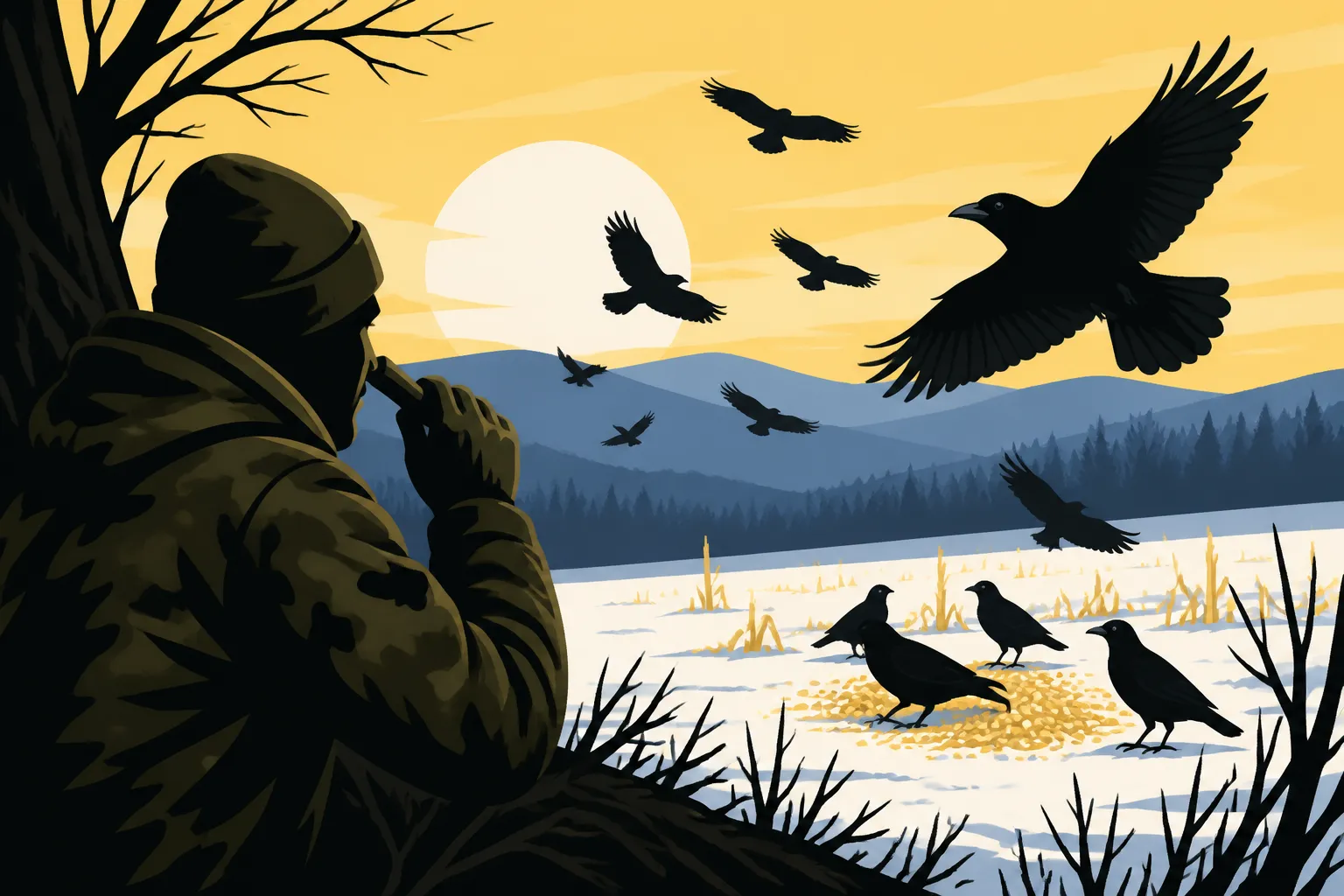
Once the leaves have fallen and the cold sets in, crows in West Virginia undergo a remarkable transformation in their social structure. Unlike the smaller family groups you might see in summer, winter sees them congregating in massive communal roosts, sometimes numbering in the tens of thousands. Imagine the sheer volume of birds! This congregation is both a blessing and a curse for hunters. On one hand, it concentrates the target, making them easier to locate. On the other, these large groups are incredibly wary, having survived many seasons of predator evasion.
The scarcity of natural food sources during winter is another huge factor. Gone are the easy pickings of summer insects, fallen fruits, and garden scraps. This forces crows to become highly dependent on predictable, concentrated feed sites. These can range from agricultural fields with leftover grain to cattle feedlots, and even landfills. They're driven by hunger, and that drive makes them more responsive to calls that suggest either a food source or a threat to their kin. Furthermore, the bare trees and open landscapes of a West Virginia winter provide less cover for crows, making them easier to spot when they're flying high, but also making it harder for you to remain undetected. This open visibility makes your concealment even more crucial.
Identifying Key Winter Feed Sites
Successfully hunting crows in winter isn't just about calling; it's about location, location, location. Crows are creatures of habit, especially when it comes to finding reliable sustenance in tough conditions. Your first step should always be diligent scouting.
Focus your attention on agricultural areas. Think about the sprawling cornfields and soybean fields across the Eastern Panhandle, or even smaller plots in river bottoms. Even after harvest, residual grain provides a vital food source. Areas with livestock are also goldmines; cattle feedlots, chicken houses, and even pastures where cattle are fed hay often have spilled feed that crows eagerly scavenge. Don't overlook municipal landfills either. While perhaps not the most glamorous hunting spot, they are guaranteed to attract huge numbers of crows seeking an easy meal.
Beyond the actual feeding grounds, pay attention to the surrounding landscape. Crows will often stage in tall, dense conifer stands or thick woods near their chosen feed site before flying in to eat. They feel safer in these areas, allowing them to survey the scene before committing. Observing their flight paths from these staging areas to the feed site can give you a crucial insight into their approach. You'll want to set up along these corridors.
While driving around and simply observing is a classic method, modern technology can give you a significant edge. Tools like GoHunt are incredibly useful for identifying potential agricultural areas, identifying property boundaries, and even spotting dense wooded areas adjacent to fields on satellite imagery. This digital reconnaissance, much like when you're Reading West Virginia Mud for Fresh Deer Movement for deer, helps you narrow down potential hot spots before you ever set foot on the ground. Look for patterns: where do they fly in the morning, where do they feed midday, and what routes do they take back to the roost in the evening? Answering these questions through diligent scouting, both digital and in-person, will dramatically increase your chances of success.
Essential Gear for West Virginia Crow Calling Success
Just like any other hunting pursuit, having the right tools for crow calling can make all the difference. You wouldn't go after a trophy buck with a slingshot, and you shouldn't expect consistent crow hunting success without proper gear. It's about combining visual trickery with auditory deception to outsmart some of the smartest birds in the woods.
Decoy Strategies for Winter Crows
Crows possess incredibly keen eyesight, perhaps even better than a turkey's. This means that visual attraction, in the form of decoys, is just as important as your calling, if not more so. A lone hunter making crow noises in an empty field is far less convincing than a hunter surrounded by a convincing spread of "other crows."
When it comes to decoys, think quantity. The more, the better. While you can certainly have success with a dozen, aiming for 20-30 decoys will create a much more compelling visual. These can be full-bodied shells, lightweight silhouettes, or even a mix. Place them realistically: some on the ground as if feeding, some perched on fence posts (if safe and legal to use the fence) or on strategically placed poles to act as "sentinels" surveying the area. A few decoys placed higher up can catch the attention of distant crows.
Motion decoys are absolute game-changers. A flapping crow decoy, often battery-operated, adds an element of realism that static decoys simply cannot replicate. The movement catches the eye and convinces wary incoming birds that there's active, safe feeding happening. If you've managed to harvest a few crows previously, and local regulations allow, using freshly killed crows strategically placed in your spread can be incredibly effective. Just ensure they look natural. Always remember that realism and cleanliness are key; a spread of dusty, sun-faded, or poorly placed decoys will do more harm than good. Keep them clean, and position them as you would observe real crows in a field.
Choosing the Right Crow Calls
Once you have your visual setup, it's time to add the sound. The world of crow calls is diverse, offering options for every budget and skill level. Your choice will largely depend on how much control you want over your sound and your personal preference.
Hand Calls: These are the traditional choice and require a certain level of skill to master. They generally fall into categories like open reed or closed reed. The beauty of hand calls is the nuance you can achieve – the subtle variations in tone, volume, and cadence that an electronic call might sometimes struggle to replicate. You'll want to practice a variety of sounds: general caws to attract attention, assembly calls to gather the flock, distress calls (imitating a crow being attacked by a predator), and even fight calls which can sometimes draw in aggressive birds. Brands like Faulk's, Primos, and Johnny Stewart offer excellent hand calls. The ability to instantly change the intensity and emotion of your call with a hand call can be incredibly effective when working with incoming birds.
Electronic Calls: For many hunters, especially those new to crow hunting or looking for maximum efficiency, electronic calls are an excellent choice. These devices, from companies like Foxpro, Icotec, or Lucky Duck, offer a wide range of pre-programmed crow sounds at the push of a button. Their benefits are undeniable: incredible volume to reach distant birds, a huge variety of authentic sounds, and hands-free operation once set up, allowing you to focus on shooting. They are particularly useful for initial long-range attraction. You can cycle through different calls, adjust volume, and create complex sequences without needing to take a breath. Just be sure to check local regulations regarding the use of electronic calls for migratory birds, although crows are generally considered non-game or pest species, rules can vary. Whether you choose hand or electronic, remember that varying your calls and not overdoing it is crucial. A good Coyote Calling in West Virginia Farm Country strategy often involves varying calls and timing, a principle that applies just as well to crow hunting.
| Call Type | Purpose | Sound Description | When to Use |
|---|---|---|---|
| Basic Caw | General communication, assembly | "Caw, caw, caw" – even, moderate pitch | Initial calling, getting distant attention |
| Assembly Call | Gathering the flock, calling them in | "Caw-caw-caw-CAW!" – increasing intensity, urgent | When crows are far off, encouraging them to fly closer |
| Distress Call | Crow in trouble, predator attack | Erratic, frantic "CAW-aw-AW-AW!" – high-pitched, desperate | When crows are approaching, to incite mobbing or aggression |
| Fight Call | Crows fighting or mobbing a predator | Loud, aggressive "RAAAW-Caw! RAAAW!" – harsh, agitated | Can draw in curious or territorial crows, often paired with distress |
| Young Crow Call | Submissive, less threatening | Softer, higher-pitched "caw" | When crows are wary, to sound less aggressive |
Effective Calling Techniques at Winter Feed Sites
You’ve scouted your location, you’ve got your decoys, and your calls are ready. Now comes the art of the hunt: setting up correctly and mastering the calls to bring those sharp-eyed birds within range. Crows are notoriously smart, and a clumsy setup or poor calling sequence will send them packing faster than you can say "caw."
Setting Up Your Calling Station
Concealment is absolutely paramount when hunting crows. Their eyesight is legendary, and any glint of sun off your barrel, an exposed face, or unnatural movement will send them veering away. You need to become part of the landscape.
Identify natural cover such as thick hedgerows, the edge of a dense woodlot, or even a strategically placed brush pile along the flight path leading to the feed site. A pop-up ground blind is an excellent investment for crow hunting, offering quick and effective concealment. If you use one, go the extra step and Brushing In a Blind on a Field Edge by adding natural vegetation to break up its outline. Remember, even a small patch of woods can provide enough cover. Just make sure your back is to the thickest part of the cover, creating a dark backdrop that helps you disappear.
Wind direction is another critical factor. Crows, like most birds, tend to approach and land into the wind. Set up so that the prevailing wind will bring incoming birds over or past your decoy spread, allowing them to approach from a direction where you are well-concealed. This often means having the wind at your back or quartering. You want them focused on the decoys, not on your position.
Place your decoys strategically within shotgun range, typically 20-40 yards from your calling station. This allows for clean, ethical shots. Ensure you have clear shooting lanes through your concealment. Nothing is more frustrating than having a flock of crows commit only to have your shot blocked by an unseen branch. This thoughtful setup, much like effectively Using a Ground Blind on West Virginia Public Land for deer, dramatically increases your chances of success.
Mastering the Art of the Crow Call Sequence
Once you're concealed and your decoys are set, it's time to bring the magic of the call to life. Don't just blast away haphazardly; crow calling is about telling a story with sound, building curiosity, and then inciting a reaction.
Start your sequence with basic assembly or general caws. These are softer, more inquisitive calls designed to attract distant birds and make them curious enough to fly closer. Think of it as a casual conversation. Use your electronic call for this initial phase, as its volume can carry further and grab attention from birds you can't even see yet. A good starting sequence might be a series of three to five caws, followed by a minute or two of silence, and then repeating.
As you spot incoming crows, or if they're still a good distance out, transition to a more urgent assembly call. This tells them, "Hey, something's happening over here, you better come check it out!" Once they get closer and are within a few hundred yards, switch to distress calls. This is where you imitate a crow in trouble—perhaps being attacked by a hawk or owl, or even a territorial fight. This often triggers a "mobbing" response, where crows, driven by aggression or a desire to protect their own, will fly in to harass the perceived threat. This is your moment to shine with a hand call, adding the realistic, frantic nuances that can seal the deal.
Vary the volume and cadence of your calls. Crows are intelligent and can become "call shy" if they hear the same monotonous sequence repeatedly. Mix it up, be dynamic. Sometimes less is more; letting the decoy spread and the natural curiosity do some of the work. If birds are hanging up just out of range, try a few soft, pleading distress calls, or even go completely silent for a moment. This unpredictable nature can sometimes entice those wary birds just a little closer. The principles of timing and varied vocalization are similar to what you’d use when Predator Calling West Virginia Ridgelines at Dusk, needing to adapt to how your target responds.
Safety and Ethics in Crow Hunting
While crow hunting often takes a backseat to other game species, it's still a serious pursuit that demands adherence to safety protocols and ethical considerations. Being a responsible hunter means respecting the land, wildlife, and your fellow citizens.
Respecting Landowner Rights and Regulations
The vast majority of winter crow hunting takes place on private land, especially around those prime agricultural feed sites. This makes obtaining explicit permission from the landowner absolutely non-negotiable. Even if you're targeting what some consider a "pest" species, hunting without permission is trespassing and illegal. Always ask, and if possible, get written permission. This is especially true in West Virginia, where it's wise to understand the specifics of Do You Need Written Permission in West Virginia? to avoid any misunderstandings.
Beyond permission, you must be intimately familiar with West Virginia's specific hunting regulations for crows. While they are often classified differently than game birds, there can still be legal shooting hours, bag limits (though often very liberal or non-existent for crows), and restrictions on certain equipment. Consult the West Virginia Small Game Season Rules to ensure you are compliant. Always know your surroundings, especially regarding setbacks from roads, dwellings, and occupied structures. A crow hunt that results in a call to law enforcement is a failed hunt, regardless of how many birds you harvested. Use mapping applications such as GoHunt to identify property boundaries and ensure you're on legal ground, confirming your location before you begin calling.
Handling Your Harvest Responsibly
While crows are not traditionally hunted for table fare, responsible handling of your harvest is still crucial. Leaving a pile of crow carcasses visible from a roadway or where they might cause a nuisance reflects poorly on all hunters and can jeopardize future hunting access. If you're going to use harvested crows as additional decoys, ensure they are positioned naturally and removed at the end of your hunt. Otherwise, dispose of them discreetly and respectfully.
Crow hunting is a fantastic way to sharpen your shooting skills, practice concealment techniques, and learn how to read animal behavior under pressure. These are skills that are directly transferable to other forms of hunting, like Spring Turkey Hunting in West Virginia or even deer hunting. It’s also an excellent opportunity to introduce new hunters to the sport in a fast-paced, action-filled environment with fewer regulatory complexities than big game hunting. By adhering to ethical hunting practices and respecting the land, you ensure that this thrilling winter pursuit remains available for years to come.
Disclaimer
Please ensure you check the most current West Virginia Department of Natural Resources (WVDNR) hunting regulations before heading afield, as rules and seasons can change. This guide is for informational purposes only and does not supersede official WVDNR regulations.