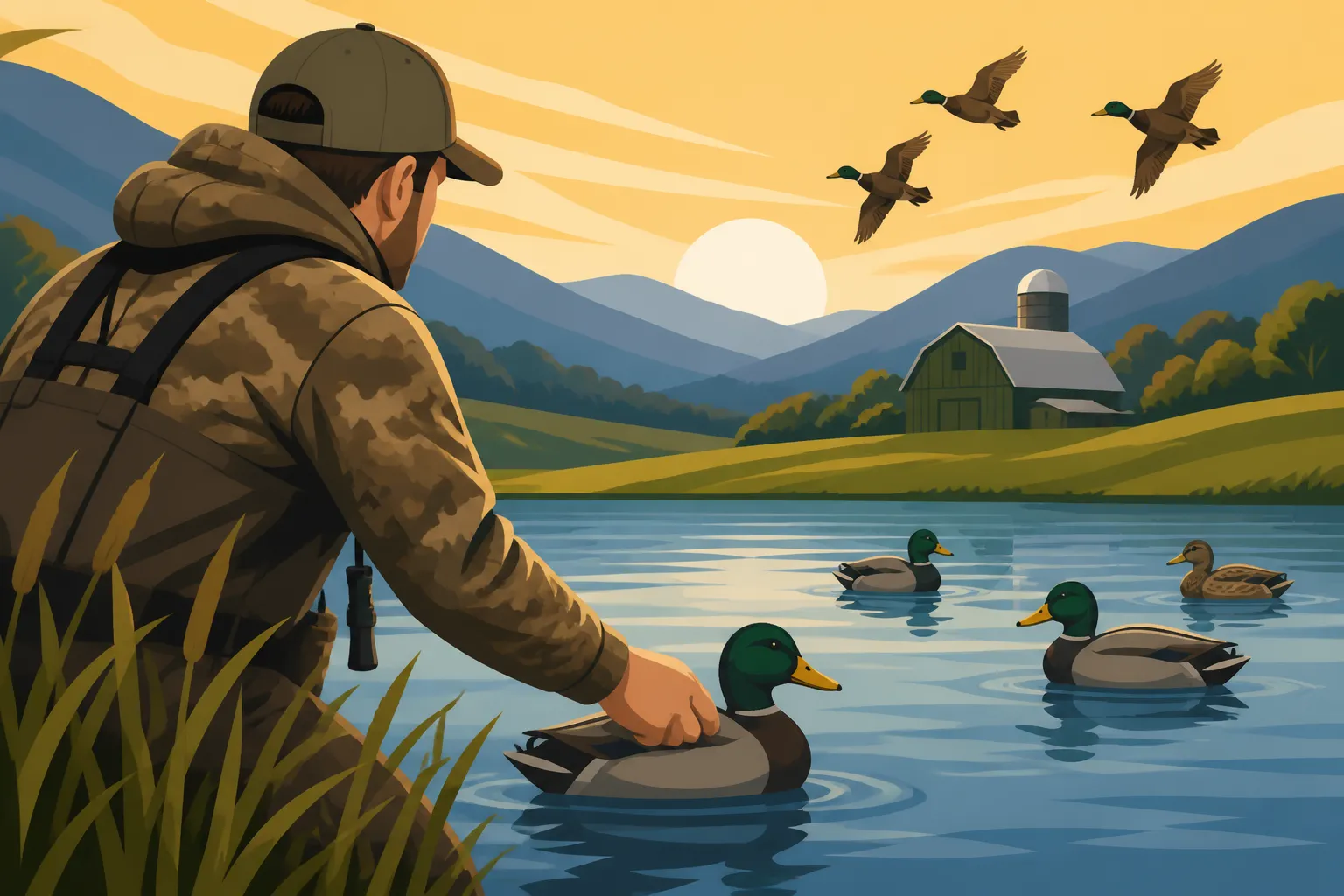
Setting Decoys on a Farm Pond
Hunting waterfowl on West Virginia farm ponds can be incredibly rewarding, but it often comes with the frustration of birds flaring at the last second or never committing to your spread. It feels like you've done everything right—set up early, got your calls ready—only for the ducks or geese to give your pond a wide berth. This guide will walk you through the nuances of setting decoys effectively on these smaller bodies of water, helping you understand how local conditions and bird behavior dictate successful spreads, and ultimately, put more birds in your bag.
Understanding Farm Pond Dynamics for Waterfowl
Farm ponds are a unique beast compared to the vast rivers or sprawling lakes that often come to mind for waterfowl hunting. Their smaller size and isolated nature mean that ducks and geese use them differently, and your decoy strategy needs to reflect that. It's not just a mini-version of a big water spread; it requires a whole different mindset.
Reading the Water and Surrounding Habitat
Before you even think about tossing out a single decoy, take the time to really read the pond and its surroundings. Is it a deep, clear pond, or is it shallow and muddy with emergent vegetation? Are there standing cornfields nearby, or perhaps freshly cut bean fields that birds might be feeding in? The surrounding habitat dictates what birds are likely using the pond and why. For instance, a pond nestled beside a cornfield is often a staging area for Canada geese after they've had their fill of grain, or a resting spot for mallards and wood ducks passing through. Conversely, a pond in a heavily wooded area might attract more wood ducks seeking cover and acorns.
Understanding these habitat connections is crucial. If ducks are feeding in a nearby field, they might only use the pond for loafing, resting, or getting a drink. This influences the mood your decoy spread should convey. A relaxed, loafing spread is much different from an aggressive, feeding one. Also, consider the pond's edges: are there steep banks, or gentle slopes with muddy edges perfect for dabbling? Even small details like a lone standing dead tree or a brush pile can become a natural attractant or a key reference point for incoming birds. Utilizing tools like GoHunt's aerial imagery can provide an invaluable scouting advantage, letting you pinpoint these features and surrounding agricultural fields without even stepping foot on the property. This kind of pre-hunt intelligence, much like Scouting West Virginia Public Land Before Season, is often the difference between a bust and a bounty.
Understanding Waterfowl Behavior on Ponds
Waterfowl, particularly on smaller, more intimate settings like farm ponds, are highly attuned to their environment and the behavior of other birds. They're looking for safety, food, and a place to rest. On a small pond, especially one that sees some hunting pressure, birds are often warier. They've likely been shot at before, or at least observed others doing so. This means your decoy spread needs to scream "safety and contentment" rather than "party central."
Think about how ducks and geese actually behave when they land on a small pond. They don't typically pile up in one massive clump. Instead, they might spread out a bit, with some dabbling on the edges, others preening in the middle, and a few acting as sentinels. They tend to land into the wind, often setting down short of the main group before swimming in. Geese, being larger and often more cautious, might circle several times, gaining altitude to survey the scene before committing. Wood ducks, on the other hand, often drop in quickly, almost vertically, especially if the pond is partially timbered. Your spread should mimic these natural landing patterns and relaxed behaviors, creating an inviting, believable scene. It’s a subtle game of persuasion, telling the birds through your spread that this particular pond is exactly where they want to be.
Strategic Decoy Placement: It's More Than Just Throwing Them Out
The common mistake I see hunters make is simply tossing out a dozen decoys in a blob and hoping for the best. While that might occasionally work on unpressured birds in a remote area, it's rarely effective on West Virginia farm ponds where ducks and geese are usually more cautious. Strategic placement is about creating an illusion of safety and a clear, inviting landing zone.
Creating Landing Zones and Funnels
The core principle of any good decoy spread, especially on smaller water, is to create a well-defined "landing zone." This is the open patch of water where you want the birds to land, ideally within easy shooting range. The landing zone should always be positioned so that incoming birds will approach it flying into the wind, presenting a natural shot as they cup their wings.
To achieve this, your decoys should form a shape that funnels birds into that open space. Common effective shapes include a "J-hook," a "U-shape," or even a loose "V" pointing away from your blind. The long arm of the "J" or one side of the "U" should extend downwind, drawing birds past your blind and into the open water where they can turn and land. Imagine you're an air traffic controller, guiding the aircraft (ducks and geese) to their designated runway. This strategic thinking applies whether you're focused on Waterfowl Gear for Ohio River Bottoms or simply a small farm pond in the Eastern Panhandle. The landing zone doesn't need to be huge; on a small pond, even a 10×15-foot open area can be plenty. Just make sure it's clear of obstructions and offers a calm, appealing space.
Decoy Numbers and Types
For farm ponds, less is often more when it comes to decoy numbers. A massive spread of 50 decoys can look unnatural and overwhelming on a small body of water, making wary birds suspicious. For ducks, a spread of 6-12 realistic decoys is often perfect. For geese, depending on the size of the pond, 3-6 full-body or shell decoys can be incredibly effective. The key is realism over quantity. Mix up your decoy types: include a few feeders with heads down, some upright sentinels, and a preener or two. This diversity adds to the illusion of a relaxed flock.
If you're targeting a mix of species, it's fine to have a few different types of decoys. For instance, a small group of mallards with a couple of wood ducks and perhaps a pair of teal can create a very natural-looking spread. Don't forget motion decoys! A spinning wing decoy (like a Mojo) strategically placed at the edge of your landing zone, or a jerk string setup, can add vital movement that makes your spread come alive, especially on calm days. However, be mindful of overdoing it; sometimes, a single motion decoy is enough to catch attention without making the spread look artificial.
Here's a quick comparison of common decoy types and their typical uses:
| Decoy Type | Best Use Case | Pros | Cons |
|---|---|---|---|
| Floating Decoys | Most common, versatile for ducks/geese | Realistic motion in wind, easy to deploy | Can tangle, limited motion in calm conditions |
| Full-Body Decoys | Geese on field edges or shallow water | Highly realistic, visible from a distance | Bulky to transport, expensive, less movement in water |
| Shell Decoys | Geese on field edges, lighter than full-bodies | Lighter, stackable, more affordable | Less realistic than full-bodies, less effective on water |
| Spinning Wing Decoys | Attracting ducks from a distance, calm days | High visibility, adds crucial motion | Can spook wary birds if overused, battery dependent, less natural |
| Jerk Rigs / Swimmers | Close-range realism, subtle motion for wary birds | Natural, subtle movement, no batteries | Requires user interaction, best for shallow water |
| Feeder Decoys | Mimics feeding behavior, adds realism to spreads | Looks natural, encourages commitment | Can be less visible to high-flying birds |
Decoy Spreads for Different Scenarios
The "perfect" decoy spread doesn't exist; it's always an adaptation to the specific birds you're hunting, the pond's layout, and the day's conditions. But we can certainly talk about some proven setups for common West Virginia scenarios.
Early Season Puddle Ducks
When West Virginia's duck season first opens, especially for early segments like the youth hunt or even the general opener, you'll often find a mix of local birds—lots of mallards, wood ducks, and green-winged teal. These birds might not be as pressured yet, but they're still wary. On a farm pond, a smaller, more intimate spread works best.
For puddle ducks, focus on a relaxed, feeding, or loafing look. A "loose J-hook" or "U-shape" with the opening pointing towards your blind, and the long arm extending downwind, is often ideal. Place most of your mallard decoys in the "body" of the J or U, with a few wood duck or teal decoys mixed in closer to the shore, perhaps near some cover. The key here is not to cram them too tightly; give them some breathing room. Have a few feeder-style decoys with their heads down near the edges of the open water, suggesting contentment. You want to create the impression that this pond is a safe, easy place to relax or grab a bite before heading to nearby fields. This approach is excellent for attracting local groups of ducks, and often complements methods used when Hunting the West Virginia Youth Deer Weekend if you're out with a young hunter, as early season hunts often overlap. Remember, these birds are still enjoying the bounty of summer, so keep the vibe mellow and inviting.
Late Season Divers and Honkers
As the season progresses and colder weather pushes more migratory birds south, you might find divers like ring-necks or buffleheads on deeper ponds, and definitely more Canada geese on nearly all farm ponds, especially those near agricultural fields. Your decoy strategies need to shift accordingly.
For geese, a small cluster of 3-6 full-body or shell goose decoys placed either on the bank or in very shallow water near the edge of the pond can be highly effective. Geese often land outside a water-based spread and walk in, or they'll loaf on the bank. If you're targeting geese coming from a cornfield, placing a few goose decoys in a natural family group (a few feeders, one or two sentinels) on the field edge near the pond can be deadly. For divers, who tend to congregate in tighter groups on open water, a small "blob" or "pod" of 6-8 diver decoys in the middle of a deeper pond can work. Leave plenty of open water around them for the birds to land, but divers typically commit more aggressively to a tight group than dabblers do. If you have both ducks and geese using the pond, you can combine these elements: a small duck spread with a landing zone, and a separate, distinct group of goose decoys. This mimics how different species often segregate themselves slightly on the water, but still share the same general area. Think about how Canada Geese on West Virginia Farmland interact with smaller puddlers, and adjust your spread to reflect that dynamic.
Adapting to Conditions and Local Birds
Even the most well-thought-out decoy spread can fall flat if you don't adapt to the ever-changing conditions of the day or the specific habits of the local birds. West Virginia weather is notoriously unpredictable, and bird behavior can shift on a dime.
Wind and Weather Considerations
Wind is arguably the single most important factor after concealment when setting decoys. Ducks and geese almost always land into the wind, as it provides lift and allows them to slow down for a controlled descent. Your landing zone must be positioned so that birds approaching it will be facing into the wind as they set their wings. If the wind shifts, you might need to quickly reposition your decoys. This is where having easily retrievable lines and weights comes in handy.
On windy days, your decoys will have natural movement, which is a huge advantage. On calm days, however, decoys can look lifeless. This is where motion decoys, like jerk strings or even battery-operated flappers, earn their keep. Just remember the "less is more" rule for motion; one well-placed spinning-wing decoy is usually enough to draw attention without looking fake. Rain, fog, or snow can also impact visibility and bird behavior. In heavy fog, birds might fly lower and be less likely to spot a spread from a distance, requiring closer attention to calling. In snow, contrasting your decoys against the white background can be effective, and birds might be more desperate for reliable food and resting spots. Hunters should also consider that Where Nontoxic Shot Is Required in West Virginia often includes wetlands and some public lands, so be sure your ammunition complies.
Calling and Concealment
Your decoy spread sets the visual stage, but your calling provides the auditory invitation. On small farm ponds, subtlety is often best. Aggressive calling can spook wary birds, especially late in the season. Start with soft greeting calls or feeding chuckles. As birds approach, if they seem interested, you can increase the intensity slightly, but back off immediately if they start to flare or show signs of suspicion. Observe how the birds respond, and adjust your calling to match their mood. Sometimes, just a few quiet quacks or honks are all it takes. For a truly realistic setup, sometimes a simple pair of soft quacks from a mallard hen and a contented grunt from a goose are all that’s needed to seal the deal.
Crucially, all this effort in decoy placement and calling is wasted without proper concealment. On a small pond, birds are often looking directly at your setup from a relatively close distance. Build a blind that truly blends into the natural surroundings, whether it's brushing in a natural hide along the bank or using a portable blind that matches the local vegetation. Don't forget overhead concealment! A bird circling high might spot you through an open top. Keep your movements to an absolute minimum once birds are in sight. If you need to check your phone or consult your GoHunt app for a topo map of nearby fields, do it when the coast is clear. The less a duck or goose perceives any threat, the more likely they are to commit fully to your perfectly laid-out spread. After all, what good is a perfect spread if the birds see you moving around like a marionette?
Disclaimer
Hunting is an inherently dangerous activity. Always prioritize safety, understand and follow all West Virginia hunting regulations, and obtain appropriate licenses and permissions. The information provided here is for educational purposes and should not replace professional guidance or official WVDNR resources.