Turkey Tactics for Eastern Panhandle Field Edges
Hunting turkeys on those expansive, often beautiful field edges in the Eastern Panhandle can be incredibly rewarding, but let's be honest, it can also be infuriating. You spot a magnificent gobbler strutting his stuff a mile away, meticulously plan your approach, get set up perfectly, and then… he just hangs up, mocking you from 100 yards out, or worse, he vanishes into thin air. It’s a common frustration when those birds seem to have a sixth sense for danger. This guide is all about tackling those challenges head-on, giving you the field-tested tactics you need to bring those wary Eastern Panhandle gobblers within range.
Understanding Eastern Panhandle Turkeys and Their Field Edge Habits
The Eastern Panhandle of West Virginia is a unique mosaic of rolling farmland, scattered woodlots, and deep hollows. This isn't the dense, unbroken timber of the Allegheny Mountains, and that means the turkeys here operate a little differently. They have a constant interplay between open fields and the security of the forest, which shapes their daily routines and, crucially, their wariness.
Why Turkeys Love Field Edges (and Why They're Tricky Here)
Turkeys are opportunists, and field edges offer a smorgasbord of advantages. In the spring, those greening fields are often teeming with insects, tender young plants, and spilled grains from previous harvests, providing crucial food sources after a long winter. The open expanse of a field also serves as the ultimate strutting stage for gobblers looking to attract hens. Imagine a king on his throne, putting on a grand display where every hen in the vicinity can see him. The edge of the field provides that perfect transition zone – open enough for display and feeding, but with immediate access to dense cover for escape or roosting.
However, this convenience comes with a catch, especially in the Eastern Panhandle. These birds are often exposed to higher levels of human activity compared to their deep-woods cousins. Farmers are out working, hikers might be on nearby trails, and other hunters are certainly in pursuit. This constant exposure breeds a keen sense of self-preservation, making these gobblers notoriously wary. They’ve likely seen it all before: the suspicious lump in the fencerow, the movement that wasn't a deer, the calls that just didn't sound quite right. So, while they love the edges for resources and strutting, they approach them with extreme caution, often "hanging up" just out of shotgun range, especially as the season progresses. It’s a frustrating dance, but understanding their wariness is the first step to outsmarting them.
Reading the Land: Field Edge Features That Attract Gobblers
Not all field edges are created equal. To consistently find success, you need to learn to "read" the terrain and identify those specific features that act as natural magnets for gobblers. In the Eastern Panhandle, where you'll find everything from open pastures to fields bordered by thick laurel and oak stands, certain topographical and vegetative elements almost guarantee turkey activity.
Look for natural pinch points where a field narrows or a strip of timber juts out, forcing turkeys to travel through a concentrated area. Creek bottoms are another prime location; they provide water, lush vegetation, and often serve as protected travel corridors, allowing birds to move from one field to another with relative stealth. Logging roads or old farm tracks that parallel a field edge also act as highways for turkeys, offering easy travel and visible strutting lanes within the safety of the tree line. Isolated woodlots or islands of timber within a larger field can be gold mines, serving as daytime loafing areas or even impromptu roosts. Gobblers will often move from a field, into these small pockets of woods, and back out again, using them as staging areas.
Elevation changes are subtle but critical. A gentle rise or a small knoll overlooking a field might be a favorite strutting spot, giving the gobbler a commanding view of his domain and any approaching danger. Conversely, a low spot or a dip in the terrain could be a preferred entry or exit point, as it provides a degree of cover. Tools like GoHunt or other detailed topographic maps are invaluable here, helping you visualize these features before you ever step foot in the woods. By knowing these specific terrain features and understanding how turkeys utilize them, you can position yourself strategically, anticipating their movements rather than simply reacting to them.
Strategic Scouting and Setup for Eastern Panhandle Fields
Successfully hunting field-edge turkeys is less about luck and more about meticulous planning and execution. The preparation you put in before the season, and even before each hunt, directly correlates to your success. These Eastern Panhandle gobblers demand respect, and a thoughtful strategy will pay dividends.
Pre-Season Reconnaissance: Glassing and Digital Tools
The best turkey hunts begin long before opening day. Pre-season scouting, done quietly and intelligently, is paramount, especially for these smart field-edge birds. Start by utilizing long-range glassing. From a distant vantage point, use binoculars or a spotting scope to observe fields at dawn and dusk. Look for turkeys flying down from roosts, strutting, feeding, and entering/exiting the fields. Pay close attention to where they enter and how they move along the edges. Are they always using a particular low spot? Is there a fence line they prefer? Observing their natural, undisturbed patterns is priceless.
Alongside visual scouting, embrace modern digital mapping tools. Platforms like GoHunt allow you to pore over aerial imagery, identifying potential roost sites, travel corridors, and critical pinch points that you might miss on the ground or couldn't access. You can mark potential setup locations, anticipate sun angles, and even gauge typical distances across fields. It’s also crucial for understanding property boundaries, which can be tricky in the mixed public/private landscape of the Eastern Panhandle. For more general scouting tips that apply across the state, you might find value in exploring Scouting West Virginia Public Land Before Season. Don't forget to scout for physical sign as well: large J-shaped droppings, wing drag marks in soft earth, and strut marks all indicate recent gobbler activity.
Choosing Your Setup: Blinds, Decoys, and Angles
Once you have an idea of where turkeys are moving, the next critical step is selecting your setup. For field-edge hunting, concealment is king, and you have a couple of primary options: pop-up blinds or natural cover. Pop-up blinds offer superior concealment and allow for movement, which can be a huge advantage when dealing with a gobbler that's hanging up. However, they must be set up well in advance if possible, or very carefully brushed in on the day of the hunt to avoid looking like a foreign object. You can get some great tips on concealment by reading about Brushing In a Blind on a Field Edge.
When it comes to decoys, less is often more with pressured birds. A single hen, or a jake and a hen, often provides enough visual appeal without overwhelming wary gobblers. Place your decoys far enough into the field that an approaching gobbler has to commit to coming out into the open to get to them, but not so far that he hangs up. Think 20-30 yards from your position. Consider the sun angle carefully. You want the sun at your back, illuminating the gobbler as he approaches, rather than having him looking into the sun or silhouetting your blind. Your backdrop is equally important; never set up with a wide-open sky behind you. Always choose a position against a thick tree line, a large tree, or a brushy fencerow to break up your outline. For a deeper dive into effective decoy strategies, check out Decoy Placement for Pressured West Virginia Birds.
| Scenario | Decoy Setup | Calling Strategy | Notes |
|---|---|---|---|
| Gobbler Roosted Nearby | Single hen, 15-20 yds out | Soft tree yelps, fly-down cackle | Mimic hens waking up. Be ready for quick approach. |
| Gobbler Strutting in Field | Jake and hen, 20-25 yds out | Subtle clucks, soft yelps | Challenge his dominance, but don't overcall. Be patient. |
| Gobbler Hung Up (100+ yds) | None or single hen, barely visible | Light clucks, soft purrs, silence | Don't pressure. Let curiosity win. He sees the decoy, let him come. |
| Gobbler Entering from Woods | Single hen, 20 yds from entry | Mid-volume yelps, cuts | Get his attention as he emerges. Simulate a ready hen. |
Calling and Decoying Strategies for Field Edge Success
Once you’re set up, the real fun (and challenge) begins: the calling. Eastern Panhandle field-edge gobblers are often highly educated, meaning your calling strategy needs to be nuanced and adaptable. This isn't usually the place for non-stop, aggressive yelping right off the bat.
The Art of the Soft Sell: When Less is More
One of the biggest mistakes hunters make with field-edge gobblers is overcalling. These birds have heard it all, especially in areas with moderate hunting pressure. If a gobbler is visible in the field, or you know he's working his way towards you, loud, aggressive calling can often be a deterrent rather than an attractant. Instead, practice the "soft sell." Start with subtle clucks and purrs, mimicking a contented hen casually feeding. These quiet, unassuming sounds often pique a gobbler's curiosity without raising his alarm.
If he responds, try a few soft yelps, just enough to let him know you're there and available. The goal is to make him believe he's encountering a real hen going about her business, not a hunter trying to trick him. If he’s close and approaching, even go silent. Let the visual of your decoy and his natural instinct take over. Sometimes the most effective call is no call at all. When you're trying to pull a gobbler off the roost near a field edge, a few soft tree yelps followed by a fly-down cackle can work wonders, but be ready, as they often hit the ground running. For more specific advice on getting them off the limb, check out Calling a West Virginia Gobbler Off the Roost.
Adapting to the Situation: Aggression and Patience
While the soft sell is often preferred, there are times when a more aggressive approach is warranted. If a gobbler is far off, perhaps across a large field or still in the woods, a series of excited yelps or sharp cuts might be necessary to grab his attention and gauge his interest. This is especially true if you suspect he's with real hens and you need to pull him away from them. However, once he starts heading your way or becomes visible, scale back the intensity immediately.
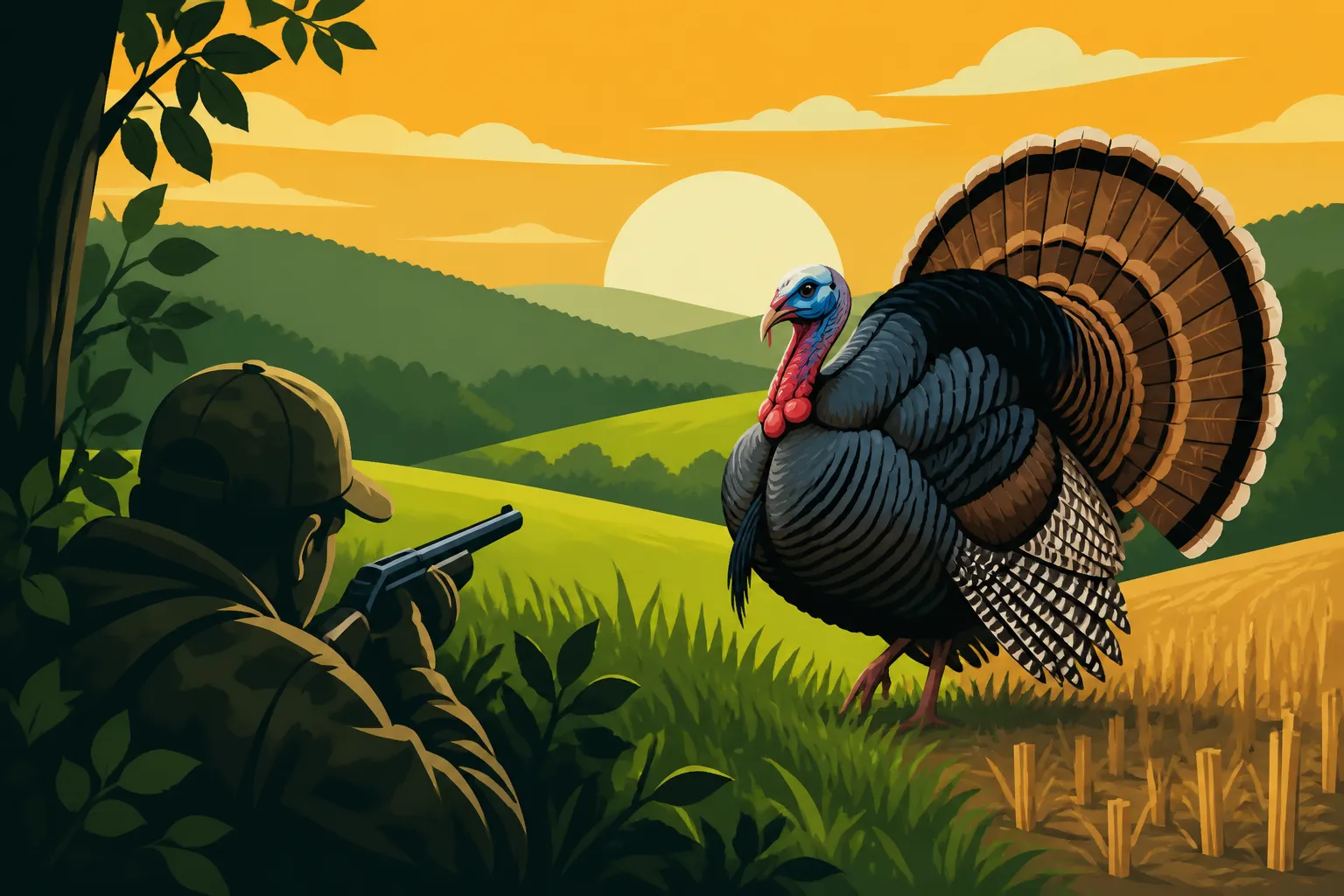
Patience is your absolute best friend. Field-edge gobblers are famous for "hanging up" just out of range. They'll stand there, often strutting, just outside of 60 yards, waiting for the "hen" to come to them. This is where many hunters fold, either by trying to move, calling too much, or trying to rush the shot. Resist the urge! If he's committed and looking in your direction, stay silent, stay still, and let him work. Give him time. His natural instinct to breed will often overcome his wariness, especially if your decoy looks enticing. If you find yourself in a situation where the field edge simply isn't working, and the birds are proving impossible to close the distance on, you might consider more mobile options. You can read up on techniques like Run-and-Gun Turkey Tactics on Public Land to switch things up, but remember, moving on an already wary bird in the open is incredibly difficult.
Overcoming Common Field Edge Challenges
Field edge turkey hunting in the Eastern Panhandle, while potentially incredibly rewarding, comes with its own unique set of frustrations and challenges. These aren't always easy birds, and understanding how to navigate these hurdles can be the difference between tagging a bird and going home empty-handed.
Dealing with Wary Gobblers and Pressure
The single biggest headache for field-edge hunters is the gobbler that simply refuses to commit. He'll show up, strut, gobble, and sometimes even fan right at the edge of your effective range, then turn and walk away. It's enough to make you pull your hair out! This wariness is often a direct result of hunting pressure, which can be intense, especially during the peak of the season or around Hunting the Statewide Spring Opener in April.
To counter this, you need to think outside the box. First, try positioning your setup closer to known roost trees if legal and safe. If you can get within 75-100 yards of a roost before fly-down, you have a much better chance of catching that gobbler on the ground before he heads to open fields or hooks up with real hens. Secondly, consider your decoy setup. While a full-strut gobbler decoy can be incredibly effective, it can also intimidate smaller birds or be perceived as a threat by dominant gobblers who are already on edge. Sometimes, just a single hen decoy is less threatening and more inviting. If a bird is absolutely hung up, and you have ample cover, a fanning technique (stalking behind a gobbler fan or full-strut decoy) can sometimes draw him in, but this is an advanced, high-risk maneuver that demands extreme caution and awareness of other hunters. Always prioritize safety.
Navigating Property Lines and Public/Private Mix
The Eastern Panhandle is a patchwork of private farms and smaller tracts of public land, often bordering each other. This creates a significant challenge for field-edge hunting, as turkeys frequently use private property for feeding and strutting before moving onto public ground (or vice-versa). The frustration of watching a gobbler strut on a neighboring property where you don't have access is a common lament.
This is where meticulous pre-season scouting with detailed mapping apps like GoHunt becomes not just helpful, but absolutely essential. You need to know exactly where the property lines are. Digital mapping tools allow you to identify fence lines, creeks, or other natural boundaries that define property. While hunting these areas, always carry a GPS-enabled device with a land ownership layer (many GoHunt products offer this) to ensure you stay on legal ground. You can learn a lot about how deer use these transitions, which often applies to turkeys too, by Reading Aerial Photos for Eastern Panhandle Deer and Hunting Eastern Panhandle Farmland Deer. If you're targeting public land field edges, try to find spots where the public ground extends into the field or offers a natural funnel that turkeys will use to transition. Sometimes, the best strategy is to set up just inside the public timber, allowing you to call the birds off the private fields and into range on accessible land. Always be respectful of private property, and never assume access without explicit permission. Knowing the West Virginia Spring Turkey Season Rules regarding property boundaries is non-negotiable.
Disclaimer
Hunting is an inherently dangerous activity. This guide is for informational purposes only and does not guarantee success or safety. Always prioritize safety, adhere to all local, state, and federal hunting regulations, and be aware of your surroundings. It is the responsibility of each individual hunter to know and follow all applicable laws and practices. Consider taking a hunter education course to ensure you have the necessary skills and knowledge for a safe and ethical hunt.