Waterfowl Loads for River Divers
Choosing the right waterfowl loads for river divers in West Virginia can feel like a guessing game. You're out there, shivering in the blind, hearing those whistling wings, and when the birds finally commit, you want to make sure your shots connect and bring them down cleanly. This guide is all about demystifying ammunition choices for those fast-flying ducks that frequent our state's waterways, helping you pick the perfect load for a successful hunt.
Understanding River Divers and Their Habitat in West Virginia
When we talk about "river divers" here in West Virginia, we're really focusing on a specific group of ducks that behave differently from your typical puddle ducks. They're built for speed, often found on deeper, moving water, and their flight patterns can be incredibly challenging.
What Makes River Divers Unique?
River divers, such as the various scaup species (greater and lesser), goldeneyes, buffleheads, ring-necked ducks, and even some mergansers, are characterized by their powerful, direct flight. Unlike mallards or wood ducks that might dabble in shallow marshes or pick acorns from flooded timber, divers prefer larger, deeper bodies of water where they can dive to feed on aquatic insects, crustaceans, and small fish.
Their flight is often described as rocket-fast and quite erratic, especially when they're locked onto your decoy spread or trying to evade hunters. They fly low over the water, hugging the contours of the river, and can be on you and gone before you've even fully shouldered your shotgun. This speed and their typically tougher body composition, compared to a teal or wood duck, means you need a load that can deliver substantial energy and a dense pattern to ensure a clean harvest. You'll often find yourself shooting at birds that are moving at incredible velocities, demanding quick reactions and effective ammunition.
Typical River Hunting Scenarios in West Virginia
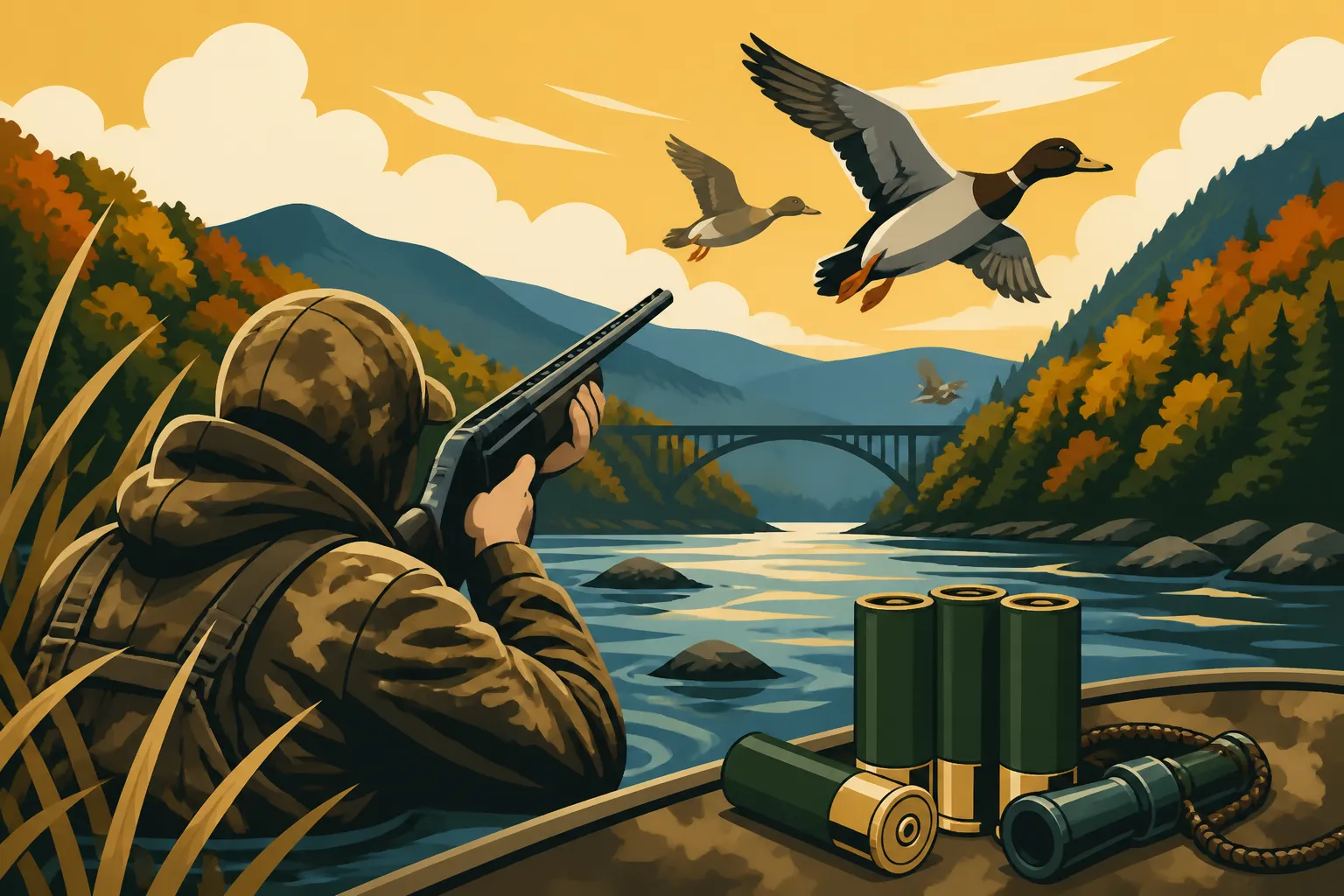
Hunting river divers in West Virginia often means heading to our larger rivers, like the Ohio, Kanawha, or the Potomac. These aren't your typical swamp hunts; you're dealing with currents, open water, and often more unpredictable weather.
One common scenario involves setting up a spread of decoys on a main river channel, perhaps in a large eddy or a slack-water pocket near a bend. Here, divers might see your spread from a distance and commit, giving you opportunities for overhead or incoming shots. However, the current can make decoy spreads challenging, and birds might zip past quickly. Another scenario is pass-shooting along river bends, points, or over islands where birds naturally funnel as they travel up or down the river. This often means very fast, crossing shots at birds that aren't necessarily slowing down or trying to land.
The challenges are considerable: judging distance over open water can be tricky, the wind can play havoc with your shot string, and you might be shooting from a layout blind on a gravel bar, a boat blind tucked into the bank, or even just hunkered down in some sparse cover. The varying shooting distances – from close-in decoying birds to longer pass shots – demand versatile ammunition. Understanding these scenarios helps inform your choice of load, ensuring you’re ready for whatever the river throws at you.
The Non-Toxic Mandate and Its Impact on Load Selection
Before we even dive into specific pellet sizes and materials, there's a fundamental rule that governs all waterfowl hunting in West Virginia and across the United States: you absolutely must use non-toxic shot. This isn't just a suggestion; it's a federal law designed to protect wildlife.
Why Non-Toxic Shot is Non-Negotiable
The reason for the non-toxic shot mandate is rooted in environmental conservation. Lead shot, when deposited in wetlands and waterways, can be ingested by waterfowl and other wildlife, leading to lead poisoning. Birds might pick up spent pellets while foraging, mistaking them for grit, and the lead can slowly poison them, causing suffering and eventually death. This was a significant issue for waterfowl populations before the ban.
West Virginia, like all other states, strictly adheres to these federal regulations. This means that if you're out hunting ducks or geese, whether on a tiny farm pond, a vast public lake, or the roaring Ohio River, your shells must be loaded with non-toxic pellets. There are no exceptions for specific species or locations within waterfowl hunting. Game wardens are vigilant about this, and getting caught with lead shot while waterfowl hunting can result in serious fines and penalties. It's simply not worth the risk, for your wallet or for the health of our wildlife. Always double-check your ammunition to ensure it clearly states "non-toxic" on the box. For more details on this, you can check out resources like Where Nontoxic Shot Is Required in West Virginia.
Steel vs. Bismuth vs. Tungsten Alloys
The non-toxic mandate has opened up a world of material science in ammunition, and for good reason. Each non-toxic option has its own set of pros and cons, especially when targeting tough, fast-flying river divers.
-
Steel Shot: This is by far the most common and economical non-toxic option available.
- Pros: It's affordable and widely available in almost any sporting goods store. For many hunters, steel offers adequate performance for closer shots over decoys, especially on smaller ducks.
- Cons: The major drawback of steel is its density. Steel is significantly lighter than lead, meaning it carries less energy per pellet and loses velocity faster. To compensate, you often need to go up two shot sizes compared to lead (e.g., if you'd use lead #4, you'd use steel #2). This means fewer pellets in your pattern, which can be a real issue for fast-moving divers or at longer ranges. It also retains less energy, leading to reduced penetration on tougher birds or at distance. The hardness of steel can also lead to more erratic patterns if not paired with the right choke.
-
Bismuth Shot: Bismuth emerged as a fantastic alternative, bridging the gap between steel and the more exotic, expensive tungsten options.
- Pros: Bismuth is much denser than steel, approaching lead in density, which means better energy retention and deeper penetration. You can typically drop down one shot size from what you'd use in steel (e.g., if you use steel #2, you might use bismuth #3). It's also softer than steel, making it safer for older shotguns not rated for steel and leading to less pattern deformation as it passes through the choke. It delivers excellent knockdown power for divers without the harsh recoil of some super-dense loads.
- Cons: The primary downside is cost. Bismuth shells are noticeably more expensive than steel, though still more accessible than tungsten. Availability might also be slightly less widespread than steel.
-
Tungsten Alloys (e.g., Hevi-Shot, Apex Ammunition): These represent the pinnacle of non-toxic performance, offering incredible density and hitting power.
- Pros: Tungsten-based shot (often alloys with iron, nickel, or other metals) is incredibly dense, often significantly denser than lead. This allows you to use much smaller shot sizes while retaining superior energy and penetration. For instance, a tungsten #6 pellet might hit harder and penetrate deeper than a steel #2. This means you get a much denser pattern with plenty of individual pellet energy, which is absolutely devastating on tough divers, even at extended ranges. They are exceptional for high-wind conditions or when you know you'll be taking longer shots.
- Cons: The biggest hurdle for tungsten alloys is the price. They are, by far, the most expensive option on the market, sometimes costing several dollars per shell. This can make a season of frequent shooting quite an investment. Also, due to their extreme hardness, you need to be careful with older shotguns and ensure your choke tubes are rated for these materials to prevent damage.
When selecting your load, consider your budget, the typical ranges you expect to shoot, and the species of divers you're targeting. A blend of steel for close-decoying birds and bismuth or tungsten for those longer pass shots or particularly tough species might be the best approach for many West Virginia river hunters.
Choosing the Right Load for River Divers
Now that we've covered the non-negotiable non-toxic rule and the different materials, let's talk about the specifics of putting together an effective load for West Virginia's river divers. It's a combination of gauge, shell length, shot size, and choke that ultimately determines your success.
Gauge and Shell Length Considerations
For waterfowl hunting, especially for tough river divers, the 12 gauge shotgun reigns supreme. Its ability to handle heavier payloads of non-toxic shot and deliver consistent patterns makes it the go-to choice for most hunters.
- 12 Gauge: If you're serious about diver hunting, a 12 gauge is your best bet. It provides the versatility to shoot a wide range of shot sizes and densities, and the larger bore tends to pattern non-toxic loads more effectively than smaller gauges.
- 20 Gauge: While traditionally considered a bit light for larger ducks, modern 20 gauge offerings, especially with high-density bismuth or tungsten loads, can be surprisingly effective for divers. It offers less recoil and a lighter gun, which might be appealing if you're doing a lot of hiking or hunting from smaller boats. However, you'll generally be limited in your payload and might sacrifice some range compared to a 12 gauge. It's certainly viable for closer decoying birds, but less so for longer pass shots.
When it comes to shell length, you'll primarily be choosing between 3-inch and 3.5-inch shells.
- 3-inch Shells: These are the workhorse of waterfowl hunting. They offer a good balance of payload, velocity, and manageable recoil. For most diver hunting situations, a 3-inch shell with an appropriate shot type and size will be more than sufficient.
- 3.5-inch Shells: These "magnum" shells pack a heavier payload, theoretically offering more pellets and sometimes higher velocity. However, they come with significantly increased recoil, which can lead to flinching and slower follow-up shots. For many, the added payload of a 3.5-inch shell might not translate into a statistically significant increase in lethal hits, especially if the recoil causes you to miss. Often, a well-placed 3-inch shell with a high-quality, dense shot will outperform a flinched shot from a 3.5-inch shell. Consider if the extra payload is truly necessary for your typical hunting distances and if you can manage the added recoil effectively.
The key is to balance pellet count (more pellets, better pattern density) with individual pellet energy (needed for penetration). A 3-inch bismuth or tungsten load can often outperform a 3.5-inch steel load in terms of effective range and knockdown power, simply because of the inherent density of the shot material.
Optimal Shot Sizes for Different Divers
Selecting the right shot size is critical for achieving clean kills on divers. It's a balance between having enough pellets in your pattern for good coverage and each pellet carrying enough energy to penetrate and dispatch the bird.
-
For Smaller Divers (Buffleheads, Goldeneyes, Ring-necks): These birds, while fast, aren't as large or as heavily feathered as a large scaup or a canvasback.
- Steel: #3 or #2 steel shot is a good starting point. You need those larger pellets to carry enough energy.
- Bismuth/Tungsten: With denser materials, you can often drop down a size or two. #4 or #3 bismuth, or even #6 or #5 tungsten, will deliver excellent performance. The smaller, denser pellets give you a much higher pellet count for a dense pattern while still retaining plenty of energy.
-
For Larger Divers (Scaup, Mergansers, Canvasbacks): These are tougher birds, often with denser bone structure and thicker feathering, especially mergansers.
- Steel: #2 or #1 steel shot is usually recommended. Even then, steel can struggle with consistent penetration on these birds at longer ranges.
- Bismuth/Tungsten: #3 or #2 bismuth, or #5 or #4 tungsten, will provide superior penetration and knockdown power. The confidence that these denser pellets give you on a crossing shot at a big scaup can be a game-changer.
Think of it this way: a single pellet needs to hit a vital area with enough force to cause a clean kill. More pellets in your pattern increase the statistical probability of that happening. However, if those pellets don't have the energy to penetrate, they're useless. Denser shot allows you to get both a higher pellet count (by using smaller shot sizes) and superior individual pellet energy. You can even use tools like GoHunt to analyze ballistic performance data and see how different shot sizes and materials perform at various distances, helping you visualize the trade-offs.
Choke Selection for River Hunting
Your choke constricts the shot pattern, and choosing the right one is paramount for hitting fast-moving divers effectively, whether they are working your decoys or blowing by at full speed.
-
For Decoying Birds (Closer Shots): When divers are committing to your spread, they're often within 20-35 yards.
- Modified (MOD): This is often the most versatile choice for decoy hunting. It provides a good balance of pattern density and spread, offering a bit more forgiveness than a tighter choke while still delivering plenty of pellets on target.
- Improved Cylinder (IC): If your birds are consistently coming in very close, say within 20-25 yards, an Improved Cylinder choke will give you a wider, more forgiving pattern, which can be beneficial for fast-flushing or erratic divers.
-
For Pass-Shooting (Longer Shots): If you're primarily pass-shooting birds that aren't working decoys, but rather flying past at 40+ yards, you'll want a tighter pattern.
- Full (FULL): A Full choke delivers the tightest pattern, concentrating the shot for maximum range. This is excellent for those longer, crossing shots where every pellet counts. However, it's very unforgiving at close range, making it harder to hit if a bird unexpectedly flares into your face.
- Improved Modified (IM): This is a good compromise between Modified and Full. It offers a tighter pattern than Modified for increased range, but with a bit more spread than a Full choke, providing a slight edge in forgiveness.
Important Note on Chokes and Non-Toxic Shot:
- Steel Shot: Due to its hardness, steel shot does not compress like lead. Using a very tight choke (like Full) with steel shot can actually deform the pattern and potentially even damage your barrel if your choke isn't rated for steel. Many manufacturers recommend sticking to Modified or Improved Modified chokes with steel.
- Bismuth/Tungsten: These materials are generally softer than steel (especially bismuth) or engineered to be safe for most chokes (check manufacturer recommendations). They typically pattern well through tighter chokes, including Full, allowing you to maximize their density advantage.
Always, always pattern your shotgun with your chosen loads and choke combination before the season. What works well on paper might not be ideal in your specific gun. We'll dive into patterning next.
Practical Tips for Maximizing Your Waterfowl Loads
Having the right ammunition is only part of the equation. To truly maximize your effectiveness on West Virginia's river divers, you need to combine that knowledge with practice, good technique, and smart preparation.
Patterning Your Shotgun
This cannot be stressed enough: patterning your shotgun is the single most important thing you can do to ensure your ammunition performs optimally. Every shotgun is an individual, and every load behaves slightly differently. Just because a box says "good for ducks" doesn't mean it's good for your gun with your choke.
Here's how to do it:
- Choose Your Distances: Start with the distances you expect to shoot most often, typically 30 and 40 yards for decoying and pass-shooting divers.
- Set Up Targets: Use large sheets of paper or cardboard (at least 3×3 feet) with a central aiming point.
- Shoot from a Rest: This eliminates shooter error. Aim precisely at the center.
- Fire Multiple Shots: Shoot at least three to five shots with each choke and load combination you plan to use.
- Analyze the Pattern:
- Density: Draw a 30-inch circle around the densest part of your pattern (which might not be exactly where you aimed). Count the number of pellet holes within that circle. For ducks, you generally want at least 100-120 pellets for a reliable kill, though specific numbers can vary by shot size and bird.
- Evenness: Is the pattern evenly distributed, or are there "holes" where a bird could pass through unscathed?
- Point of Impact: Does your gun shoot where you look? Many shotguns shoot slightly high or low, or off to one side. Knowing this helps you adjust your aim.
- Experiment: Try different chokes with different loads. You might find that your gun patterns a particular brand of steel shot better with a Modified choke, but really shines with bismuth through an Improved Modified. This is where the magic happens and you truly dial in your setup.
Patterning gives you the confidence to know exactly what your gun and load combination can do, helping you judge effective range and make better shots in the field.
Shot Placement and Lead for Fast Divers
River divers are speed demons, and hitting them consistently requires understanding lead and shot placement. They don't fly in a straight line, and they often come in low and fast over the water.
- Lead is Key: You're not aiming at the bird; you're aiming at where the bird will be when your shot gets there. For fast, crossing shots on divers, this means a significant lead. The exact amount of lead depends on the bird's speed, angle, and distance, and your shot's velocity.
- Swinging Through vs. Sustained Lead: Many experienced shooters advocate for the "swing through" method: starting behind the bird, swinging past it, and firing just as your barrel passes the target, continuing the swing. This ensures consistent movement. Others prefer a "sustained lead" where you establish your lead and maintain it before firing. Practice will help you find what works best for you.
- Visualize the Bird's Path: Before you even shoulder your gun, track the bird with your eyes. Anticipate its path, especially considering the wind and current.
- Focus on the Front End: For waterfowl, especially divers, aim for the front half of the bird. A head, neck, or breast shot is far more likely to be instantly lethal than a shot to the tail or wing.
The best way to get better at leading fast targets is practice. Clay target shooting, especially sporting clays or trap variations that simulate crossing shots, is invaluable in the off-season. It builds muscle memory and helps you instinctively judge lead.
Packing the Essentials
Beyond just your perfectly patterned shotgun and chosen loads, successful river diver hunting in West Virginia requires a thoughtful approach to your gear.
- Ammunition Redundancy: Always pack more shells than you think you'll need. The river can be unpredictable, and missed shots happen. A good rule of thumb is at least a box (25 shells) per hunter, per outing, and often more if the birds are flying hot.
- Decoys: A realistic and appropriately sized spread of diver decoys is crucial. Consider species-specific decoys for birds like goldeneyes or bluebills to attract them better.
- Calls: While not as critical as for mallards, diver calls (like diver whistles) can sometimes help get attention or turn birds.
- Waders and Layering: River hunting often means cold water, wind, and varied temperatures. High-quality waders are essential, and a robust layering system, including proper base layers and outer shells, will keep you comfortable and focused. You might find tips in Waders for River Bottom Hunting helpful.
- Safety Gear: Rivers can be dangerous. Always wear a PFD (personal flotation device) if you're in a boat, even if you're a strong swimmer. Carry a dry bag with essentials like a first-aid kit, a fully charged phone, and extra layers.
- Navigation and Scouting: Having a reliable GPS or a mapping app like
GoHunton your phone can be incredibly useful for navigating river bends, identifying potential public access points, and scouting for advantageous hunting positions or cover. The ability to mark your blind location or track your path in low light is invaluable. - Dog: A well-trained retrieving dog can save countless birds from being swept away by the current, especially in a swift river.
By paying attention to your ammunition, practicing your shooting, and preparing with the right gear, you'll be well-equipped to enjoy the fast-paced, exhilarating challenge of hunting river divers in West Virginia.
| Shot Type (Non-Toxic) | Density (Relative to Lead) | Price (Relative) | Pros | Cons | Optimal Use Case (River Divers) |
|---|---|---|---|---|---|
| Steel | 60-70% | Low | Affordable, widely available | Less dense, lower energy, requires larger shot sizes, can pattern poorly | Close-range decoying shots (under 30 yds) on smaller divers |
| Bismuth | 90-95% | Medium | Good energy retention, safer for older guns, patterns well | More expensive than steel, less common than steel | General purpose (20-40 yds) for all divers, good balance of cost and performance |
| Tungsten Alloys | 150-180% | High | Extremely dense, superior energy/penetration, smaller shot sizes | Very expensive, can be hard on unrated chokes, limited availability | Long-range pass-shooting (40+ yds), large/tough divers, challenging conditions |
Disclaimer
This article is for general informational purposes only and does not constitute professional advice. Laws, prices and regulations vary by location and change over time. Consult a qualified professional for guidance on your specific situation.