West Virginia Buck-to-Doe Ratio by Region
It’s a common frustration for hunters in West Virginia: you spend countless hours scouting, preparing, and then sitting in your stand, only to feel like you’re seeing nothing but does or young bucks. We all dream of a truly mature whitetail, and part of finding that buck means understanding where the older deer are. This guide is here to unravel the mysteries of West Virginia’s buck-to-doe ratios across different regions, giving you a better understanding of where your efforts might be best spent.
Understanding West Virginia's Deer Management Philosophy
West Virginia's wildlife management philosophy plays a huge role in shaping the deer herd, including those critical buck-to-doe ratios we all obsess over. The state's approach is designed to balance herd health, hunter opportunity, and agricultural impact, which can mean different things for different parts of the state. It's not a one-size-fits-all strategy, and that's precisely why you see variations in deer numbers and ratios from one county to the next.
For years, the focus was often on growing the overall deer population, which, while great for general hunting opportunities, can sometimes lead to a skewed buck-to-doe ratio in certain areas. Think about it: if you're consistently harvesting bucks and passing on does, the male side of the equation can quickly become underrepresented, especially the older age classes. However, in recent times, there's been a more nuanced approach, often encouraging antlerless harvests in areas with high deer densities to keep populations in check and improve the health and age structure of the herd. This includes specific antlerless seasons and bonus tags in many counties. Understanding these underlying management goals, which you can often find detailed in West Virginia Deer Season Structure Explained, helps explain why the numbers vary.
This careful balancing act by the WVDNR directly impacts the buck-to-doe ratio. In areas where antlerless harvest is encouraged and hunters participate, you might see a more balanced ratio, leading to better opportunities for mature bucks and a healthier overall deer population. Conversely, in areas with less antlerless harvest pressure, the ratio can become highly skewed, making it harder to encounter those elusive older deer during the rut.
Regional Breakdown: East, Central, and Western West Virginia Ratios
When we talk about buck-to-doe ratios in West Virginia, it's really important to break it down regionally. Our state is so diverse, from the high Alleghenies to the rolling hills and river bottoms, and each area presents its own unique challenges and opportunities that influence deer populations. What you see in one corner of the state can be dramatically different from another, and that means your hunting strategy needs to adapt.
Eastern Panhandle: Opportunities for Quality Bucks
The Eastern Panhandle counties, particularly those bordering Maryland and Virginia, often boast some of the best buck-to-doe ratios in the state. This region is characterized by a mix of agricultural lands, woodlots, and some rugged mountain terrain, offering a diverse habitat. Historically, hunting pressure has been high, but also well-managed, leading to a more balanced herd in many areas. Hunters here often focus on older age class bucks, which contributes to a more stable buck population relative to does. If you're looking for areas that consistently produce larger, older bucks, this region often stands out. You can find out more about why this region specifically excels by reading Why the Eastern Panhandle Grows Big Bucks. The sheer amount of food, often from agriculture, combined with good cover and management that encourages selective harvesting, helps foster a healthier buck-to-doe balance. When you're using a scouting tool like GoHunt, you'll often see distinct land patterns in this region that highlight prime deer habitat, making it easier to pinpoint areas where these ratios might be most favorable.
Hunting here might involve sitting field edges in the early season or working small woodlots during the rut. The deer tend to be well-fed and can grow impressive antlers, attracting hunters who are willing to put in the time to understand the nuances of the terrain and deer movement. Many hunters in this region understand the value of a balanced herd and practice quality deer management on private land, which spills over to general population health. This leads to a higher percentage of older bucks surviving and contributing to a more natural buck-to-doe ratio. Comparing this to other areas, such as the Eastern Panhandle Versus Southern Coalfield Deer, quickly illustrates the differences in deer densities and hunter expectations.
Central Mountains: Diverse and Challenging Ratios
Moving into the central mountain regions, particularly around the Monongahela National Forest and other large public tracts, the buck-to-doe ratios can be a bit more variable and, frankly, often a bit more challenging. These vast, rugged areas are dominated by dense forests, steep hollows, and high elevations. While the habitat can support a healthy deer population, the sheer scale and remoteness of some areas, combined with hunting pressure patterns, can influence the ratios.
In easily accessible public land areas, hunting pressure can lead to a lower number of mature bucks, resulting in a more skewed doe-heavy ratio. This isn't necessarily a bad thing for the overall deer population in terms of numbers, but it can make finding an older buck more difficult. However, deep within the backcountry, where human presence is minimal, ratios might be more balanced simply because fewer bucks are harvested. These remote areas offer a different kind of hunting experience, one that rewards physical endurance and serious scouting. Often, looking at topography and cover on GoHunt can help identify those pockets of less-pressured terrain. Even though the overall deer density might be lower in certain parts of the mountains, the deer that are there are often wilder and harder to pattern.
Western and Ohio River Valley: Influences of Habitat and Pressure
The western parts of West Virginia, including the Ohio River Valley, offer another distinct deer hunting landscape. This region features a mix of rolling hills, agricultural bottomlands, and smaller woodlots. Here, the buck-to-doe ratios can be influenced heavily by agricultural practices, population density, and localized hunting pressure. In areas with abundant food sources like corn and soybean fields, deer populations can be very high.
In some of these fertile bottomlands, particularly near human populations, antlerless harvests are often encouraged to mitigate deer-vehicle collisions and crop damage. This management can lead to a healthier, more balanced ratio of bucks to does, as the doe population is kept in check. Conversely, in other localized areas with less antlerless harvest, you might find a higher concentration of does. The key here is often localized conditions. A productive farm with good cover might hold a very different ratio than a heavily hunted public woodlot just a few miles away. Hunting Ohio River Bottomland can be an entirely different endeavor than hunting the mountains. Utilizing tools that help you identify land ownership and habitat types, such as GoHunt, can be invaluable for understanding the nuances of these ratios and predicting where you might find a more balanced herd.
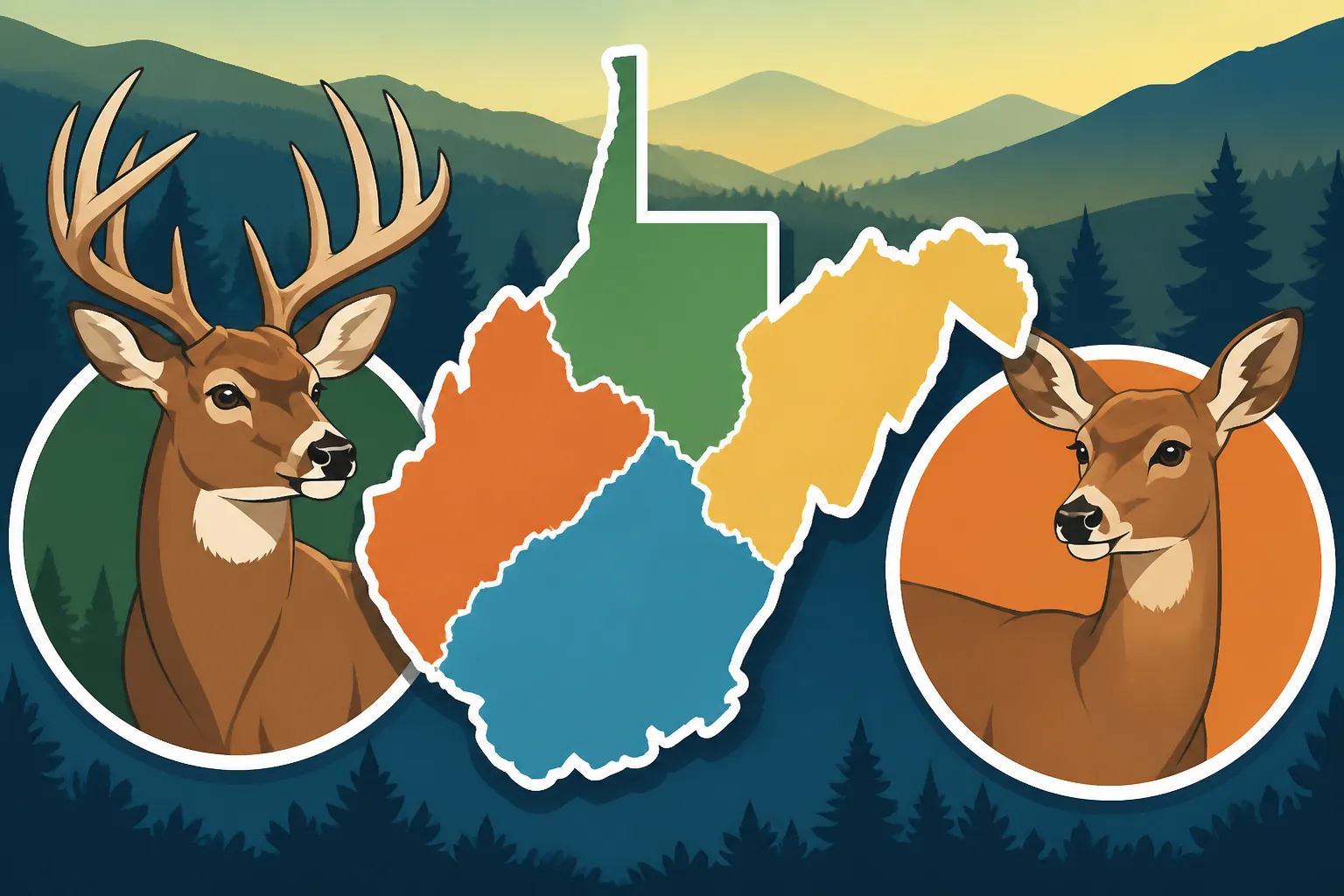
Here's a generalized overview of how buck-to-doe ratios might look across regions:
| Region | General Buck-to-Doe Ratio (Bucks:Does) | Influencing Factors | Hunting Focus |
|---|---|---|---|
| Eastern Panhandle | 1:2 to 1:3 | Agricultural food sources, QDM practices, moderate-to-high hunter pressure | Mature buck hunting, antlerless harvest encouraged |
| Central Mountains | 1:4 to 1:6 (variable) | Vast timber, rugged terrain, varied hunting pressure (remote vs. accessible) | Wilderness experience, opportunistic, specific scouting |
| Ohio River Valley | 1:3 to 1:4 | Abundant agriculture, localized hunting pressure, suburban influence, high deer density | High harvest opportunity, managing local populations |
| Southern Coalfields | 1:3 to 1:5 | Dense cover, limited agriculture, traditional hunting culture, unique regulations | Archery-focused, managing growing populations |
Note: These are general observations and actual ratios can vary significantly by county, WMA, or even specific property within a region.
Impact of Hunting Pressure and Habitat on Ratios
It’s easy to just look at a number, but understanding why that number exists is far more important for a successful hunt. The buck-to-doe ratio in any given area isn't just a random statistic; it's a dynamic reflection of several crucial factors, primarily hunting pressure and habitat quality. These elements intertwine to create the deer populations we encounter in the woods, and ignoring them means missing a huge piece of the puzzle.
How Hunting Pressure Skews the Numbers
Let's be realistic: hunters love harvesting bucks. This is a fundamental truth of deer hunting. When an area experiences heavy, consistent hunting pressure on bucks, it naturally skews the ratio towards does. Imagine a favorite public hunting area near a town; every opening day, dozens of hunters are out looking for antlers. Over time, the removal of a higher percentage of available bucks, especially younger ones, can lead to a situation where there are significantly more does than bucks. This is particularly true for older, more mature bucks. It's often referred to as "buck mortality," and while it's part of hunting, it has consequences for the herd's social structure and breeding dynamics. You might find areas where the buck-to-doe ratio is as wide as 1 buck to 8 or 10 does, making it incredibly challenging to even see a legal buck, let alone a mature one.
On the flip side, in areas with lower hunting pressure, perhaps deep in the backcountry of the Monongahela National Forest, or on private lands where Quality Deer Management (QDM) principles are strictly applied, you're more likely to find a balanced ratio. Here, bucks have a better chance to reach older age classes because they simply aren't being pursued as relentlessly. This doesn't mean those areas are easy to hunt – the bucks might be older and wiser – but your odds of encountering one are statistically better. Understanding Hunting Pressure on West Virginia Public Land is key to recognizing where these conditions might apply. Using a mapping app like GoHunt to analyze access points and road networks can give you a strong indication of how much pressure a specific piece of public land might be receiving.
Habitat Quality and its Role in Deer Survival
Habitat is the foundation of any healthy deer herd. It provides food, water, and cover—the three necessities for survival. When habitat is rich and diverse, offering abundant natural forage, browse, and secure bedding areas, deer populations tend to thrive. This strong habitat can support a higher deer density overall and often contributes to better fawn survival rates and stronger antler growth in bucks. Areas with diverse mast crops, such as oak ridges producing acorns, or regenerating clear-cuts offering fresh browse, are magnets for deer.
Conversely, poor or fragmented habitat can lead to stressed deer, lower fawn survival, and an unbalanced sex ratio. If does are struggling to find enough food to sustain pregnancies and raise fawns, their numbers might decline, or their fawns might not survive, which can indirectly impact the buck-to-doe ratio over time. Additionally, habitat impacts where deer feel safe. If secure bedding cover is scarce, deer might congregate in the few areas that offer it, leading to localized over-browsing and increased vulnerability to hunters. A good understanding of West Virginia Buck Age Structure will show you how habitat, in combination with hunting pressure, allows bucks to live long enough to reach their full potential. When you're scouting, whether in person or on a digital mapping platform like GoHunt, pay close attention to the quality and diversity of the cover. Is it thick enough to hold deer year-round? Are there varied food sources available throughout the seasons? These questions can help you predict not just deer presence, but potentially the health and balance of the herd in that specific locale.
Using Ratio Data to Inform Your Hunting Strategy
Understanding buck-to-doe ratios isn't just an academic exercise; it's a powerful tool that can dramatically improve your hunting success. Knowing these numbers, and more importantly, what causes them, allows you to make informed decisions about where and how you hunt, turning frustration into focused effort.
Researching Regional Ratios and Local Conditions
The first step is always research. While generalized regional information is a good starting point, truly successful hunters dig deeper. Look at county-level harvest data and WVDNR reports, which often provide insights into population trends and antlerless harvests. If a county has consistently high antlerless harvests over several years, it’s a good indicator that managers are actively working to balance the herd, which can translate to better buck-to-doe ratios and older bucks. Conversely, low antlerless harvests might indicate a more skewed ratio.
Don't stop there. Talk to local hunters, wildlife biologists, and landowners if possible. Their on-the-ground knowledge can be invaluable. What's the acorn crop like this year? Was there a severe winter that impacted fawn survival? Has a new timber cut opened up bedding cover in a previously dense area? All these factors contribute to the current deer situation. When using mapping tools, like the ones in GoHunt, overlay public land boundaries with satellite imagery to identify potential food sources, bedding areas, and travel corridors, which can vary wildly even within the same county. This granular data, combined with official reports on West Virginia Deer Harvest Records, paints a much clearer picture of what to expect.
Adjusting Tactics for Balanced vs. Skewed Ratios
Once you have a good grasp of the likely buck-to-doe ratio in your chosen hunting area, you can tailor your tactics accordingly.
-
In Areas with Balanced Ratios (e.g., 1:2 to 1:3): These are often the holy grail for mature buck hunters. A balanced ratio means competition among bucks during the rut will be higher, leading to more active movement and responsive behavior. Bucks will be more aggressively seeking does, fighting off rivals, and generally covering more ground. This is prime territory for rut-focused tactics like rattling and grunting. You're more likely to see multiple bucks, and the odds of encountering an older, larger deer are elevated. Focus your scouting on traditional rut funnels, pinch points, and major travel corridors where bucks are likely to cruise between doe bedding areas. Knowing Hunting the West Virginia Rut in November and concentrating your efforts during this peak can be highly productive here.
-
In Areas with Skewed Ratios (e.g., 1:5 or wider): These areas can be tougher, but not impossible. The key here is patience and understanding that bucks might be harder to find and less visible. With fewer bucks per doe, a single buck might have a larger "harem" of does, meaning he doesn't have to travel as far or compete as hard. Calling tactics might be less effective, as bucks don't feel the same pressure to respond. Your best bet in these areas is often to focus on doe bedding and feeding areas, recognizing that a buck will eventually show up to check for receptive does. Stealthy still-hunting, glassing from a distance, or setting up on reliable food sources can be more productive. Scouting takes on even greater importance here; you need to find the specific pockets where bucks are likely to be present, perhaps areas with thicker cover or less human disturbance. Don't be afraid to walk further and look for overlooked areas that other hunters might skip. Scouting West Virginia Public Land Before Season is crucial for these scenarios, as is learning to Read Aerial Photos for Eastern Panhandle Deer to identify hidden cover or terrain features. Utilizing mapping tools to identify remote areas or thick cover that might hold a mature buck is incredibly helpful in these challenging spots.
Disclaimer
This article is for general informational purposes only and does not constitute professional advice. Laws, prices and regulations vary by location and change over time. Consult a qualified professional for guidance on your specific situation.