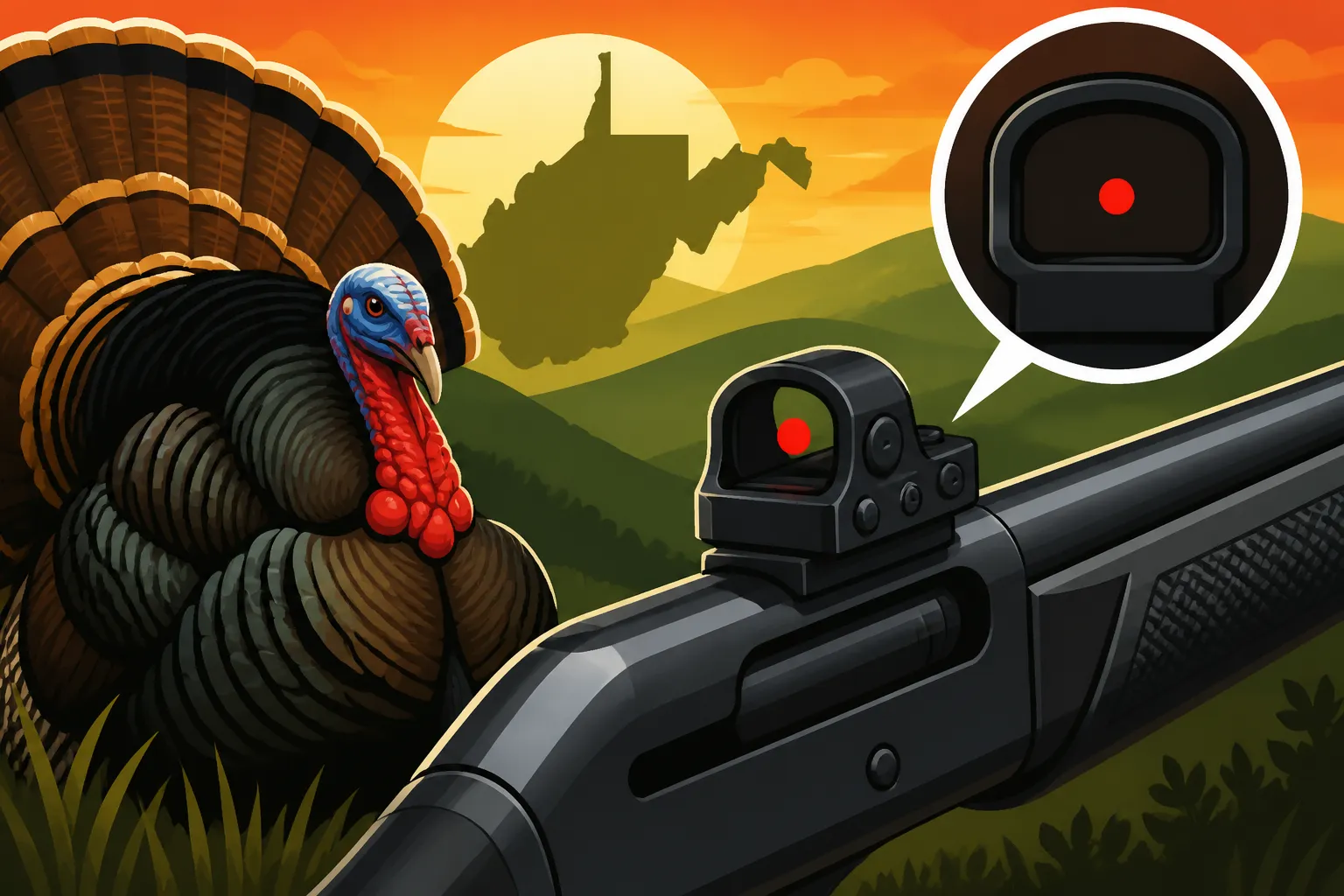
Red Dots on a Turkey Shotgun
Every West Virginia turkey hunter knows the frustration of a missed bird. Sometimes, it’s a blur of movement in the dense timber, or a gobbler that hangs up just a bit too far for a confident shot with a traditional bead. If you've ever thought there has to be a better way to get on target quickly and precisely when a strutting tom finally commits, then it's time we talked about red dots on your turkey shotgun. This guide will walk you through everything you need to know to decide if this modern optic is right for your next spring hunt in the Mountain State.
Why a Red Dot for West Virginia Turkeys?
For generations, turkey hunters relied on the simple bead sight at the end of their shotgun barrel. And while it still works, the dynamics of modern turkey hunting, especially in West Virginia's varied and often unforgiving terrain, can often benefit from a more precise aiming system. A red dot can dramatically improve your confidence and accuracy when that hard-earned gobbler finally presents a shot.
The Precision Advantage
Let's be honest, trying to line up a small bead on a tiny target like a gobbler's head and neck can be tricky, especially under pressure. Shotguns, unlike rifles, aren't designed for pinpoint accuracy with open sights. A red dot sight, however, offers a single, illuminated aiming point that floats in your field of view. This eliminates the need to perfectly align a front and rear sight, drastically simplifying your aim. The principle of a red dot means that where the dot is, that's where your pattern will go, assuming it's properly sighted in. This precision is absolutely critical when you consider how small the kill zone on a turkey's head and neck truly is. You're not aiming for the body; you're aiming for a very specific spot.
In the thick laurel and rhododendron patches, or when a bird is skirting the edge of a field in the low light of dawn, that illuminated dot can make all the difference. It takes the guesswork out of alignment and allows you to focus solely on that red or green beacon. This becomes particularly valuable when you've patterned your gun with specialized turkey loads and a tight choke, striving for the densest possible pellet count in that small target area. Every pellet counts, and a red dot helps ensure those pellets are heading exactly where they need to go.
Think about those moments where a bird might be slightly obscured by a sapling or you're crouched in an awkward position on a steep hillside. Trying to get a perfect cheek weld and align a bead can lead to subtle errors in aim. A red dot mitigates this by allowing you to simply put the dot on the target, and as long as you can see that dot, you're on target. It’s a game-changer for consistency, especially after a long morning of calling and waiting.
Speed and Target Acquisition
West Virginia turkey hunting can be a fast-paced affair. One minute you're hunkered down, thinking nothing's going to happen, and the next a gobbler is running in, or steps out from behind a rise much closer than you anticipated. In these adrenaline-fueled moments, getting your gun up and on target quickly is paramount. Traditional beads can be slow to acquire, requiring you to find that front bead and then ensure it's "sitting" properly.
A red dot excels in speed. Because you're only looking for one illuminated dot, your eye naturally finds it faster. There's no front sight, rear sight, and target triangle to form. Just dot on target, pull the trigger. This speed can be invaluable when a tom suddenly appears in a clearing or makes a quick move, especially if you're engaging in Run-and-Gun Turkey Tactics on Public Land. Every second counts when a bird is wary or on the move, and a red dot shaves precious milliseconds off your aiming time.
Consider a scenario where you've set up perfectly, but the bird approaches from an unexpected angle, forcing you to shift your body or gun. With a red dot, you can maintain focus on the target while bringing the dot into your vision, rather than having to re-establish a full sight picture. This fluid target acquisition can make the difference between tagging out and watching a gobbler disappear back into the hardwoods. Many hunters who've made the switch report a significant increase in confidence for those quick, close-range shots that often characterize successful turkey hunts.
Low Light Performance
West Virginia spring turkey season often means early mornings, with legal shooting hours beginning thirty minutes before sunrise. This means much of your prime hunting time can occur in very dim light, before the sun has fully cleared the eastern ridges. In these conditions, a traditional black bead can simply disappear against the dark backdrop of trees, shadows, or even the dark feathers of a gobbler. Trying to get a precise aim can become a frustrating guessing game.
This is where a red dot truly shines. The illuminated reticle, often with adjustable brightness settings, provides a clear, bright aiming point regardless of ambient light conditions. You can dial it down for legal shooting light at dawn, or crank it up if the sun is glaring through the canopy later in the morning. This ensures that you always have a visible aiming point, giving you the confidence to take ethical shots when you might otherwise hesitate with a traditional bead.
Imagine you're trying to call in a bird you heard Roost Hunting West Virginia Gobblers right off the roost. The woods are still steeped in shadow, but you hear him fly down and start strutting just out of sight. When he finally steps into a small patch of dim light, that illuminated dot will be your best friend. It allows you to place your shot accurately even when your natural vision is struggling to define the target or align a dark bead. It's a significant advantage for those critical moments when light is at a premium and a shot must be taken.
Types of Red Dots and Mounting Options
Once you're sold on the idea of a red dot, the next step is choosing the right one and getting it securely mounted on your shotgun. There are several styles and considerations, and what works best often comes down to personal preference and your specific hunting style in West Virginia's diverse environments. You'll want something rugged enough to handle the abuse of climbing steep hills and busting through thick brush.
Open Emitter vs. Tube-Style
When you start looking at red dots, you'll generally find two main categories: open-emitter (often called "mini reflex sights") and tube-style sights. Open emitters are very compact and lightweight, essentially just a small screen or lens with an LED projecting the dot onto it. They offer a very wide, unobstructed field of view because there's very little housing around the lens. This can be great for quick target acquisition, as it feels very natural, almost like the dot is floating in thin air. However, their open design can also make them more susceptible to rain, snow, or debris getting on the emitter or lens, potentially obscuring the dot. While many are waterproof, a wet lens can still be a nuisance.
Tube-style red dots, on the other hand, look more like miniature rifle scopes, with the emitter and lens enclosed within a sealed tube. These tend to be more robust and better protected from the elements, making them a popular choice for all-weather hunting in West Virginia. The enclosed design means less worry about rain or snow interfering with the dot. They might be slightly bulkier and heavier than an open emitter, and the field of view is more constrained by the tube, but for many hunters, the added durability and protection are worth it. Both styles can be extremely effective, so consider the conditions you most often hunt in and your preference for minimalist design versus maximum protection.
A robust tube-style option might be a better fit if you're frequently in very wet conditions or pushing through dense undergrowth. The extra housing provides a shield against branches and rain, giving you one less thing to worry about when you're focusing on the hunt. Conversely, if you prioritize ultra-light gear and open sight pictures, and primarily hunt in more open woods or fields, an open-emitter could be an excellent choice. Both types have proven their worth in the field, so it’s about aligning the features with your specific needs.
Mounting Considerations
Securing your red dot properly is just as important as choosing the right optic. A loose or improperly mounted sight will never hold zero and will lead to frustration and missed opportunities. Most shotguns aren't drilled and tapped for optics directly, so you'll typically need an adapter. The most common solution is a Picatinny rail, which can be mounted onto the receiver. Some shotguns may have pre-drilled holes for a specific base, or you might need a gunsmith to drill and tap your receiver. Another popular option, particularly for older shotguns, is a saddle mount, which clamps onto the receiver without permanent modifications. These can be very secure, but sometimes add a bit more bulk.
Once you have a rail or mount, the red dot itself attaches to it. Always use Loctite (the blue, removable kind) on all mounting screws to prevent them from vibrating loose under recoil. Shotgun recoil, especially with heavy turkey loads, can be substantial, and screws have a way of working themselves free at the worst possible time. Ensure that the mount is tight and stable, with no play. It's also worth considering how the red dot's placement affects your natural sight picture and cheek weld. You want the dot to appear naturally as you shoulder the gun, without having to crane your neck or search for it.
The position of your red dot on the receiver can also impact your shooting comfort. Too far forward, and you might have to stretch to acquire the dot; too far back, and it could interfere with loading or your field of view. A good mounting solution will place the red dot in a comfortable, intuitive position that allows for quick and consistent target acquisition. Take the time to experiment with placement before tightening everything down permanently. Your Turkey Shotgun Gauge Choice can also influence the amount of recoil your mount needs to withstand, so choose a sturdy option.
Dot Size and Color
Red dot sights come with various dot sizes, usually measured in MOA (Minute of Angle). A 1 MOA dot covers roughly 1 inch at 100 yards. For turkey hunting, where your target is small and your ranges are typically 25-40 yards, you generally want a dot that is precise enough for a turkey's head but also easy to acquire. Common dot sizes range from 2 MOA to 8 MOA. A smaller dot, like a 2 or 3 MOA, offers a finer aiming point, which can be great for pinpoint accuracy on a gobbler's head at longer ethical ranges. However, a smaller dot can sometimes be harder to pick up quickly in cluttered backgrounds or thick cover.
Conversely, a larger dot, such as a 5 MOA or 8 MOA, is much faster to acquire and more visible in various conditions. While it covers more of the target, at typical turkey ranges of 25-40 yards, even an 8 MOA dot is still relatively small on a turkey's head. Many turkey hunters prefer a larger dot (5 MOA or greater) for its speed and visibility, finding that it still provides plenty of precision for the task at hand. The trade-off is often between ultimate precision (smaller dot) and rapid target acquisition (larger dot).
You'll also have a choice in dot color, most commonly red or green. Red dots are traditional and work well for most people. However, some hunters find green dots to be more visible, especially in daylight conditions or against certain backgrounds. This can be a very personal preference, so if you have the opportunity, try looking through both colors to see which one your eye picks up more easily and comfortably. Factors like color blindness or individual eye sensitivity can influence this choice. Ultimately, the best dot size and color is the one that allows you to be most consistently accurate and confident when that West Virginia gobbler steps into range.
| Feature | Open Emitter Red Dot | Tube-Style Red Dot |
|---|---|---|
| Appearance | Small window, minimal housing | Enclosed tube, similar to mini scope |
| Field of View | Very wide, unobstructed | More constrained by tube |
| Size/Weight | Generally more compact and lighter | Slightly bulkier and heavier |
| Durability | Vulnerable to debris/rain on emitter | Well-protected from elements and impacts |
| Target Acq. | Extremely fast, natural feel | Fast, but eye adapts to tube |
| Cost | Varies widely, some budget-friendly | Tends to be slightly higher for robust models |
| Best For | Speed, minimalists, fair weather | All-weather, ruggedness, ultimate protection |
Practical Application and Sighting In
Having a red dot on your turkey shotgun isn't a magic bullet that guarantees success. It's a tool, and like any tool, it needs to be properly configured and practiced with. The key to maximizing its potential lies in proper patterning and familiarization with your specific setup.
Patterning Your Turkey Gun with a Red Dot
This step is absolutely non-negotiable. You must pattern your turkey shotgun with your chosen red dot and turkey load. Do not assume that because your gun was patterned with a bead, or because the red dot is zeroed at 25 yards, that it's automatically perfect for turkey. The relationship between your gun, choke, and ammunition is unique, and a red dot simply ensures you're aiming consistently at the sweet spot of that pattern. Start by setting up paper targets at 20, 30, and 40 yards.
Your goal is to adjust the red dot so that the center of your densest pellet pattern (the core where most pellets land) is directly under or around your aiming dot. This might not be the exact center of the overall pattern, but rather the part that delivers the most lethal concentration to a turkey's head and neck. Use a rest to eliminate human error during this process. Fire several shots at each distance, carefully adjusting the red dot's windage and elevation until you're consistently putting the dot on the target and seeing the desired pellet density there. Don't be afraid to experiment with different loads if your initial results aren't satisfactory; finding the right combination can take time and a few boxes of shells.
Remember, a red dot makes you more precise, but it doesn't change your gun's actual pattern. If your gun and choke combination throws a donut pattern or has thin spots, the red dot will only accurately aim those imperfections. That's why dedicated turkey loads and good patterning are still critical. A properly patterned setup with a red dot is incredibly effective, offering both speed and surgical precision. Check out Patterning a Turkey Gun at 40 Yards for more detailed steps on this process.
Battery Life and Durability
Red dots are electronic devices, and like all electronics, they rely on batteries. This means battery life is a crucial consideration, especially when you're deep in the West Virginia backcountry. Always carry spare batteries, and make it a habit to replace the battery in your red dot at the start of each turkey season. You don't want to find yourself in the middle of a hot setup only to have your dot blink out. Many modern red dots have excellent battery life, lasting hundreds or even thousands of hours, but unexpected drainage or cold weather can reduce performance.
Beyond battery life, durability is paramount for any hunting optic, especially one mounted on a shotgun. Your gear will get bumped, scraped, and exposed to the elements. Look for red dots constructed from aircraft-grade aluminum or similar robust materials, designed to withstand significant recoil and harsh outdoor conditions. Waterproof and fogproof ratings are also critical, as West Virginia weather can change on a dime, going from sunny to a sudden downpour or heavy fog in a matter of minutes. You need an optic that won't fail when the conditions get tough.
Some premium brands offer red dots with exceptional durability and long warranties, like those you might find reviewed or discussed on the GoHunt community forums. Investing in a quality optic now can save you headaches and potential missed opportunities down the line. A reliable red dot should be able to take a few knocks, endure rain and mud, and keep ticking without losing zero. If your hunting involves rugged terrain and adverse weather, don't skimp on durability.
Downsides and Considerations
While red dots offer significant advantages, they aren't without their downsides. The most obvious is the added cost. A quality red dot can be a significant investment, ranging from surprisingly affordable to quite expensive, depending on features and brand. This is an additional expense on top of your shotgun, choke, and premium turkey loads. For some hunters, especially those on a tight budget or who only hunt turkeys occasionally, the traditional bead might still be the most practical choice.
Another consideration is potential bulk and weight. Even compact red dots add a little something to your shotgun, and while often negligible, every ounce counts when you're hiking miles through steep terrain. There's also the electronic aspect: while reliable, any electronic device can fail. A dead battery, a broken emitter from a hard fall, or an internal malfunction can leave you without an aiming point. This is why some hunters prefer the absolute simplicity and fail-proof nature of a fixed bead.
Finally, while red dots are incredibly helpful, they don't replace the fundamental skills of turkey hunting. You still need to call effectively, scout for birds, understand Turkey Tactics for Eastern Panhandle Field Edges, and practice your shooting form. A red dot enhances your ability to execute a shot, but it won't put you in front of the bird or make you a better caller. It’s an aid, not a substitute for woodsmanship and skill.
Legalities and Best Practices for West Virginia Hunters
Before you head to the woods with your new red dot, it's always smart to double-check regulations and ensure you're using the equipment responsibly and ethically. West Virginia has specific rules for hunting, and while red dots are generally permitted, understanding the broader context is important.
West Virginia Legalities and Ethics
As a general rule, red dot sights are completely legal for turkey hunting in West Virginia. They are considered an optical sight that projects an aiming point, distinct from prohibited devices like night vision, thermal imaging, or laser sights that project a visible beam onto the target. The key distinction is that a red dot only illuminates the aiming point within the optic itself, not on the animal. So, you can install your red dot with confidence, knowing you're operating within the state's hunting regulations. Always consult the current West Virginia hunting regulations booklet, easily accessible through the WVDNR website or app, to confirm any specific updates or changes before each season.
Ethically, the use of a red dot should always be in service of making a clean, humane kill. A red dot provides a distinct advantage in aiming precision, but it does not extend the ethical range of your shotgun. You still need to know the effective range of your gun and load combination, and only take shots at birds within that distance. A good rule of thumb for most turkey setups is to limit shots to 40 yards or less, ensuring maximum pellet density on the vitals. The red dot helps you hit precisely at 40 yards, but it won't make a 60-yard shot ethical if your pattern isn't dense enough.
The responsibility remains with the hunter to ensure the shot is clean and humane. A red dot is a tool to improve accuracy, reducing the chance of crippling an animal. This commitment to ethical hunting is a cornerstone of our heritage here in West Virginia, and embracing technology like red dots should always align with that principle.
Training and Familiarity
Acquiring a red dot is only half the battle; the other half is becoming truly proficient with it. Just like practicing with your calls or running through Decoy Placement for Pressured West Virginia Birds scenarios, spending time on the range with your red dot equipped shotgun is crucial. Don't just sight it in and assume you're ready. Practice quickly shouldering your shotgun and finding the dot. Work on shots from various positions – sitting, kneeling, even an awkward lean against a tree – replicating the real-world situations you might encounter in the turkey woods.
The more you practice, the more intuitive the red dot will become. You want to reach a point where acquiring the dot is second nature, requiring no conscious thought. This familiarity will pay dividends when that adrenaline-pumping moment arrives and a gobbler is strutting into range. You'll be able to focus on the bird's movement and your breathing, trusting that your aim will be precise when you put the dot on his head. Consider simulating a hunt by wearing your full gear, including your Turkey Vests With a Kickstand Seat, during practice to get a realistic feel.
Even after the initial patterning, occasional check-ups at the range are a good idea. Ensure your optic hasn't shifted from being bumped or from repeated recoil. This due diligence ensures that when you're out there, chasing gobblers across the ridges and hollows of West Virginia, you have absolute confidence in your equipment and your ability to make a clean, ethical shot. The combination of modern optics and dedicated practice makes for a truly formidable and responsible turkey hunter.
Disclaimer
This article is for general informational purposes only and does not constitute professional advice. Laws, prices and regulations vary by location and change over time. Consult a qualified professional for guidance on your specific situation.