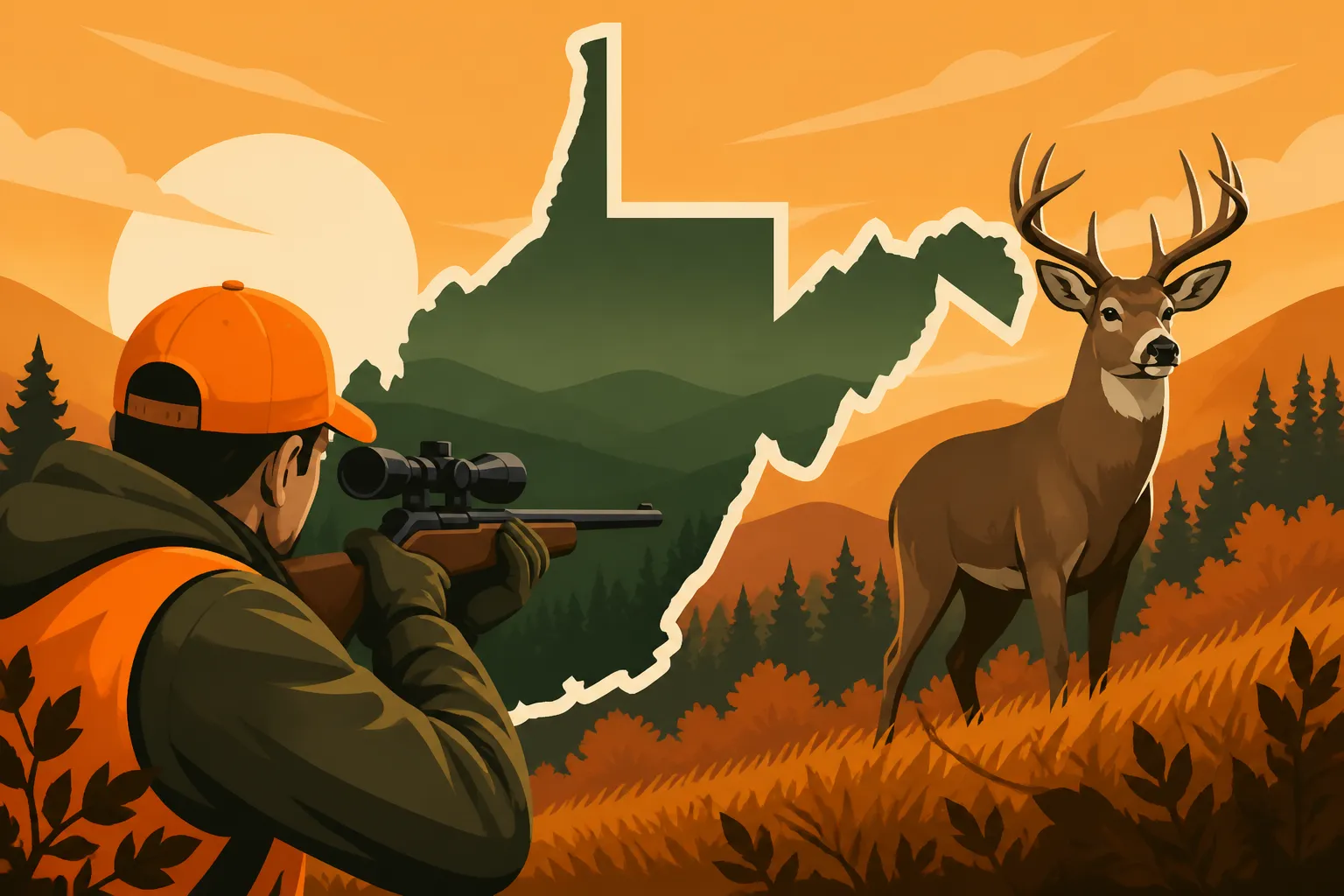
West Virginia Legal Firearms for Deer Hunting
Navigating the ever-evolving world of deer hunting regulations can feel like trying to hit a moving target, especially when it comes to understanding what firearms are actually legal to use in West Virginia. Many hunters, myself included, have stood in the sporting goods aisle, scratching our heads over caliber choices, contemplating shotguns versus rifles, and wondering if that new straight-wall cartridge is even allowed in our preferred hunting grounds. This guide is here to cut through the confusion, break down the specifics of legal firearms for deer hunting in the Mountain State, and help you head into the woods with confidence, knowing your chosen tool is both effective and compliant.
The Foundation: General Rifle Regulations for Deer Hunting
When you picture deer hunting in West Virginia, often the first image that comes to mind is a hunter with a trusty rifle. And for good reason! Rifles are widely used, but the specific rules around them can sometimes feel a bit like reading fine print. It’s not always as simple as "if it shoots, it hunts."
Understanding Rifle Caliber and Ammunition
One of the most common questions I hear is about rifle caliber. West Virginia doesn't impose a minimum caliber for deer hunting, which might surprise some folks used to other states' rules. This means theoretically, smaller calibers like a .223 Remington could be used, but from an ethical standpoint, most seasoned hunters advocate for something with more punch. We're looking for clean, humane kills, and that usually means a larger bullet with more kinetic energy to dispatch a deer quickly. Most hunters lean towards calibers like the classic .30-06 Springfield, .308 Winchester, .270 Winchester, or even the popular 6.5 Creedmoor. These cartridges offer a good balance of accuracy, range, and knockdown power for our mountain whitetails. When considering your rifle setup, it’s worth thinking about a caliber like the .30-30 in Thick Highlands Cover if you're primarily hunting in dense timber where shots are usually close.
As for ammunition, West Virginia law specifies that deer must be hunted with projectiles that are "soft-point or expanding type." This is crucial. Full metal jacket (FMJ) ammunition, which doesn't expand, is generally not legal for deer hunting because it doesn't create the necessary wound channel for a quick, humane kill. This focus on expanding bullets ensures that hunters are using ammunition designed for ethical harvesting. Always double-check your box to make sure you're using appropriate hunting rounds.
Magazine Capacity and Practical Considerations
Unlike some states, West Virginia generally doesn't have a specific legal restriction on magazine capacity for rifles when deer hunting. You can use standard capacity magazines. However, in practice, most deer hunters carry magazines that hold 3 to 5 rounds. Why? Because realistically, how many shots do you anticipate needing to take at a deer? Often, it's one, maybe two if follow-up is necessary. Carrying a large capacity magazine might seem cool, but it adds unnecessary weight and bulk for a task where precision and a single, well-placed shot are paramount. Think about the terrain – scrambling up steep ridges or navigating dense laurel thickets. Every ounce and every snag point matters. So while technically legal, consider what's truly practical and safe for your hunting style. For a deeper dive into optimal choices, check out information on Choosing a Rifle Caliber for West Virginia Deer.
Shotguns and Muzzleloaders: Traditional Deer Hunting Tools
While rifles dominate much of the discussion, shotguns and muzzleloaders remain incredibly popular and effective tools for deer hunting in West Virginia, each with its own set of regulations and dedicated seasons.
Shotgun Rules for Deer Hunting
Shotguns used for deer hunting in West Virginia must be chambered for slugs, not buckshot. This is a critical distinction. Buckshot scatters, leading to a higher risk of wounding animals without retrieving them, or causing damage outside the intended target. Slugs, on the other hand, are single projectiles designed for accuracy and knockdown power at closer ranges. You'll typically see 12-gauge and 20-gauge shotguns used, and both are highly effective with modern sabot slugs.
Many hunters prefer shotguns in areas with shorter sightlines or if they own property that borders residential areas where a rifle's longer range might be a concern. A good shotgun, properly sighted in with quality slugs, can be surprisingly accurate out to 100-150 yards, especially with a rifled barrel and a low-magnification scope. The barrel length doesn't have a specific restriction for deer, but most hunters opt for shorter, handier barrels (around 20-24 inches) for maneuverability in thick cover.
Muzzleloader Specifics for the Late Season
Muzzleloaders offer a unique challenge and a return to hunting's roots, often being the firearm of choice for the late season. West Virginia's muzzleloader season typically runs in early December, providing an exciting opportunity after the general gun season. To be legal, a muzzleloader must be a single-shot firearm loaded from the muzzle. That means no breach-loading modern inline muzzleloaders if they don't meet the "loaded from the muzzle" definition strictly.
For projectiles, West Virginia allows conical bullets, sabots, or round balls. Black powder or approved synthetic black powder substitutes (like Pyrodex or Triple Seven) are the only legal propellants. Smokeless powder is strictly prohibited. The minimum caliber for muzzleloader hunting deer is generally .38 caliber, but most hunters choose .50 caliber for deer to ensure sufficient ethical stopping power. Keeping your powder dry in the often wet and cold December weather is a skill in itself, crucial for a reliable shot. If you're considering this traditional method, our guide on West Virginia Muzzleloader Tactics offers excellent insights.
Handguns and the Rise of Straight-Wall Cartridges
Handgun hunting for deer, while certainly more challenging, is a legal and growing pursuit in West Virginia. And then there's the newer, yet increasingly popular, category of straight-wall cartridge firearms that are bridging the gap for many hunters.
Handgun Hunting for Deer
Yes, you can hunt deer with a handgun in West Virginia, but there are specific requirements to ensure ethical hunting. The law mandates that handguns used for deer must be chambered for a centerfire cartridge and have a minimum barrel length of 4 inches. Just like rifles, the ammunition must be of the soft-point or expanding type.
Common calibers for handgun deer hunting include .357 Magnum, .41 Magnum, .44 Magnum, .45 Colt, and larger revolver or semi-automatic pistol calibers. It's not for the faint of heart, as it demands a high level of shooting proficiency, excellent woodsmanship for close-range opportunities, and a deep understanding of deer anatomy for precise shot placement. The effective range of a handgun for deer is significantly shorter than a rifle, typically within 50-75 yards for most hunters. This means a lot more stealth and patience are required. If you're interested in handgun hunting, make sure your optics are suited for closer work, perhaps a red dot or a low-power scope.
Understanding Straight-Wall Cartridge Options
Straight-wall cartridge firearms have become a game-changer for many hunters, especially those who might hunt in states or zones that restrict bottleneck rifle cartridges. West Virginia embraces them, and they offer a fantastic blend of rifle-like performance with shotgun-like legality in certain scenarios. These are cartridges where the brass casing is straight from base to mouth, unlike bottlenecked rifle cartridges which taper down.
Some of the most popular and effective straight-wall cartridges legal in West Virginia for deer include:
- .350 Legend: A relatively new round, gaining immense popularity for its low recoil, high velocity, and excellent performance on deer. It's often compared to a .223 in terms of recoil but with significantly more energy for deer.
- .450 Bushmaster: A hard-hitting, powerful cartridge that delivers substantial energy. It's a favorite for those wanting significant knockdown power, though with more recoil than the .350 Legend.
- .44 Magnum: A classic, versatile cartridge available in both handguns and lever-action rifles, offering proven performance on deer at moderate ranges.
- .45-70 Government: A venerable, powerful cartridge often found in lever-action rifles. It's known for its heavy bullet and effectiveness on large game, including bears, making it certainly adequate for West Virginia deer.
- .35 Remington: Another classic, often found in older lever-action rifles, still highly effective for deer in dense woods.
These cartridges are often chosen for their versatility, especially in zones or states where bottleneck rifle cartridges are restricted, or simply for those who appreciate their ballistic characteristics. They offer excellent performance in the timber and often fit well into AR-platform rifles, giving hunters a modern sporting rifle option with a legal straight-wall chambering. You can explore more about Straight-Wall Cartridge Options in West Virginia to see if one fits your style.
Exploring Semi-Automatic and Magazine-Fed Firearms
The landscape of deer hunting firearms has expanded beyond traditional bolt-actions and shotguns. Semi-automatic rifles, often styled after popular military and sporting platforms, are increasingly common in the deer woods of West Virginia, as are reliable pump and lever-action firearms.
Semi-Automatic Rifles for Deer
One of the questions that frequently arises concerns the legality of semi-automatic rifles, such as AR-15 variants, for deer hunting in West Virginia. The good news for those who prefer these platforms is that yes, semi-automatic rifles are legal for deer hunting in West Virginia, provided they meet the general requirements for all rifles, such as using expanding-type ammunition.
There are no state-specific restrictions on features like pistol grips, adjustable stocks, or flash suppressors when hunting deer. As mentioned earlier, there are also no specific magazine capacity limits for hunting. This means you can use your favorite AR-10 in .308 Winchester or an AR-15 chambered in a legal straight-wall cartridge like the .350 Legend or .450 Bushmaster. These platforms offer rapid follow-up shots, which can be an advantage in certain hunting scenarios, though a single well-aimed shot is always the primary goal.
For hunters venturing into areas where quick shots might be needed in dense cover, or for those who simply enjoy the ergonomics and modularity of modern sporting rifles, these semi-automatic options are perfectly viable. However, it’s always wise to ensure your rifle is clean, reliable, and properly sighted in. Before heading out, make sure you know your way around your rifle, from cleaning a Rifle After a Wet Sit to ensuring consistent accuracy.
Lever-Action and Pump-Action Options
While semi-automatics get a lot of attention, the workhorse lever-action and pump-action firearms remain incredibly popular among West Virginia deer hunters, and for good reason. They are reliable, often lightweight, and exceptionally quick for follow-up shots without the complexity of a semi-automatic system.
Lever-Action Rifles: These are truly iconic and deeply ingrained in American hunting culture. Brands like Winchester, Marlin, and Henry produce beautiful and highly functional lever guns chambered in classic calibers like .30-30, .45-70 Government, and .44 Magnum. The .30-30, in particular, has probably accounted for more West Virginia deer than any other caliber. Its compact size and sufficient power for shots within 150-200 yards make it ideal for the thick forests and rolling hills of the Mountain State. Lever-actions are fast to cycle, and their tubular magazines (for most models) are efficient and reliable.
Pump-Action Shotguns: For shotgun enthusiasts, the pump-action remains king. Models from Remington (like the 870) and Mossberg (like the 500) are legendary for their durability and versatility. When fitted with a rifled barrel and sighted in with quality slugs, a pump-action shotgun becomes a formidable deer hunting tool. They are simple, robust, and offer excellent reliability in all weather conditions. Many hunters appreciate the positive control they have over each shell being loaded and ejected.
Both lever-action rifles and pump-action shotguns are fantastic choices for hunters who value reliability, maneuverability, and a traditional feel in the deer woods. They are especially well-suited for still-hunting or for Deer Drives on West Virginia Public Land where quick, close-range shots might present themselves.
Navigating Specific County Restrictions and Best Practices
Understanding the general rules is one thing, but West Virginia, like many states, has nuances. It's crucial to be aware of county-specific regulations and, more broadly, to always prioritize ethical hunting practices.
County-Specific Rules and Archery-Only Zones
This is arguably the most important "fine print" you need to know: Four southern West Virginia counties are strictly archery-only for deer hunting. These are Logan, McDowell, Mingo, and Wyoming counties. In these areas, no firearms are permitted for deer hunting at any time. This is a critical distinction that often catches new hunters or those visiting from other parts of the state off guard. If your hunting plans take you to these counties, you'll need to leave your rifle, shotgun, or muzzleloader at home and stick to archery equipment. Understanding Why Four Southern Counties Skip Gun Season is vital for anyone planning a hunt there.
Beyond these four counties, other localized restrictions can sometimes apply, especially on certain Wildlife Management Areas (WMAs) or private land with specific agreements. Always, and I mean always, check the current West Virginia hunting regulations pamphlet or the WVDNR website for the most up-to-date information for your specific hunting location. It’s better to spend a few minutes verifying than to face a citation or, worse, compromise ethical hunting. Digital tools like the GoHunt app are fantastic for quickly checking boundaries and regulations, often even when you're out of cell service. They're invaluable for Scouting West Virginia Public Land Before Season.
Ethical Considerations and Shot Placement
Regardless of the firearm you choose—be it a high-powered rifle, a slug shotgun, a trusty muzzleloader, or a challenging handgun—ethical hunting remains paramount. The goal is always a quick, humane kill. This means:
- Practice, Practice, Practice: Know your firearm, its capabilities, and your own limitations. Spend time at the range, shooting from various positions you might encounter in the woods (standing, kneeling, from a simulated treestand). Don't just sight in once; shoot frequently to maintain proficiency.
- Understand Deer Anatomy: Know where to place your shot for a vital hit. The lung/heart area is the largest target and offers the highest probability of a quick kill. Avoid "Texas heart shots" or shots at running deer unless you are absolutely confident in your abilities and the conditions.
- Know Your Max Ethical Range: Just because your rifle can shoot 300 yards doesn't mean you should take that shot in every hunting scenario. Factors like wind, deer movement, obstructions, and your personal skill level all dictate your ethical range. In West Virginia's often dense cover, many shots are much closer, making practical range in Steep Mountain Hollows more important than theoretical maximums.
- Confirm the Kill: After the shot, give the deer time if it runs. Track it carefully, looking for blood and signs of direction. Even with a good shot, deer can run a surprising distance. Our article on Tracking a Deer Through West Virginia Leaf Litter provides crucial tips for this vital step.
Responsible hunting isn't just about following the law; it's about respecting the animal and the privilege of the hunt. Your choice of legal firearm is just one piece of that puzzle.
Here’s a quick overview of legal firearm types for deer in West Virginia:
| Firearm Type | Permitted Calibers/Gauges | Ammunition Type | General Seasons Permitted | Notes |
|---|---|---|---|---|
| Rifles | All centerfire rifle calibers | Soft-point or expanding | General Buck Gun Season, Youth Deer Weekend, Late Antlerless | No minimum caliber (ethical recommendation for larger calibers), no magazine capacity restriction (practical recommendation for 3-5 rounds). |
| Shotguns | 12 gauge, 20 gauge (and others) | Slugs only (no buckshot) | General Buck Gun Season, Youth Deer Weekend, Late Antlerless | Effective at closer ranges (up to 150 yards with rifled barrels/slugs). Good for dense cover or areas with proximity to residences. |
| Muzzleloaders | .38 caliber and larger | Conical bullets, sabots, round balls | Muzzleloader Season (early Dec), General Gun Season, Youth Deer Weekend, Late Antlerless | Single shot, loaded from the muzzle. Uses black powder or approved synthetic substitutes (no smokeless powder). Often used for West Virginia Muzzleloader Tactics. |
| Handguns | Centerfire, .357 Mag and larger | Soft-point or expanding | General Buck Gun Season, Youth Deer Weekend, Late Antlerless | Minimum 4-inch barrel. Requires high proficiency and close-range hunting skills. |
| Straight-Wall Rifles | .350 Legend, .450 Bushmaster, .44 Mag, .45-70 Gov't, .35 Rem | Soft-point or expanding | General Buck Gun Season, Youth Deer Weekend, Late Antlerless | Combines rifle accuracy with compliance for potential future restrictions. Excellent for varied terrain. |
| Crossbows | N/A (shoots bolts) | Expanding broadheads | Archery Season, General Buck Gun Season, Youth Deer Weekend, Late Antlerless | While not a firearm, it's often used during firearm seasons. Legal in all areas where gun hunting is allowed, and during archery season with specific rules on Crossbow Rules During West Virginia Archery Season. |
Disclaimer
The information provided in this guide is for general informational purposes only and is subject to change. Hunting regulations can be complex and are updated periodically by the West Virginia Division of Natural Resources (WVDNR). It is the individual hunter's responsibility to review and comply with all current state and local hunting laws and regulations before engaging in any hunting activities. Always refer to the official WVDNR hunting regulations pamphlet or website for the most accurate and up-to-date information.